Charter for improvements in rare disease drug evaluation launched

77 patient groups, including Aniridia Network UK are calling for improvements in rare disease drug evaluation in a ground breaking new report. This is the first time so many patient groups have come together to set out a united case for change.

Today Genetic Alliance UK launch a landmark Patient Charter that highlights the concerns patients have about the new approach the Government and NICE are using to determine whether or not medicines for rare conditions are made available through the NHS.

The Patient Charter, sets out a list of recommendations to improve the way medicines for rare conditions are evaluated.  Published by Genetic Alliance UK it shows patients are concerned that, while greatly needed, the existing process is opaque, potentially disruptive to the wider NHS and risks downplaying the patient voice.

Alastair Kent OBE, Director of Genetic Alliance UK, said:

“The public have consistently given support to the concept of providing highly priced medicines to patients with rare diseases. It is right that we have the HST evaluation process, but given what is at stake, it is critical that the process is fit for purpose. It needs to be transparent, it needs to integrate with the health service, and the patient voice needs to be central to the entire process.

77 patient groups agree on these 29 recommendations for progress. Never before have we seen so many patient groups from across the rare disease community come together with a united call for change. Let’s use this is as strong starting point from which to move forward and develop the evaluation process that the rare disease community needs.”

The Patient Charter is launched today (Wednesday 2nd April) at a breakfast meeting hosted by the Association of the British Pharmaceutical Industry (ABPI) at their headquarters in central London. Present will be representatives from patient groups, the National Institute for Health and Care Excellence (NICE), NHS England, clinicians, the pharmaceutical industry and other stakeholders.

The meeting is being chaired by Alastair Kent OBE and on the panel are

  • Steve Bates (Chief Executive Officer, Bioindustry Association)
  • Josie Godfrey (Associate Director, NICE)
  • Dr Robin Lachmann (National Hospital for Neurology and Neurosurgery)
  • Frances Macdonald (Association of the British Pharmaceutical Industry).

Commenting on the publication of Genetic Alliance UK’s Patient Charter, ABPI Director of Value and Access Paul Catchpole said:

“The ABPI welcomes the publication of Genetic Alliance UK’s Patient Charter to support further stakeholder engagement around the development of the NICE Highly Specialised Technology (HST) Programme. Providing more meaningful and extended opportunities for patient involvement in decision making about medicines is very important. The Patient Charter will be particularly helpful when NICE reviews its interim processes and methods for the HST programme after it has gained more experience of the programme and a number of medicines have completed evaluations using the new process.”

The Patient Charter is a clear and unified communication of patients’ perspectives and priorities on NICE’s interim Highly Specialised Technology (HST) evaluation framework through the eyes of patients affected by those diseases most likely to require an HST evaluation for newly developed medicines in order for them to be accessed through the NHS.

The Patient Charter is intended to directly inform NICE in advance of its planned review of the HST evaluation framework, which it has committed to undertake before the end of 2014, and to provide a future reference point for the patient view on this issue. The recommendations have been endorsed by 77 patient groups who support the need for change.

Aniridia Network UK is a member of Genetic Alliance UK. With drugs such as potentially curing START eye drops currently being researched these issues are becoming increasingly relevant to people with aniridia.

For more information visit Genetic Alliance UK

Posted in Other agencies, Research | Leave a comment

Our Patron’s Life Scientific on Radio 4

.

Veronica van Heyningen, CBE at Aniridia Network UK Conference 2013

Aniridia Network UK’s Patron, Veronica Van Heyningen, was the subject of the BBC Radio 4 programme Life Scientific today. The half hour interview explored her love of research, particularly on the aniridia and the PAX6 gene plus her contribution to the ethics of working in genetics.

Her colleague Professor Wendy Bickmore said, “She’s got a great eye for the unusual. So rather than brushing aside the one case that perhaps doesn’t fit the simple hypothesis she’ll take that case and really use that and work away at that to uncover something quite new.”

Professor Nick Hastie commented, “Veronica pays so much attention to good design of experiments clear interpretation and doing experiments the right number of times to know you are on the right track. She is so meticulous in writing papers, she really wants to be accurate and precise.”

“One of the things that impresses me most about Veronica is her passionate desire to inform the public about genetics and the ethical issues, to take a stance not hide away from taking this stance.”

Since retiring Veronica has become Honorary Professor and Visiting Scientist at the Institute of Ophthalmology, University College London which is attached to Moorfields Eye Hospital. She is a good friend and colleague of many of the doctors that ANUK members are seen by.

We announced Veronica’s appoint as Patron at our 2013 Conference. Since then she has been outstanding at recruiting several of the most experienced doctors and researchers in aniridia, in the UK to join her on our Medical Panel.

Hence ANUK members can ask these experts questions via our enquiries service and at our conferences. She has also contributed to discussions on how ANUK should develop.

Thousands of listeners will have heard details of aniridia for the first time from this programme. So thank you Veronica for sharing your scientific life with the world and with Aniridia Network UK.

Listen to the show on iplayer or
download the show as a podcast


Posted in Aniridia Network news, Medical staff talking, Research | Tagged , , | Leave a comment

Sunglasses and eyeshields

Alternatives to traditional sunglasses that could be well suited to people with aniridia are available from RNIB.

The HiView range of eyeshields and the green coloured HiView Plus in particular are designed to cut down glare while increasing contrast.

They offer additional top and side protection by fitting close to the face. They come in non-prescription, prescription and fit-over variants.

Here’s a video all about the complete range.

Have you tried these eyeshields or glasses with different coloured lenses? How did you find them. Tell us in the comments below.

Thanks to ANUK member Marie for telling us about this product. Can you recommend a visual aid that is well suited for people with aniridia?

For example many parents of children with aniridia recommend Julbo sunglasses with their band for keeping them on their baby’s head.

Posted in Other agencies | Tagged , , | 2 Comments

TV programme looking for people with aniridia

Optomen Television, the BAFTA award-winning producers of Mary Portas: Queen of Shops, Kevin McCloud’s Man Made Home and Heston Blumenthal’s Feast is producing a brand new TV medical series for the Discovery Network and needs your help.  

The programme makers say:

“In this series, we’ll be exploring a variety of health conditions in the hope that we can raise awareness on them. We’re looking for people with aniridia to take part in the programme to discuss their condition and to explain to others what it is like to live with it on a daily basis. By doing this, we’re hoping to raise general awareness on the condition, its symptoms and the types of treatment/care that is currently available.

We’ll also be working with a number of specialists throughout this series and, for those who take part in the programme, we can offer a free (off-screen) consultation with one of them. So perhaps you’d like a second opinion or advice on the types of treatments/care that is available to you?”

If you are interested in taking part, fill in the form below and ANUK will send you the contact details of the programme makers. You can then get in touch with them for a no obligation, friendly and confidential chat with one of the team. All applicants must be aged 18 our over.

← Back

Thank you for your response. ✨

Optomen: We will use and store the personal details contained in your email and any further response in accordance with the Data Protection Act 1998, for the purposes of producing the Programme.

Posted in Other agencies | Tagged , | Leave a comment

Youth With Aniridia In Europe summer camp 2015

A summer camp in north east Italy for young people with aniridia across Europe is being organised. You can be involved with this exciting event

The camp will be in summer 2015 in a national park in the Venetia region of Italy. Lasting up to 16 days it will include walking in the hills, watersports in the lakes, city day trips and social activities.

There are 48 places for people aged between 13 and 25 years old from Norway, Germany Italy Spain and the UK. They will be looked after by at least 2 adults from each country.

Find out more if you might like to go as a young person or supervising adult 

Posted in Aniridia Network news, Other agencies | Tagged | Leave a comment

Open letter to anyone with a child recently diagnosed with aniridia

I am writing this to give reassurance and a firm (but virtual) shoulder to lean on. No doubt you have just returned from the hospital, numb with the news that your child has been diagnosed with a rare eye disorder called aniridia.

Or perhaps you have sat for days, thinking about this rare disorder, thinking: why has this happened to our child, to us? What is going to happen now?

If you have by now fired up the internet, you will be disheartened to see there is scant information on aniridia. Wikipedia have tried (bless them), so too have RNIB. But the real reason why you have searched, scoured and poured over all of this precious information is missing from those pages. You can talk to your consultant about tests, future prognoses, the differences between sporadic and familiar aniridia; all of those things. But I imagine what you really want is some sort of personal account of what it is like to have a child with aniridia and what sort of life does this child have?

I can write this letter because my son has aniridia. I I know how terrifying it is to find out your child is visually impaired. And to add to the unfairness of the situation, the disorder so happens to be very rare indeed. This ultimately means that few people – other than specialist consultants and of course the wonderful Aniridia Network UK – do not understand your child’s condition. Let me repeat that: few people will understand your child’s condition. Your child’s school especially. Be prepared to spend time talking to your child’s school. Be prepared to get angry when your child has been placed at the back of the class because a teacher has ‘forgotten’ about their needs. All of this will happen. Ignorance can be very annoying.

I digress. You would like to know what the future will hold for your child. I have learned to trust my son’s judgement. When he was diagnosed, aged four, I was the stereotypical over-protective parent. I held his hand far more tightly than I would my daughter’s. I dressed him because I could not bear it when he would come downstairs with a t-shirt back to front or inside out. This was ridiculous. He was acting like a ‘normal’ (and I hate that term) four year old child, and yet, because he had been given this diagnosis I treated him differently.

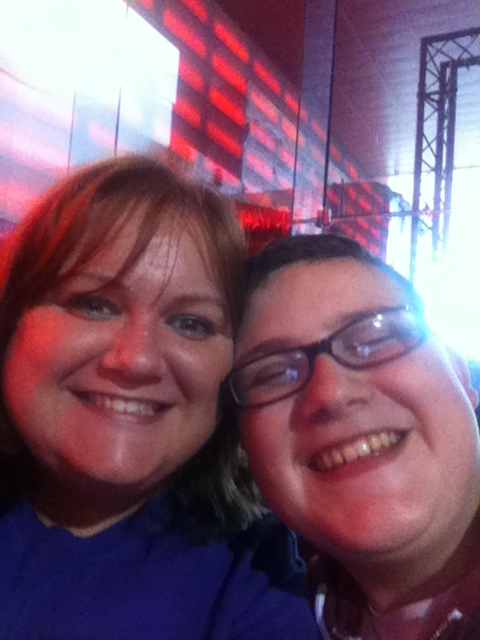
Photo of mum and son

Lisa and son Daniel

My son is now 14 years old and a typical teenager. I will list the things he finds difficulty with:

  • Getting up on time for school.
  • Going to bed at a decent time.

These are the things he excels in:

  • Cooking – he makes awesome scrambled eggs. His fairy cakes and biscuits are amazing.
  • Riding a bike – he conquered this when he was 10 years old – a proud moment.
  • Ice skating – he has a unique style.
  • Writing – he has been published in a local anthology.
  • Science – currently taking an online university course, studying molecular changes in cancer cells.

We have had bumps in the road, like all parents do. He wanted to be a firefighter when he was eight. My husband and I didn’t know what to do. Part of us wanted to maintain the fantasy, we didn’t want to crush his dreams. And the more realistic part of us knew that he would never be able to choose this career. We wrote down a list of ‘nevers’ and the one that hurt the most was that he would never be able to drive.

We sat down with our son and went through the list. It was one of the toughest things I have ever had to do. More soul wrenching than all of the hospital tests he has been through. It was hard for him because he loved watching his dad drive and was fascinated with motorsports. I am glad to say that now he is a teenager and has friends talking about taking driving lessons when they are 16, he smiles and says that he’s going to buy a car and hire a chauffeur!

You have to trust your child. They will find their own way in dealing with the enormous disadvantage they have been given. And it is a disadvantage. They will have to fight harder, shout louder, be smarter than any of their peers. They will be an easy target for bullying – my son has had his fair share of that – and may find it hard to make friends. But make friends they will. The day your child comes home from school, beaming from ear to ear, saying: ‘I’ve had a really good day’, will make up for all of the heartache of hospital visits and tests.

I hope you have found this letter some comfort. I want you to know that life with aniridia isn’t bleak. It isn’t the end of the world. For a time, I thought it truly was. I was bereft at the thought of my child having this condition/disorder/thing and felt guilty for perhaps being in some way at fault for this. But now? My son has a great life. He has a small circle of friends. He has a girlfriend. He is loved for who he is and he has a great future ahead of him. Next year, he visits Cambridge University to see if it’s the right place for him to study science. I am a very proud parent indeed.

Sincerely,

Lisa

Posted in Parents' accounts | 1 Comment

System to measure treatment of Limbal stem cell deficency)

Scientists have established a system to measure the effectiveness of treatment for cornea disease in people with aniridia – caused by Limbal stem cell deficiency  (LSCD)

This objective, standardised method allows the effect of a treatment on patients to be documented. The lead investigator Dr Alex Shortt gave an example of stem cells transplanted from a deceased donor and grown in a lab: “There was a decrease in LSCD severity and an increase in visual acuity up to 12 months post-treatment, but thereafter LSCD severity and visual acuity progressively deteriorated. However, despite a recurrence of clinical signs, the visual benefit persisted in 30 percent of aniridic at 36 months.”

This evidence can then be used to compare treatments properly for the first time, to find which work best.

The system was developed at University College London and Moorfields Eye Hospital in London where Cells For Sight are also researching Limbal stem cells.

Read more this new tool to assess treatment of LSCD.

Posted in Research | Tagged , | 1 Comment

Protected: Day in the life of an aniridia research scientist

This content is password-protected. To view it, please enter the password below.

Posted in Medical staff talking, Research | Tagged , | Enter your password to view comments.

Cure for aniridia under spotlight

A new study has suggested potential eyedrop therapy for aniridia. Is the hype justified and what are the details?

Aniridia is a genetic abnormality caused by mutations in the so-called ‘Master Regulator’ gene for eye development, PAX6.  Because PAX6 is used from the very earliest stages of eye development in the embryo, it has always been assumed that when a baby is born with aniridia, most of the damage has already been done. Sure, there are degenerative aspects to aniridia, which need to be managed carefully to minimise further damage to the cornea or the retina, but most clinicians would expect that there will never be a total ‘cure’ for aniridia.

Now a paper published by Cheryl Gregory-Evans and her colleagues, in the prestigious Journal of Clinical Investigation has raised the possibility that it may in future be possible to substantially reverse some aspects of aniridia in children, and it may be as simple as eyedrops.

The potential therapy would depend on some quirky bits of biology surrounding the DNA changes that affect the PAX6 gene.  Over 600 different mutations of PAX6 have been shown to cause aniridia in different people – in some people one copy of the entire gene is missing, other people have chunks of the gene missing, or changed in some way.  However about 50% of people with aniridia have only one ‘letter’ of DNA wrong that causes the cell machinery that makes the PAX6 protein (the ‘ribosomes’) to stop too soon, producing a short, non-functional PAX6 protein that is chewed up by the cells.

For some time it has been known that some types of drug called aminoglycosides (actually a type of antibiotic) can give the ribosomes a chance to ignore these early ‘stop’ signals in mutated genes and carry on regardless to produce a full length protein.

As a result, a number of clinical trials tried to use these drugs to treat other genetic diseases such as cystic fibrosis – without a lot of success, not least because long-term use of these drugs causes a lot of rather unpleasant side effects.

Pharmacological labs have therefore been looking for other drugs that retain the ‘good’ effects of aminoglycosides – the ability to allow ribosomes to ignore some mutations in genes – without the side effects.  One of the drugs they came up with is now called ataluren.

Cheryl Gregory-Evans and her colleagues at the University of British Columbia, Canada, used ataluren on ‘aniridic’ mice that had a PAX6 mutation similar to the ones that affect 50% of people with aniridia, where a single DNA letter mutation causes the production of a short, non-functional PAX6 protein.

Surprisingly, injecting newborn aniridic mice with ataluren produced very considerable benefit to the eyes of the mice: PAX6 levels went up, and the lens and retina of the eye looked and functioned much better than mice without treatment.

However the outer layer of the cornea had not improved much. Because the cornea does not normally contain blood vessels, they concluded that the injected drug was not reaching the cornea properly.  Although this was only a partial ‘cure’, it did suggest that the damage done to the eye by PAX6 deficiency during pregnancy could potentially be reversed after birth.

In order to deliver ataluren more efficiently to the eye and, in particular, the cornea, the scientists then formulated a sticky eyedrop solution that could be applied directly to the cornea of newborn mice. They called it START. When they did this, the results were even better – the retina and lens looked essentially healthy and functioned almost as well as normal eyes.  Furthermore the cornea got a lot healthier too, with a robust thick outer layer (epithelium) that contrasts with the thin fragile epithelium characteristic of aniridia.

Although the treated mice were still ‘aniridic’ in that iris did not grow back, the other, most troublesome, aspects of aniridia – the corneal fragility, cataracts and retinal degeneration – had effectively been reversed after birth by application of ataluren in an eyedrop formula applied directly to the surface of the eye.

This is a very exciting series of scientific results that of course raise the possibility that the technology may be applied to people too.  In the best case scenario, when in future a baby is born with aniridia, there may be an option of applying ataluren directly to the eyes to reverse the damage done to the eye by PAX6 mutation and give the babies essentially normal sight.

There is still a long way to go, of course before this scenario becomes reality. There are a number of issues:

  1. This effect has only been demonstrated on mice, and there would need to be a clinical trial on human volunteers before the treatment could become mainstream. Such a trial is now being prepared.
  2. exactly what ataluren does, and the long-term safety of ataluren in eyedrop form is unknown: some scientists dispute whether ataluren really can tell the cell to ignore DNA mutations, and the drug may have other effects or cause problems that do not affect mice but may become apparent in people using the treatment for a lifetime.
  3. Other potential treatments for aniridia, such as development of a treatment that stops blood vessels encroaching into the aniridic cornea, published in 2006, have never made it to the clinic.
  4. Even if it is safe and effective for people ataluren will only ever be useful for those 50% of patients with aniridia caused by single DNA letter changes that lead to premature termination of PAX6 production. Cheryl Gregory-Evans and her colleagues showed that it produced no benefit in mice with a different sort of PAX6 mutation, and it would be expected to be useless for people with, for example, WAGR syndrome, where the PAX6 gene is missing.

Notwithstanding the caveats, this paper demonstrates that the eye may have tremendous capacity to bounce back from aniridia, if treated early in life, Current therapeutic strategies for aniridia that focus on stem cell transplants are clinically complicated and probably only delay the progression of corneal disease. This research will encourage the many scientists looking for better ways to treat or reverse the condition.

Here’s a video interview of Cheryl Gregory-Evans talking about their work

The research was funded by the Sharon Stewart Aniridia Trust and the trial by Vision For Tomorrow .

Read more about the research and human trial of START eyedrop therapy.

Source

Cheryl Y. Gregory-Evans et al. (2014). Postnatal manipulation of Pax6 dosage reverses congenital tissue malformation defects.  J Clin Invest. 2014; 124: 111–116.

Article by Professor Martin Collinson, Medical Research Monitor for Aniridia Network UK

Update 2015

Video of Cheryl Gregory-Evans presenting at a conference by Aniridia Russia

Posted in Medical staff talking, Research | Tagged , , , , | 9 Comments

Aniridic Family group on Facebook

To get answers to questions on aniridia and meet people affected by it, a great resource is the Aniridic Family group on Facebook.

It has over 500 members from all over the world and is still growing. Anyone can start a discussion for example on genetic testing, surgery and TV watching habits. There are lots of very useful and interesting replies from people with personal experience.

News articles about people with aniridia and research are also often posted to the group. So it’s a great way to stay up to date on the subject.

If you are on Facebook just visit the Aniridic Family group and use the “Join group” button. Without a Facebook account you will not be able to access it.

Remember that there is also a Aniridia Network UK page on Facebook. Use the Like button to get the latest from us about aniridia issues in the UK in your news feed.

Posted in Parents' accounts, Patients' tales | Tagged | Leave a comment