Annual Report & Accounts 2013/14

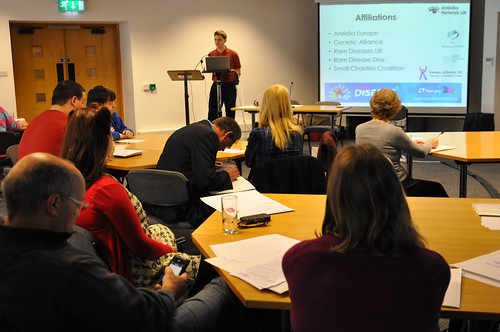
People at tables watching a speaker at a  podium and others seated as a panel We hope that you have been keeping up to date with what has been going on for Aniridia Network UK (ANUK) through the newsletters that we send out during the year.

To summarise those and add insight into what happens behind the scenes we have produced this Aniridia Network UK Annual Report 2013/14 (PDF)

You can also review the Aniridia Network UK 2013-14 Accounts (XLS)

At the meeting the following as trustees were appointed until the 2015 Annual General Meeting.

Posted in Aniridia Network news | Tagged , , , , , , | Leave a comment

Cornea Connect brings researchers and patients together

Woman next to a microscope and the cornea under it shown on a screen beside it.

Researcher Victoria giving a tour of a lab where cornea stem cells are studied

Researchers into aniridic keratopathy held a event so they could meet people affected by the condition so they could learn about each other.

Corneal opacification affects people with aniridia because of deficiencies in the eye’s limbal stem cells. The Cells for Sight Transplantation and Research team at University College London (UCL) is working to understanding it and develop treatments.

The Cornea Connect meeting on 14 February 2014 was the first of its kind at the UCL Institute of Ophthalmology which is attached to Moorfields Eye Hospital.  It aimed to bring together scientists and patients with a common interest in the cornea and to talk about the challenges faced by both parties.

Several members of Aniridia Network UK attended and some gave presentations. Chair Katie Atkinson said afterwards “We want to say thank you for organising this event which was really interesting and valuable. We would like to work with Cells For Sight to help do more activities like this in future.”

Indeed representatives of Cells For Sight will be giving a presentation about their work at the Aniridia Network UK Conference 2014.

Find out more about the day including videos and photos of the day such as this introduction from Julie Daniels who also sits on the Aniridia Network UK Medical Panel..

Read Victoria’s article A day in the life off a aniridia research scientist.

Posted in Aniridia Network news, Other agencies, Patients' tales, Research | Tagged | 4 Comments

The differences between having some useful vision and not having any useful vision

JennyBy Jenny

Having already been severely sight impaired, I’ve recently lost a significant amount of vision.

There are things I can still do and some I almost took for granted that I cannot do now. There are other things I now find difficult that I have had to find new ways to make manageable again.

What I already used feel for instead of vision

  • Tying my shoelaces
  • Brushing my hair
  • Washing up
  • Identifying loose change

What I can still do

  • Brushing my teeth – although putting the toothpaste on the brush can be a very messy and fun experience!!
  • Shower and dress myself.
  • Identify clothes – although I do have two cardigans that are very similar and once thought I was wearing the white one until a friend commented I was looking pretty in green!!
  • Use my hob and oven – both are gas. I can tell which gas mark I want by putting the dial in a certain position – for example gas mark 6 is at a 4/5 o’clock position (using the clock face method). It’s pretty easy to tell just by listening if the gas has been lit or not when using the hob.
  • Prepare and cook meals – I still do a lot on the hob, using saucepans and a wok.
  • Use the microwave – it’s a talking one!
  • Use my iphone and ipad – as soon as I started using Apple products I started using Voiceover and rely on that.
  • Type quickly – thankfully I learnt to touch type at a very young age and it’s an incredibly useful skill to have.
  • Read curled up in bed – I can read braille and I also listen to books on ibooks with Voiceover. I know a lot of people dislike the synthetic voice but I can get past that and appreciate the fact I can read books just like anyone else as soon as they are released.
  • Make a hot water bottle – I use my hearing and know the exact sound to listen out for when the water from the kettle is being poured directly into the bottle.
  • Make myself cold drinks – using the finger trick.
  • Work – it is ideal that I work at a school and college for the visually impaired. My line manager has been very supportive and my job role/title has been adapted slightly so I can still work without too much difficulty.
  • Use my clock – I have memorised where the buttons for the alarm and sleep feature are.
  • Use my stereo – having presets helps me switch stations
  • Clean my toilet!
  • Clean my kitchen surfaces.
  • Make my bed.
  • Locate objects – if you visited my house you would probably think I’m untidy but I call it an ‘organised mess’! I can pretty much lay my hands on anything I need straight away,. Everything has its place and if it gets accidently moved, even by a few inches it totally throws me.

What I’ve found difficult

These things I have had to learn new coping strategies for:

Navigating indoors

I have found I need to remember to close doors behind me or I’ll forget if they are open or not and get a nasty surprise when I walk into the end of an open door!

I have also found deliberately walking into objects gives me a good reference point to where I am in a room. For example my dining/living room is open-plan and I know I have entered the living room part when I walk into the back of one of my sofas!

Going into the dining room part from the living room from part, I deliberately walk into the end of the table!

In my bedroom I know if I walk into my wardrobe I need to turn 45 degrees and walk about 5 paces and I will reach my bed.

If people saw me doing this they would probably try and warn me that I am about to walk into something because they don’t realise I need to on purpose, it probably looks quite strange to them. Because I know what I’m aiming for, I am prepared and never hurt myself.

Using my oven

I used to be able to use the timer on my oven because the display has very large, bright red numbers. Now I can’t see the light from the numbers let alone tell what numbers they are, so I use my phone’s timer instead.

Reading

I get some letters in braille but, I quite a few still in print, mainly hospital appointment letters!

I used to be able to use my 11x hand held LED light magnifier to read letters. Now I use an app on my iphone called ‘Text Detective’. But you need incredible amounts of patience (and lots of spare time) to use this app. it can take ages for it to identify text and you must have the phone held at just the right height and angle.

Another thing I do is video call my parents and they read the letter. There is a lot of “left a bit, no left, down a bit, no not that way, the other way, now a little right …” from their end accompanied by lots of sighs of frustration but we have managed to complete a few letters successfully!

Making hot drinks

I used to rely on seeing the colour of tea change when I added milk and rarely needed a level indicator – now I use one every time. Some people refuse to use level indicators and just use their finger to check. But my aim isn’t exactly accurate at the moment and a lot of water ends up on the work surface and not in the cup so I’m afraid of burning myself. Strangely though I have no problems with filling my hot water bottle as mentioned above and haven’t burnt myself yet

Using my computer

I consider myself a visual learner (yes even though I am visually impaired). I think mainly due to auditory processing issues, I find it incredibly hard adjusting to relying solely on speech when using Windows PCs.

Funnily enough I do not have too many difficulties relying on just using the speech for reading short pieces of text and have never had issues with navigating the ipad or iphone with just speech.

The difficulties occur when writing Word documents or emails. I would say I am a fairly decent speller but recently I have had massive problems spelling words, even ones I know. I think this is because I like to be able to ‘see’ what I have written too. I used magnification software on Windows computers right up until I could no longer see the screen, because I really need that visual back-up as well as speech output. I have a braille display which does both input and output braille. It can be linked up to my phone, ipad or computer. I am using this more regularly now and find it helps to give me that much needed visual output.

Finding my house

I have tape on my gate that I used to use identify my house from all the other houses on our terrace street. Now I look for a certain lamp post when coming from one direction and plants growing in the wall when coming from the other direction.

Things I find difficult

I have not found a solution for these things yet:

Matching things

Matching up specific sets of things, such as pyjamas and bedding – I recently discovered I was wearing a pyjama top from one set and the bottoms from another. When I made my bed I realised I had no idea if my duvet cover and pillow cases matched – all my sets feel pretty much the same!

Identifying things

Before a friend came to watch a film we discussed which film to watch. She asked if I had the chosen DVD. I suddenly realised I couldn’t check. Although my vision was never good enough for me to read titles on DVDs or CDs (even using my magnifier was difficult), I could usually identify films or artist by the colours on the cover.

Online photos

Now I truly understand the frustrations vented by other VIPs when someone does not give a description of the picture they are posting. This also applies to links – often I have no idea what content people are sharing – Facebook just says “… posted a link”.

Paper money

I used to tell notes apart by colour, I know you can get note detectors – I have a cardboard frame one somewhere

Cash machines

Barclays have talking ATMs but the nearest branch is in town and I’m not yet travelling independently there. My local supermarket does not do cash-back. I used to be able to not exactly read the cash machine screen, but more recognise where in the process I was, with certain machines, namely NatWest unless the sun was glaring on the screen as it regularly was.

Washing machine

I do have ‘bump ons’ on the dial but I used to be able to see which spin and speed etc function was selected by the position of a red light, now I can’t see that at all.

Answerphone

I can no longer see the red flashing light that signals a new message.

Sleeping

Since my vision loss my sleeping pattern has altered dramatically. I now go to sleep for 2 hours, then wake up again and stay wide awake for 3 or 4 hours. It is extremely frustrating. Circardin doesn’t help and just gives me migraines


I’ve left out quite a few things out of this list. I’ve not mentioned navigating outdoors with my cane at all and my guide dog recently retired..

I really hope my experiences may be able to help people in similar situations.

Do you have any advice for Jenny?
Leave a comment below.

Have you experienced sight loss?
Tell your story.

Posted in Patients' tales | Tagged , , | 7 Comments

Doing karate while visually impaired

Elliott wearing a white gi with a purple beltBy Elliott, 14

For a lot of my life martial arts been on the list of things I wanted to do.

It all started when my mum was walking me and my sister home from school, when leaflets about karate were being given out. Both my sister and I liked the idea of it and so did our mum. In a few weeks we had joined up and here I am now as a purple belt.

Being visually impaired dose effect my accuracy but I have been trying to learn how to  make up for it like pinch a little softer or kick a little harder. This especially affects me when I’m fighting because I have to take my glasses of so they don’t get damaged. I can still fight with them off it just makes it that little bit harder but I have won gold in a competition for fighting before.

Elliot wearing a white gi with red belt and a gold medal around his neck

Elliott with his red belt and gold medal

My sensei and the other students are very supportive of me. When he is showing the class a technique he sometimes does it to me so I can get a good sense of how to do it. I have doubted whether I should continue at times, especially when there are other things happing like at home or school but I have gotten through.

I have really enjoyed karate. I think it’s a great sport for someone who is visually impaired like me as everything is close up not like tennis or other sports like that. But in karate you are able to see what your opponent is doing and where they are. I have personally found that this boosted my level of confidence. Even if I have had a bad day it makes me really relaxed and calm, I would suggest doing martial arts if you are visually impaired. I have loved doing it and I think it has helped me become who I am today.

See also: James’s jujitsu blue belt and self-defence for the visually impaired

Do you do martial arts or a sport? How does being visually impaired affect it? Tell your story

Posted in Patients' tales | Tagged | Leave a comment

It’s tough to be different -The Adventures of Zip and Mike

Black and whilte headshot of young man

Mike

Being born with aniridia, I’ve spend most of my life discovering that people often know who I am long before I ever meet them. Word would spread quickly around the schools I attended and the places I went, and I would learn how quickly we, as a species, will jump to conclusions.

I acquired an affinity for writing at a very young age, and one of the things that drew me to it was the way that fantasy can be used to make observations about the real world without the context of everyday life giving the reader bias and preconceptions about those ideas.

For a long time I’d never written anything about aniridia or disability. I was very used to having people reducing my personality to that, and nothing else. I’m frequently asked how I cope with my condition, but really, it’s not something I have to cope with, it’s just who I am. If I’d lived all my life on a desert island I wouldn’t even be aware there was anything different about me, I’ve even once or twice caught myself forgetting that there is when I spend time in an environment where I can do things my way.

I’ve come to believe that it’s society’s narrow ability to accommodate differences that have been at the core of the difficulties in my life and not any inherent inferiority on my part, and it was this belief that would come to be the basis for a webcomic series that I now consider the best story idea I’ve ever had, and the first one I’ve ever written that was directly inspired by experiences living with aniridia.

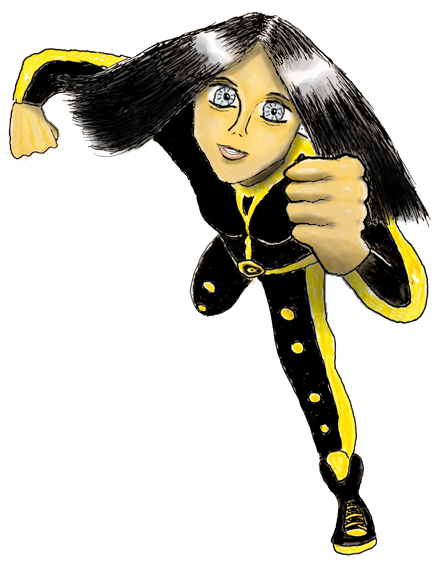
Drawn female comic character running, wearing a black and yellow superhero style outfit

Zip, the main character of Mike’s webcomic

A long time fan of comic books, having a condition caused by a mutant gene, I always took superhero origin stories with a pinch of salt; because I knew that even if someone were to survive an accident capable of altering their DNA the chances of the change not causing complications would be extremely small. But it wasn’t until I read an article on 7 Awesome Super Powers (Ruined by Science) [includes strong langauge] that I had the idea to use the  concept of having superpowers as an analogy for the way that being different can make it a challenge to fit in with everyday society.

I made my protagonist a superhero, an archetype normally associated with superiority and power, but who also faces problems informed by the ones I’d had living with aniridia, despite those problems being caused by the very things that give them their power. As the series goes on, my hope is to challenge the notion that the disabled are helpless, and to be pitied, as well as spreading the message that no matter who you are, it’s tough to be different.

Read the comic for free at www.adventuresofzip.co.uk 

By Mike, 25

Contact us to tell your story about how aniridia has affected you.

Posted in Patients' tales | 1 Comment

50 years with aniridia

To discover that your child has been diagnosed with Aniridia is upsetting and stressful.  In 1964 it was devastating.  Diagnosis: blindness, prognosis, no hope.  I have read my recently deceased mothers diaries and her hopelessness, despair and unfounded guilt are etched on every page.

Two years later, pointing at a plane passing over our London back garden, brought my parents untold joy. I wasn’t blind!

Mainstream schooling followed.  I learnt to ride a bike, ignoring frequent crashes, and played outdoors unsupervised, as most children did in the 1970s.  I recall riding at top speed with a group of my friends to the park.  My eyes just never registered with me in my childhood and my parents never over protected me.

Strangely, it wasn’t until senior comprehensive school in 1978 that my parents encountered prejudice, the like unheard of today.  The teachers asked my parents to remove me as my eyes were “disturbing”.  Despite pointing out that I was on or near the top of the class in most subjects, the school refused to budge.  They claimed I should go to a specialist school for the disabled even though I had no learning difficulties at all.

My parents were self-employed at the time and their business was doing well.  This gave them an option not open to most families then or now.  They sent me to a fee paying private girls school where I encountered no further prejudice, made good friends and found high expectations in learning.  And learn I did, leaving school with 8 O’Levels.

I wanted to be a doctor but was firmly told by my careers advisor and my parents that this would not be suitable for me.  I remember it being explained to me that no patient would trust a doctor that couldn’t read drug labels.  Visual aids were not considered!

My options limited in the 1980s I went to secretarial college and learnt high speed touch typing.  Blank keyboards levelled the playing field!

As the 90s turned to the noughties, computers entered the office.  I found I had a knack for picking up software and soon mastered many systems.  Now I program databases, with a big screen provided by my employer.

Visits to the doctor, whether my GP or my eye consultant often resulted then and now in excitement and a gathering of students accompanied by a polite request as to whether they might take a look!  I was told this would probably be a once in a career opportunity so how could I say no?  My consultant would bring in nervous students, warning me to give away no clues, and ask them to diagnose me.  Their nervous efforts, under the stern watchful eye of a senior consultant, always brings a wave of pity from me.  My consultant would berate me afterwards for blurting out clues to the hapless students!

In the 90s I met and married a wonderful man who did not give my eyes a single moment of doubt.  We had a son who inherited my Aniridia.  He received all sorts of help and assistance at school and is now a confident 20 year old.

Then we had our daughter, born with normal vision.  Oddly I felt more at sea with her than with my son.  How should I deal with a daughter who could see so much better than I?  I spent hours staring at her beautiful blue eyes in fascination.  She is 12 years old now and Mum and Brothers helper around the house without complaint.  She is an expert on the condition and explains it to all comers.

I was assessed a few years ago by Action for the Blind and I attended a course to learn what assistance I was entitled to etc.  It was a surprise to be told that I had amassed a large variety of coping strategies in my everyday living that were completely sub-conscious to me, until discussed with an expert.  I realise now that I do a lot of things differently in order to retain my independence as much as possible and keep my status as a “normal” working mum intact.  I still do the food shopping, washing, cooking and go to work full time.  My husband does the hoovering (he can see the dirt!) and ironing and changes all the lightbulbs!

My independence is critical to me.  I will go very far to be considered just another working mum.  I have always said that I want to be someone who just happens to have aniridia, rather than a disabled person who manages to have a job and a family.  It is so important that aniridia does not define us.

If you are on this website and reading this because you are looking for information, reassurance and most importantly hope, because someone you love or care for has been diagnosed with Aniridia I only have one thing to say:

It’s going to be OK.

You know they will have problems in life, that their options may be limited.  They however, will simply get on with the business of living.  If they are a child, then trust in their resilience.  They will achieve things in life you thought unlikely or even impossible, simply because no one told them they couldn’t!!  And, if they reach a wall they can’t climb they’ll simply try another route around it, just as I did.

By Annette

Posted in Parents' accounts, Patients' tales | 3 Comments

Protected: James’s jujitsu blue belt and self-defence for the visually impaired

This content is password-protected. To view it, please enter the password below.

Posted in Patients' tales | Tagged , | Enter your password to view comments.

“Artificial iris implant surgery is not a very difficult procedure and is becoming more popular”

“Cataract surgery in eyes with iris defects can be challenging, but careful preparation as well as recent advances in surgical instruments and iris implants mean outcomes are significantly improving for these patients.”

This was the subject of a presentation given at the 2013 annual congress of the United Kingdom and Ireland Society of Cataract & Refractive Surgeons. The speaker was, Sathish Srinivasan FRCSEd, FRCOphth from University Hospital Ayr, in Scotland. He gave a comprehensive overview on how to approach cataract surgery in patients with iris defects, with detailed surgical video demonstrations of his work on these patients.

Read a full article about the session

Posted in Medical staff talking | Tagged , | 2 Comments

Join our trustee team for 2014/15

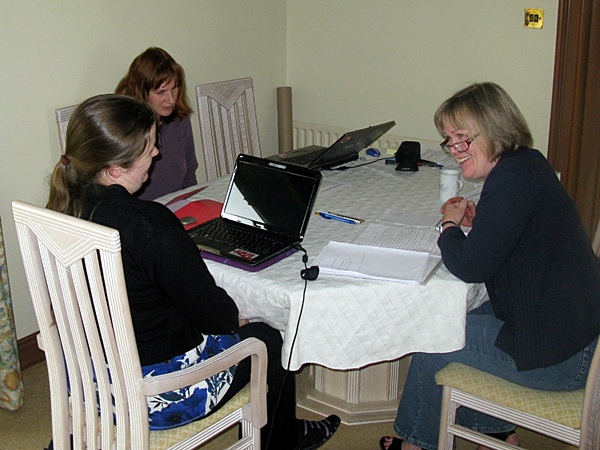
Three women sitting around a table with laptops and meeting papers

Jenny, Katie and Liz discussing issues

Could you lead our charity to: ensure it runs properly and enjoys success?

We need all the help we can get. Don’t take it for granted that others will do it all or even as well as you could. We’re seeking new people to join the Aniridia Network UK Trustee Board – how about you?

Trustees are the people who form our governing body. They are responsible for controlling the management and administration of the organisation. Trustees are volunteers, and receive no payment (other than to repay necessary out-of-pocket expenses incurred). Trustees work together as a team, and have collective responsibility for the charity.

Being a trustee can be hard work, but also be rewarding and provide opportunities for personal development and improving employability.

Find out more about what is involved in being a trustee at Aniridia Network UK

Trustees for the coming year will be at voted in by our members at our next Annual General Meetings in Bristol on 7 June 2014. Use that link to find details of who is standing for election.

If you want to join the team, fill in the form below. Include up to 200 words that we can publish online as a profile explaining who you are and what qualities you would bring to the post.

Before or on the day of the AGM at Conference 2014 the Secretary must also receive from you a signed paper or electronic copy of the trustee nomination and declaration form. Ideally you would attend the AGM but it is not essential.

If you have any questions, ask them in the comments below or email info@aniridia.org.uk

← Back

Thank you for your response. ✨

Posted in Aniridia Network news | Tagged , , , | 3 Comments

Notice of 2014 Annual General Meeting

Notice is hereby given that the Annual General Meeting of Aniridia Network UK will be held at: Armada House, Telephone Avenue, Bristol, BS1 4BQ at 15.30pm  on 7 June 2014 to transact the following business.

Agenda

  1. Speaker at a lecturn at Conference 2013Minutes of the previous meeting
    To be agreed and matters arising.
  2. Reports and accounts
  3. To receive and consider the accounts for the year ended 2014 and the reports of the charity trustees
  4. Appointment of charity trustees
    To (re-)appoint the following as trustees until the 2015 Annual General Meeting.

    1. Katie Atkinson
    2. James Buller
    3. Jenny Langley
    4. Sarah Hargraves
    5. Liz Atkinson
    6. Chris Moore
    7. Ben Rendle
    8. Others who may be nominated
      Details of how to submit nominations
  5. Resolutions No resolution are currently proposed.
    Details will be given once proposed resolutions are received.
    Proposed resolutions should be sent to the Secretary by 10am on 5 June 2014
  6. Any other business

By order of the Trustee Board
Sarah Hargraves, Secretary
3 April 2014

The AGM 2014 will be a session at Conference 2014. Members may come to the AGM for free but to attend other sessions the conference ticket fee must be paid.

Posted in Aniridia Network news | Tagged , , , , | 2 Comments