Recruiting guide dog Connie

After retiring my guide dog Sandie I received an e-mail asking if I would be prepared to consider a German Shepherd as they have very different temperaments and need different handling to the two labradors I have had before.  I said I would as I had always wanted a shepherd as a guide dog ever since I had heard about their work.

Sandie and Connie in the boot of a car

Going to beach together

At my matching visit this huge dog came sniffing round my house.  It was very strange as I am used to a tiny 26kg labrador.  We had a chat about her issues and what needs work and then we went out for our matching walk.  She is a very fast paced little worker with lots of initiative and very good stamina.  We walked about 2 miles which was great for me to be able to see how she does in different conditions.  I decided that as her only real issue is doing big busies on walks and that I have had Sandie who has IBS I would take her.

Connie is a beautiful long haired black and tan German Shepherd.  She weighs 32kg but is very long and tall.  She is very chilled out and likes her cuddles and licks your hand to say hello.  She has a wild side and likes to throw toys at you, play fetch and puppy play.

We started training from home 2 weeks ago doing routes around my local area.  I like training from home in some respects because you get to learn routes that you do on a day to day basis.  I dislike the fact you don’t have support from others who are going through the process.  Connie enjoys our local routes as she can really stride out on long stretches of pavement with no kerbs to slow her down.  She needs lots of praise in her work and because she is nosey she someties needs to be told to ‘leave it!’ as she is too busy watching what is going on rather than where she is going.

We did the route to work and everyone thought that she was beautiful although my colleague Vici is very scared of Connie’s big teeth.  She seemed to enjoy looking around the building and sniffing her bed.  I think she thinks ‘that bloomin’ labrador gets everywhere’.

How is working with a labrador different to working a shepherd?  Shepherds do emergency stops at kerbs whereas labs slow down and then stop to give you warning.  Shepherds also leave the kerb very fast when you give them the command.  Shepherds are very smooth and you don’t feel much bouncing in the harness.  Their obstacle avoidance is very smooth and they only nip in and out if they are doing crowd work.  Usually you don’t notice they have guided you round something.  They are also incredibly focused on where they are going if they know the route.  Labs are always very pleased with themselves whereas shepherds seem to be quietly pleased.

I thought I might get less attention having a German Shepherd but actually people often say that they have never seen the breed used as guide dogs.  In actual fact they were the first breed to be used as guide dogs.

Beth and Connie on the garden patio

At home in the garden

Connie and I qualified on Wednesday, the manager followed us in the car.  They say it was because two people walking behind might be a distraction but I reckon it’s because they couldn’t keep up. roflol  I think our walk was a true reflection on what a good partnership we have made already but also how far we have to go.

I have my shepherdess as my left hand lady now and we are both getting to know each other and settling in which will take up to a year.  Their will be laughter and tears but most importantly love and trust between us.  I am sure she will make a fabulous guide dog and I am loking forward to spending many years with her.

Posted in Patients' tales | Tagged | 1 Comment

Retiring guide dog Sandie

Some of you may remember the daily diary I did on the Aniridia Network International Yahoo group about my guide dog training with Sandie.

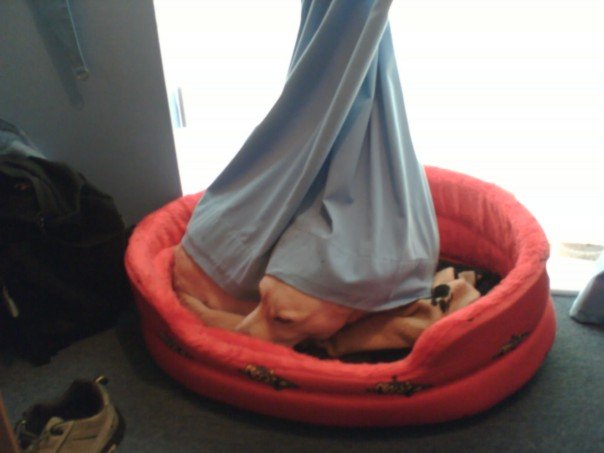
Sandie in bed with a curtain also twirled around on top of her

"I made this mess myself"

That little pint sized yellow labrador is now 8 and has been working for just over 6 years.  She was diagnosed with arthritis of the elbow at 4 years old and has been on Rimadyl, doggy Ibruprofen, ever since.

After the snow which fell on my wedding day and lasted 4 weeks Sandie became very slow.  I decided that I needed to think about retirement so I called my local guide dog team to come out and have a look at her work and a chat.

I was anxious all day about my visit at lunchtime. It turned out that Stig (My instructor) was 3 hours late due to a 3 hour trip to HMV with someone he is on class with! I joked that he must have a good music collection now.

I decided to do the walk to the metro station as it has two hills one down
and one up. We walked through the gap in the hedge and then about 20 paces down the hill. Sandie was working slowly and I could feel her elbow going (you can’t see a limp you can just feel it in harness). She was looking around for Stig at one point so he had to walk closer as she likes to keep the pack together. As we were walking I told him I could feel her elbow going. He said he didn’t need to see any more and we went back inside for a chat.

He said she was showing that physically she cannot do the job anymore but
mentally she still wants to and therefore I needed to go on the list as a priority. Her workload had to be reduced as much as possible.  We then discussed all the practical paperwork stuff and what kind of dog I would like next.After he went I got a hug off my support worker and Sandie (who also did her
head stand and gave me a big lick on the mouth!) and then my PA turned up to get her pay slip so she gave me a hug too. I shed a few tears but I also felt
relieved that at some point this year I would be able to let Sandie put her paws up. She is always so willing to work even though it is getting hard for her.

She has been with me through so much:

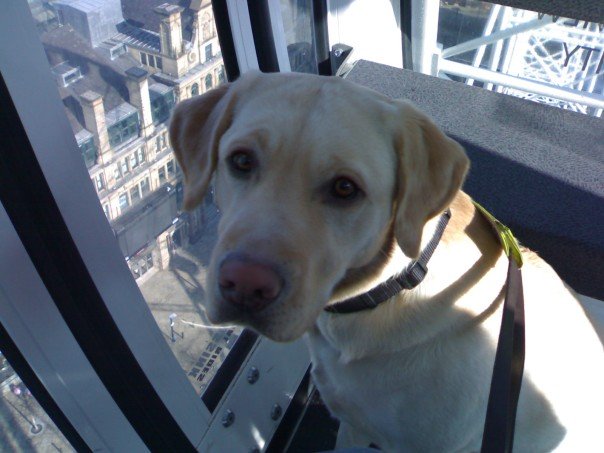
Sandie looking into the camera while the pod of the big wheel is up in the air

Sandie on the big wheel in Manchester

  • We’ve lived in:
    • Barnsley (2 weeks)
    • Manchester (3 years)
    • Hartlepool (2 years)
    • Newcastle (1 year).
  • We spent 2 years of living in Manchester travelling to Hartlepool and back every other weekend.
  • She has been on:
    • a plane to Devon
    • the London Underground
    • the big wheel in Manchester.
  • She’s met the Mayor of Manchester She’s appeared on the front page of the Hartlepool Mail.
  • She literally sat next to me through some of the darkest months of my life when I struggled for a reason to live and with what was reality and what wasn’t.
  • It was also an honour for her to lead me up the aisle on my wedding day which is a dream I always had for her.

She’s got into some scrapes

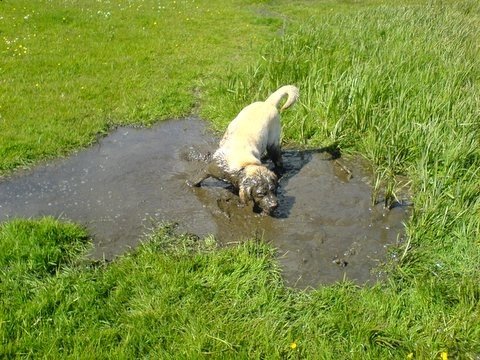
Sandie diving in to a muddy pddle

"More mud - woof woof!"

  • Dulcie and Sandie stole a sock off my washing line and played tug with it.
  • She once dragged me unknowingly into a pet shop in Kendal and stood wagging her tail at the toys!
  • She also dragged me off the bus into Wilknsons to the pet section in Salford (we had never been there before)
  • and this is still her best trick being able to go to any Wilkos and find the pet section.

A few weeks later with all the paperwork complete I decided that my  best chance of finding the right dog for me in the quickest time possible was to give up the harness and become a Priority 1.  Priority 1’s are people who are waiting for a replacement dog but do not have a working dog.   I waited 2 more weeks and received an e-mail asking me if I would consider a possible match.   I will tell you more about that in my next blog post.

Posted in Patients' tales | Tagged | 1 Comment

Pig & Pimms Garden Party in aid of Shine The Light On Aniridia

By Elly Chappele

Shine The Light On Aniridia has been been raising funds to enable research for a cure for Aniridia to begin this year. we hope, at Moorfields Eye Hospital in London under Dr Julie Daniels and her team.

We have reached approximately £30,000 now with the campaign Shine the Light on Aniridia which is a feat we never thought possible! The target we need to achieve is £50,000 by the end of the year.

This event will help us get closer to the target:

‘Pig & Pimms’ Garden Party
from 3pm Saturday 21 May 2011 at
Acton House in Felton, Northumberland
by kind permission of the Ferguson family. 

It promises to be a wonderful day with a hog roast, Pimms, bouncy castle, face painting, planting in the walled garden, treasure hunt, jazz and much more…..

Please help spread the word about this event and if you can attend yourself we would love to see you there!

Tickets can be booked via email at: info@actonhouseuk.com

Prices

  • Adult £15
  • Child of school age £7.50
  • Under 5s FREE
  • Family ticket (2 adults and 2 school age children) £40.

All monies from this campaign go directly to the research, there are no overheads, no third parties and no admin fees.

Best wishes

Elly, James, Ella the Fairy Queen and Reuben

Posted in Aniridia Network news, Fundraising | Tagged , | Leave a comment

Taking part in research into aniridia, hearing and memory

In the Summer 2010 Aniridia Network UK newsletter there was a call to take part in research into the effect of the aniridia gene (PAX6) on the parts of the brain that deal with hearing and memory.

Having done some similar experiments in the past I volunteered. I was soon on the train to Chalfont-St-Peter outside north west London. The venue was the National Society for Epilepsy. because there is the highest resolution MRI scanner in the UK.

National Society for Epilepsy MRI Unit Mar Martin

Mar the researcher first put me through a series of verbal perception, language and memory tests. Some were quite taxing but all were fun.

Scan of James's head on computer screen with MRI scanner in the backgroundThen I was laid down and slid into the MRI scanner. The noise necessitated ear plugs and its cooling system meant I needed a blanket to keep warm.
The scanning took 45 minutes. During this time I mused about some of the memory tests and decided that the sound of the scanner could be used as the base line for a dance music track, I wonder what effect this had on the resulting imagery of my brain!

Afterwards we did a few more tests. Then I was on my way home.

The lead researchers (Professors Sisodiya and van Heyningen) also wrote to my GP to recommend that I get genetic testing. I did have this as a I child but my medical notes give no details of the results. My full notes and testing are necessary if I am to take part in the WAGR NIH study in the USA. A nice coincidence is that Mar also used to work at National Institute Of Health (NIH).

Volunteers are still needed for this study. If you would like more information or take part email sisodiya@ion.ucl.ac.uk.

Posted in Patients' tales | Tagged , , , | 1 Comment

We are now an official charity

Charity XT26830 as if printed with a rubber stampAniridia Network UK is extremely pleased to announce that we have been recognised as a charity. Our reference number is XT26830.

It is a big step forward as it gives us an additional level of respectability and other benefits.

HM Revenue & Customs have registered us as a charity for tax purposes – backdated to 16th May 2009.
This means we can now claim Gift Aid on our income, including donations and membership fees.

We can also benefit from discounts and special services for charities. This includes websites where we can raise and accept raise money such as PayPal, ebay, Everyclick and Charities Aid Foundation.

Internally it reinforces our drive to be more professional in how we run the organisation as it affects the perception of other charities.

But we are not registered with the Charity Comission. They are currently not accepting applications from organisations with an annual income less than £5,000. With your help fundraising we can achieve that but currently our income is in the hundreds of pounds. Nevertheless we will look to follow Charity Commission guidance and good practice.
HMRC recognition should give us the same benefits as Charity Commission registration though we are expecting that some businesses may take some convincing, The HMRC route is just as rigorous. They check:

  • our aims are charitable
  • how we govern ourselves
  • that no  one involved with the running of the charity have any history of fraud or tax evasion.

We passed on all counts and are now looking to the bright future this gives us.

Posted in Aniridia Network news | Tagged | Leave a comment

Bring rare diseases to the attention of your local politicians

Rare Diseases UK. Improving Lives, Optimising Resources: A Vision for the UK Rare Disease Strategy

PDF of report

Aniridia Network UK recently joined Rare Diseases UK, an alliance of industry, patient organisations and individuals developing strategic planning for rare diseases in the UK.

The European Union defines a rare disease as a disorder which affects 1 in 2000 people or less. Figures for the incidence of aniridia range from 1 in 50,000 to 1 in 100,000 which certainly makes aniridia a rare disease and WAGR/11p deletion syndrome even more so. Although each rare disease may affect only a small number of people it is estimated 3.5 million people in the UK will be affected by a rare disease at some point in their lives.

On Rare Diseases Day, 28 February 2011, Rare Diseases UK published their report Improving Lives, Optimising Resources: A Vision for the UK Rare Diseases Strategy [pdf]. The report contains some great recommendations which could really benefit people with aniridia and WAGR/11p deletion syndrome, if they were adopted by the government and health service.

Local elections are being held on the 5th May and if you live in Scotland, Wales or Northern Ireland you will have the opportunity to vote for your MSP or Assembly Member. Aniridia Network UK and Rare Diseases UK encourage you to write to the candidates in your area and encourage them to pledge their support for a strategy on rare diseases.

Rare Diseases UK have created model letters you can send to the candidates and have provided information on how to find out who the candidates are in your area. For details see:

Please take a few minutes to write to your local politicians and encourage your friends and family to do the same. Thank you for supporting aniridia, WAGR/11p deletion syndrome and rare diseases in general.

Let us and Rare Diseases UK  know who you write to and the response you get

Posted in Campaigns | Leave a comment

James’s introduction

Photo of James wearing sunglasses

James, July 2010

I’m James, a born (1979) and bred Londoner. I have sporadic aniridia. I’m married to Zoe and work as a web developer. Good causes are my passion. I’ve worked and volunteered for several charities and community organisations. This now includes being a trustee for Aniridia Network UK.

While I am partially sighted my vision (6/24 6/36) seems to be better than many of the people who have aniridia that I’ve met. Having had a squint operation when I was 3, aside from some nystagmus and several bouts of conjunctivitis I’ve thankfully not had any other complications.

The only mobility/low vision aid I use nowadays is a 8×20 extra short focus monocular. As a result I’m treated by everyone as having normal sight – which is nice but is sometimes problematic too. I’ve always loved having my monocular for reading bus numbers and watching live entertainment etc. It’s a useful talking point too because using it shows what I can and can’t see.

I could write lots more but I’ll leave it for future posts on particular topics.

If anyone is in London and would like to meet up to talk about aniridia please get in touch by email or leaving a comment below.

Posted in Patients' tales | Tagged | 2 Comments

Protected: 2011 Annual General Meeting and trustee’s plans

This content is password-protected. To view it, please enter the password below.

Posted in Aniridia Network news | Tagged , , | Enter your password to view comments.

Diagnosis difficulties – a father’s experience

A picture of Fuad holding his daughter Shakila, both are smiling for the camera.
Fuad and daughter Shakila

If you follow Aniridia Network UK on Facebook you may have already read the story of Fuad and his daughter Shakila featured in these articles

Article in The Voice

Article in The Standard

Article in The East London Advertiser

Shakila was born with sporadic aniridia but was not diagnosed until she was a year old. We were dissapointed to hear it had taken so long for shakila to be diagnosed so we interviwed Fuad to find out more:
 
So when did you first notice a problem with Shakila’s eyes?

For the first few weeks we noticed that she would not open her eyes a lot, at around 2 and a half months, we indicated to the GP  that she did not recognize us or smile, because this was one of the milestones on the red baby book. We also noticed the black pupil, at one point I took out my lighter out and kept asking Shakila’s mum if she could see, but Shakila seemed to be following the lighter so I assumed that the colour of her eyes was the way god had intended. We also noticed she was squinting, sometimes one eye, sometimes in both. Looking back now I also noticed Shakila when taken out would hold her head on to my chest, as if she was sleeping or nervous of the outside noise. We also noticed in the photographs of Shakila that her eyes were coming out as silver. 
 
What diagnosis were you given?

The diagnosis was given when Shakila was 11 months old at a private clinic, the private doctor, at first asked us if, anyone had put a solution in Shakila’s eyes and had we seen anyone today, we told him no, he then explained that our daughter had Aniridia. He seemed amazed we came to see him, he kept asking why did we come to see him, what did we notice?  Before that .the only diagnosis we were told was that she had a lazy eye and that a patch would be needed after she was one years old.
 
Had Shakila’s eyes been examined previously?

Shakila had a check when she was born at the Royal London, she also had a 6 week check, which was done when she was 2 and half months old at the Tredegar Practice. She had passed all the checks and the GP had writing “no problem with the eyes”
 
How long did it take to ge referred to an opthalmogist?

Shakila was born on the 21st Oct 2008, the referral was done for a none urgent squint in June 2009, there was a problem with the hospital booking system so the referral was finally made for the 30th September 2009. We were told by the private doctor not to attend as this was a non urgent referral and to wait for his letter to Shakila’s GP. The GP then sat on the letter for a while and the first time we then saw a eye specialist was in December 2009.

 
When did you finally get a diagnosis of anirdia?

We got the diagnosis by paying for a private opthalmogist in August 2009, but it took a while for the GP to make sense of what needed to be done, even in October she still did not make any of the referrals to Moorfields and to Great Ormond hospital. I had to instruct her on what needed to be done.
 
How did this experience make you feel? Did you feel your concerns were taken seriously?

I am very angry with the system there are a lot of holes with the PCT and NHS, if I could read about aniridia in a day to know what needed to be done, why did Shakila GP seem clueless. I have also noticed that in the red baby book dates from when the health vistor noticed a squint and the dates the GP has on the system are completely wrong. The only way of both communicating is through a verbal team meeting once a day/week. It seems crazy in this day of age of protecting young children there is a massive flaw. I am also spitting mad that when I asked why did it take so long to diagnose Aniridia that the NHS that its easier to spot this condition in the pale eye than a dark brown eye. The bottom line is that if only the persons examining the eyes paid attention and not just assumed its only another check with another baby. Even now as I am asking questions and trying to create some honest discussion among the various CEO’s of the Royal College and the Strategic London Health Authority, I seem to hitting brick walls. This experience has made me now to not be afraid of asking questions to doctors and if I have a gut instinct on something to go with the gut instinct.           .   
 
How do you think the monitoring of children’s health could be improved to increase the chances of aniridia being diagnosed earlier?

 Yes I am trying to get the get the various organisations to develop a best practise guide when GP conduct the 6 weeks eye check and when the paediatrics also check the eyes at birth. Or failing that to get a opthalmogist to be conducting the eye checks. Also there needs to be a very simple messaging system set up between the GP and the health vistor so when things are spotted they act straight away. Writing things in the book book but no one but no one knowing what the other had seen or done is not a system that works.
 
Fuad is not the only parent to tell us their child was not diagnosed until a year or two after birth but we also know some other children are diagnosed very quickly. We would love to hear your comments on your own experience of diagnosis, good or bad. How old were you/your child when diagnosed? Who first spotted the problem, a doctor or family member? How long did you have to wait between a problem first being spotted and a correct diagnosis?
 
We hope to use your feedback to raise awareness of aniridia amongst the medical community and highlight examples of good practice we would like to see adopted UK wide.

Posted in Parents' accounts | 2 Comments

Jenny’s introduction

Jenny LangleyI currently live in Devon with my guide dog Jaynie. I was born with aniridia as part of WAGR syndrome.

I have most of the associated eye conditions that go with aniridia, including cataracts, glaucoma, nystamgus, corneal thickness/scarring and have had numerous surgeries over the year mostly for glaucoma. I developed a Wilms tumour at 13 months old.

I finished studying for a degree in education at the University Of Worcester and now have a job teaching touch typing to children with a visual impairment and complex needs. My hobbies include, reading/listening to audio books, walking with Jaynie, and socialising with friends.

I have been a trustee for Aniridia Network UK for many years.

Posted in Patients' tales | Tagged | Leave a comment