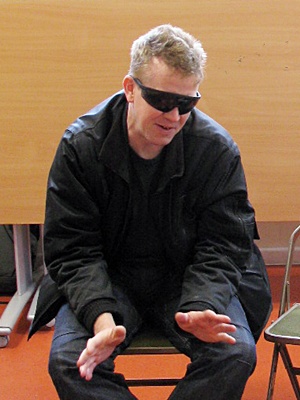
Returning to Moorfields for testing time

I just went for an appointment at Moorfields Eye Hospital for the first time in 15 years.

When I became an adult and left London for university, Moorfields said I didn’t need to keep coming to them. Instead I could just go to normal opticians to check my pressures each year. Since my sight has always been stable that’s been fine.

But I got a referral from my GP to get genetic testing. My medical notes contain no detailed results of the genetic testing that was done on me as a child in 1980. In fact there’s a stark inaccuracy that ‘perhaps 40% of any children would have aniridia’. We now know it’s 50%. Genetics has of course come a very long way since then so I felt it was time to understand my particular case better. Plus if I get a PAX6 mutation confirmed, I can go to the USA to take part in the NIH study – a good basis for a holiday!

So at 8:30am I was first in the waiting area. First a nurse did an initial sight test, checked blood sugar and pressure.

After a short wait a doctor performed the usual eye examinations, checked pressures, peripheral vision and took a complete family history. He also tested me for colour blindness, The spotty numbers were very difficult to see but he didn’t remark on it later.

Image of James's retina (taken 2003)

Next was a trip to the Laser Suite. A gadget shone lots of coloured wavey lines in to my eyes to map my retina. There was a very bright square too which was very uncomfortable and made my eyes water. The person doing it remarked that it would have been better if they hadn’t just put drops in my eyes!

Then it was back to the doctor and his consultant to review. They were very nice and were happy to organise genetic testing. In additon they said from now on I could have annual checks at Moorfields instead of at opticians. I’m very glad about that as I’ll be seen by more experienced people with better equipment and build up a consistent case history.

They sent me to have a photo taken. This was the worst bit of the day for someone with photophobia. The camera was really close and then a massive flash went off! Three times in each eye! That was horrible. I had a headache now from all the brightness and handling.

Next a genetic counsellor explained the testing consent form to me so I could sign it. Then I went up stairs for a blood sample to be taken. The results will take between two and six months to come back.

I left at 11:45 having signed with trepidation up for more at the same time next year!

Posted in Patients' tales | Tagged , | 1 Comment

Seminar about unlicensed treatments such as melatonin

Following our recent posts about melatonin we have news of a upcoming event about unlicensed and off-label treatments – which melatonin is,

Patients Involved in NICE (PIN) in collaboration with RNIB, will be holding a seminar looking at the impact using unlicensed treatment has on: patient safety, the current regulatory system and the development of licensed alternatives and innovative new treatments.

9.30am – 4pm on Thursday 23rd June at the Wellcome Collection in London. Anyone interested in attending should contact Andy Pike, andy.pike@rnib.org.uk. Please also let us know if you plan to go as we are not sure whether we’ll be able to send someone so you could be our representative.


Posted in Medical staff talking, Other agencies | Leave a comment

Trying to obtain melatonin

During my visit to the National Institute For Health (NIH) in 2009 to participate in the WAGR/11p Deletion Syndrome research, one of the findings was that I had a smaller than average pineal gland.

The NIH research and previous studies are discovering a possible link between the PAX6 gene and the development of the brain. It is thought that people with aniridia may have smaller or completely absent pineal gland.

The gland is responsible for producing a hormone called melatonin. Therefore people with aniridia who have been found to have a smaller than average, or no pineal gland may have lack of melatonin.  Melatonin is the hormone that regulates sleep. So people with aniridia may have problems sleeping.

The researchers at the NIH are recommending people who have been found to have a small or no pineal gland to take melatonin supplements to improve their quality of sleep and regulate their sleep patterns better.

This is absolutely fine for people living in the USA, where melatonin is readily available over the counter. However, in the UK it is not so easy. Here, melatonin is not a licensed drug, and it is usually only give to people over the age of 50. It has to be prescribed by a consultant neurologist. However even getting a referral to neurologist can be extremely difficult!

When I returned from my visit to the NIH, I made an appointment with my GP to talk over the test results, including the MRI scan showing I had a small pineal gland. I asked her to refer me to a neurologist who could prescribe me melatonin. She looked in her book, to see what she needed to do, and wrote a letter asking for advice from a neurologist at the local hospital.

Although I don’t have huge problems with my sleep patterns, there is definitely room for improvement, and I was curious to find out how, if at all, melatonin supplements could help me. I had read on the WAGR Yahoo mailing list, stories of how melatonin had given children with WAGR/11p Deletion Syndrome a better quality of sleep. Parents have reported that since their child has started taking melatonin, they

  • (stay) asleep for longer
  • wake up more refreshed
  • are less tired during the day.

Some of the issues I have are that: I do not feel sleepy at night, then find hard to ‘switch off’ to and fall asleep. I can easily be working on my laptop until the early hours of the morning without feeling the need to go to bed. I have to have some background noise to fall asleep to too. Usually I put on an audio book or a music CD. Once I have fallen asleep, stay asleep and don’t wake up unless I need the toilet. When I am working, I wake up when my alarm goes off at 7:30. If it is not a working day, then I can stay asleep until about 10 or 11. I usually get easily tired during the day, and sometimes can get so over-tired that I become ill with migraines. So I was keen to see if melatonin could help with these issues.

In summer 2010, a friend whose daughter has aniridia gave me some left over tablets of melatonin to try. I found that they did in fact make a noticeable difference. I was able to fall asleep more easily and I actually felt sleepy. They also made me feel more wide awake in the mornings. After these tablets ran out, I desperately wanted to get a prescription because i knew they actually were a benefit to me.

The neurologist that the GP had written to, said he couldn’t help me. So next I approached my ophthalmologist to ask him if he could refer me to a neurologist. He was very understanding and happily agreed to ask for a referral, even though he had not heard of the research into aniridia and the pineal gland. However, the neurologist he wrote to turned out to be the same neurologist that the GP had written to previously!

The neurologist, wrote another letter saying that he couldn’t help, but this time, suggested another that might. So my GP, made me an appointment with this second neurologist, who has an interest in sleep problems.

I had that appointment in April, and found it incredibly helpful. Not only did the neurologist agree to recommend the GP give me a prescription for melatonin, he was very interested and said he would write to an expert for more advice. I thought the appointment would be a one off, but I have a follow up appointment for October. In the appointment, the neurologist, asked me questions about my sleeping habits and did a survey. He said that he did not want to examine me then, but would in October. We chatted about what dosage of melatonin would suit me best, and agreed that 4mg would be most effective for me personally. It was a very informal meeting and I felt very relaxed and comfortable. I even admitted that I had been sent melatonin from a friend in America.

A few weeks after my appointment, my GP sent me a letter with a melatonin prescription enclosed.

Ed: Have aniridia and want/use melatonin? Comment below or write a post of your own to tell your story.

Posted in Patients' tales | Tagged , , , | 1 Comment

Study into frequency of glaucoma and other diseases in patients with aniridia

Purpose

To evaluate the following in patients with aniridia

  • age at first examination at the University Eye Hospital and age at diagnosis of glaucoma
  • visual acuity
  • frequency of family history of aniridia
  • and frequency of ocular and general diseases associated with aniridia.

Methods

This was a consecutive examination of 30 unrelated patients with aniridia and retrospective evaluation of ophthalmologic, pediatric, and internal findings. The relative frequency of age at glaucoma diagnosis within decades was evaluated for the 20 patients with aniridia and glaucoma. Statistical analysis was performed using the Mann-Whitney test.

Results

Relative frequency of the age of patients with aniridia at time of glaucoma diagnosis within the following decades was as follows:

  • from birth to 9 years: 15%,
  • 10-19: 15%,
  • 20-29: 15%,
  • 30-39: 15%,
  • 40-49: 35%,
  • 50-59: 5%.
  • Visual acuity in the better eye of 20/100 or less was found in 60%.
  • Family history of aniridia was found in 33.3% of patients, with 1-4 relatives with aniridia.
  • A total of 76.7% of patients had congenital cataract
  • 66.7% had glaucoma.
  • Mean maximum intraocular pressure of the 20 patients with glaucoma was 35.9 mmHg in the right and 32.6 mmHg in the left eye.
  • A total of 53.3% had nystagmus,
  • 26.6% corneal opacifications,
  • 16.7% bilateral lens dislocation upwards,
  • 6.7% optic nerve hypoplasia,
  • 3.3% poor foveal development
  • 3.3% Wilms tumor.

Conclusions

  1. Up to the age of 40 years, 15% of patients were diagnosed with glaucoma per age decade.
  2. Frequent bilateral glaucoma and similar bilateral height of intraocular pressure suggest a genetic glaucoma disposition with malformation at Schlemm canal, besides possible sequential anatomic changes in the chamber angle.
  3. Associated ocular abnormalities limit visual prognosis.

Full article “Glaucoma and frequency of ocular and general diseases in 30 patients with aniridia: a clinical study”  available in European Journal Of Opthamology

Posted in Research | Tagged | Leave a comment

Run-on mutation in the PAX6 gene and chorioretinal degeneration in autosomal dominant aniridia

Purpose: To identify the causative paired box 6 (PAX6) mutation in a family with autosomal dominant aniridia.

Methods: A family with autosomal dominant aniridia with three affected individuals in two generations was investigated for the causative PAX6 mutation by single strand conformation polymorphism (SSCP) followed by sequencing of genomic DNA from peripheral blood.

Results: A novel PAX6 mutation in the donor splice site of intron 12 was identified in all three affected individuals from the family. The automated splice site analysis web interface indicated a disturbance of splicing and it was predicted that this mutation could lead to an elimination of the normal stop codon and an abnormal 3′ elongation of the mRNA.

Conclusions: We report a novel PAX6 mutation in autosomal dominant aniridia that presumably affects splicing. The presence of chorioretinal degeneration in one of the affected individual raises the possibility that run-on mutations are associated with chorioretinal involvement in aniridia.

From Molvis

Posted in Research | Tagged | Leave a comment

Asymmetric phenotype of Axenfeld-Rieger anomaly and aniridia associated with a novel PITX2 mutation

Purpose: To evaluate the asymmetry of the anterior segment phenotype between the two eyes of a patient with Axenfeld-Rieger syndrome (ARS).

Methods: The entire database of a tertiary glaucoma practice was screened for patients with ARS. The medical records of patients with ARS were reviewed. The clinical characteristics of ocular examination of the two eyes of each patient were recorded and compared. Dental and medical information were also reviewed where available. The anterior segment phenotype was tabulated to assess asymmetry. Asymmetric anterior segment characteristics of patients with ARS were compared with reported cases in the literature.

Results: Eight patients with ARS were identified from screening of more than 5,000 patients of a tertiary glaucoma practice. All patients had Axenfeld-Rieger anomaly in both eyes except one patient presented with an asymmetric phenotype of the anterior segment with features of Axenfeld-Rieger anomaly in one eye, but aniridia in the other eye. This patient had non-ocular findings including flat midface, hypodontia with lack of an upper incisor, and redundant periumbilical skin, typical for ARS. A heterozygous C>T nucleotide substitution was identified in exon 4 of the pituitary homeobox 2 (PITX2) gene, resulting in the replacement of a glutamine codon (CAG) with a stop codon (TAG) at amino acid position 67. This mutation is denoted c.199C>T at the cDNA level or p.Gln67Stop (or Q67X) at the protein level. Only three cases with asymmetric anterior segment phenotype between the two eyes of a patient with AGS have been reported in the literature.

Conclusions: Variability in phenotype may occur between the two eyes of an individual affected by ARS. The current case undermines the advantage of genetic testing to correctly diagnose a rare disease.

From: Molvis

Posted in Research | Tagged | Leave a comment

Protected: Newcomer’s review of Conference 2011

This content is password-protected. To view it, please enter the password below.

Posted in Aniridia Network news, Parents' accounts | Tagged | Enter your password to view comments.

Conference 2011 review

The Aniridia Network UK conference 2011 was on 14 May. It  was a big success. Newcomer Jane said “The highlight of the day for me was definitely being able to meet other parents of children with aniridia, sharing experiences with those at the same stage and receiving wisdom from those who have already ‘been there’. Also, being able to ask honest and open questions of people who have aniridia themselves and to know that there are so many people out there who would be willing to chat to my daughter and support in her journey.”

The agenda included:

Mobility

Explanation of the work done by the habilitation specialists at Priestly School – an an all age specialist centre for pupils with severe sight loss.

Auditory processing disorder

This condition which affects learning has been linked to the same gene which causes aniridia. Expert Dr Doris Bamiou talked and answered questions about it.

WAGR/11p deletion syndrome

A session for discussions and talks from professionals. People coming for this are welcome to join in the morning aniridia meeting or physical activities and lunch if they wished.

Physical activities

The venue was Ackers an outdoor adventure centre. To make this 10th anniversary meeting better than ever we organised archery and climbing sessions to give time to socialise while having fun. They were supervised by staff experienced at both the activities and dealing with disabled people.

Posted in Aniridia Network news | Tagged | Leave a comment

Protected: Mobility session report from Conference 2011

This content is password-protected. To view it, please enter the password below.

Posted in Education professionals sharing, Other agencies | Tagged , | Enter your password to view comments.

Central Auditory Processing Disorder presentation

Central Auditory Processing Disorder ([C]APD) affects learning has been linked to the same gene which causes aniridia. Expert Dr Doris Bamiou talked and answered questions about it at our 2011 conference. Below are the slides and a recording of her presentation


Posted in Medical staff talking | Tagged , | Leave a comment