RNIB Phone Watch

I’ve always had a bit of a quandry with my mobile phone. I don’t really need to use a screen reader with but struggle just enough to discourage me from using the internet on it. So I’ve never gotten a tarrif that allows heavy internet use – which in a turn also limits my usage!

With an idea to change this I went to the RNIB’s recent Phone Watch event. It was billed as “short overview talks of the different mobile phone choices available for blind and partially sighted users and giving you the chance to get hands on with the latest handsets”.

Since graduating from a normal to a smart phone I’ve always stuck with Windows Mobile operating systems. Considering that parameter, when getting my current model I chose it largely on the screen size and the easy to read ‘TouchWiz’ reskin that Samsung had done to the normal interface. It certainly helped.

But compared to iphone and Anroid devices there are very few useful apps for Windows phones. It is a trend that may or may not start changing with the coming of Windows Mobile 7, plus Nokia’s takeover by Microsoft and hence swtich to Windows 7.

So I thought I’d go to Phone Watch to see what accessibilty features the alternatives have and whether I’d find them useful. This is my write up of my notes.

I arrived late, near the end of talk about apps for iphones. Twitalator and Tweetlist were said to provide large fonts or screenreader access for twitter. Big Names shows contact in large print. iloupe uses the camera to give 8x magnification but doesn’t give the help of the flashlight, which is possible more expensive apps. Generally Apple products are regarded as relatively accessible once out of the box and the feature is switched on.

Personally I don’t want to get caught up in the Apple trap. So I was more interested in the next section about Android phones. First was the news that Android has only had accessibility features appear since version 1.6. Lower end phones can also be sluggish when using them too.
There is 3rd party software called Mobile Accessiblity (requires Android 2.1) which provides a suite of screenreader friendly versions of 10 standard features such as contacts and web browser. Talkback, the built in screenreaders isn’t useful for purely touchscreen devices – it needs a trackball/dpad to move around. Most disappointing for me was learning that there are no means of enlarging or magnifying the text on screen, only apps for specific features. Indeed I was stunned later during the hands-on session to find no font size options at all.
The general feeling seemed to be was that with but limited to the features Mobile Accessibility provides Android might be considered better than the iphone for screanreader users. But for non-screenreader users iphone is currently much superior.

Finally talk turned to Blackberry devices. There is a free theme called Clarity which rearranges the interface to make it large print and high contrast. I was very impressed when I tried this later. There is a numerical screenreader but it is only available in the US. There are hopes that a new one will be coming to Europe soon.

As mentioned the evening ended with a chance to play with the various phones plus and ipad and a Kindle which was really useful. The facilitators were very knowledgeable, answering lots of questions. I’m very grateful for them running the event. For details about future events, the App Of The Month posts and more read the the RNIB’s TechKnowMore blog or follow them on Twitter.

Two of the other people there have set up a site called blindtechsupport.net. They make podcasts reviewing the latest accessiblity (features of) apps. They also have Facebook/Twitter profiles.

As for me, I’ll stick with what I have for the moment. But when it eventually gets lost/stoken/broken I’ll have a better idea of the variable state of play and where to find out the latest.


Posted in Patients' tales | Tagged | Leave a comment

Katie’s introduction

A picture of Katie Atkinson, chairperson of ANUKI was born in 1983 with sporadic aniridia and also have nystagmus, cataracts, glaucoma and aniridic keratopathy. I am registered partially sighted.

I live in Sheffield with my partner. My hobbies include ice skating, walking and reading.listening to audio books. I am/was studying for a PhD in physics/electrical and electronic engineering at the University of Sheffield.

I’ve been Chairperson of Aniridia Network for many years now.

Posted in Patients' tales | Tagged | 2 Comments

Capsular Tension Rings and Aniridia Rings in Pediatric Cataract surgery: A Case Series

Here are some slides detailing a medical study into the success of implants for aniridia patients.

Vodpod videos no longer available.

Credit: The original slideshow and transcript

We also recently came across a page showing the various implants made by Morcher available for people with aniridia.

Finally Here are result of another study not involving aniridia but which finds:  reasonable results with glued implants in pediatric eyes

Have you had implant?
Would you like to have one?

Posted in Medical staff talking, Research | Tagged | Leave a comment

Andrew’s Central Auditory Processing Disorder

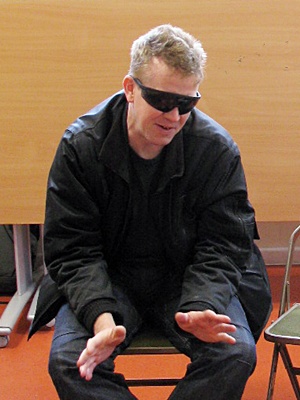
Man indoors sitting with sunglasses on

I was born with congenital aniridia (sporadic) and nystagmus. At school I struggled and was regarded as being dyslexic. Then after leaving school and going to college I was told that I was not dyslexic.
I could not understand why this was, but I have always regarded my situation, more as a challenge than a problem. So I just carried on as normal.

But when I went to a different collage, I was told that I was not dyslexic, but I had dyslexic tendencies and I did not hear words properly. I found this confusing, but just ignored it and carried on.

After years of living with my condition and never meeting any one with my condition, I decided to go to the Aniridia Network UK 2011 Annual General Meeting, more as a social event than anything.

One of the guest speakers was Doris-Eva Bamiou. Who gave a talk on CAPD (Central Audible Processing Disorder). As I listened to the talk, I found myself ticking boxes. I started to think that she could have been talking about me. So after the talk, I got the chance to talk to her personally. After a short talk she said that it sounded like I had CAPD, but I would have to contact my GP and get a referral.

So when I get home I contacted my GP as soon as I could. My GP referred me and within a month I was diagnosed as having CAPD.

The more that I think about it now, the more that things in my life make scenes. I have always struggled to communicate and take things in when I am in a noise environment. Thinking about it most of my problems at school and college, that I had put down to my sight or dyslexia, are in fact CAPD.

I wasn’t sure what could be done as I am 41 now. But I had an appointment at the hospital at the beginning of July.

It went ok. We talked about my condition and that as my brain is fully developed – there is nothing that can be done to correct it. But there are techniques that i can use to limit the condition:

  • manly avoiding conversations in noisy places
  • asking people to speak directly to me face to face, not at the side so that I can see their face and apparently lip reading helps.
  • also trying to have discussions in rooms that have carpet, soft furnishings and curtains helps.

By Andrew

Posted in Patients' tales | Tagged | 1 Comment

Protected: Mary’s annual mobility training

This content is password-protected. To view it, please enter the password below.

Posted in Patients' tales | Tagged | Enter your password to view comments.

Thoughts on the Special Educational Needs & Disability Green paper

I (Laura) recently attended parent consultation meetings run by NBCS/RNIB on the Government’s reform proposals in the Special Educational Needs & Disability (SEND) Green paper.

It leaves a lot to be desired!! I have to stress that this is not definitely going to become law, and much of the conclusions drawn from it are based on supposition on the part of concerned groups rather than hard fact. Let’s just hope the government does one of it’s now famous ‘u-turns’ on this subject!!

RNIB/NBCS wrote to lots of parents inviting us to a consultation afternoon regarding the SEND Green Paper. One of the big concerns relating to visually impaired (VI) children is that under the paper’s proposals, School Action and School Action Plus will be abolished. Only children who currently have statements will be assessed for help under a whole new plan which will encompass health, education, and social welfare of disabled children. There is also a clause which states that all school’s staff should have the expertise to deal with any disability, which puts qualified teachers of the visually impaired (QTVI) at risk, and an unrealistic burden on school staff to be able to expertly teach children with all disabilities. The RNIB feel this is not well thought out. After all, QTVIs have a 2 year course on top of their teacher training just in teaching VI children. Are the Government suggesting that every teacher becomes proficient in Braille and British Sign Language?

Certain areas of the country – like Leeds and Sheffield –do not statement partially sighted and blind children unless they have additional disabilities. This would leave most children with aniridia liable to fall through the cracks in the new system. Only those with statements will get the new ‘personal budgets’ – the rest will have to rely on adaptation made by the school, with no extra money.

Parents are also going to be given more ‘power’ through the new personal budgets. The way it would work, is that each child would be allocated a budget every year. Parents would be responsible for spending it any way they see fit. It would involve not only hours and hours of work, (and possibly a degree in accountancy!), but parents would have to find services themselves. For example, currently, children with disabilities not attending their local school, get free taxis to school. Under the new system, there is a suggestion that parents might have to:

  • ring round taxi companies to find the cheapest deal
  • pay the bills themselves
  • and keep receipts, to claim the money back.

Extend this to every single aspect of your child’s care, and parents would have a practically full time job just making arrangements and doing the paperwork. Also, if your budget runs out, (if, for example, your child needs an expensive piece of equipment such as CCTV),  and there is no money left to pay your child’s teaching assistant? Parents were very concerned that they would have to make almost impossible choices like this.

The one group of young people likely to benefit from the new proposals are the 16-25 age group, who are hardly catered for at all under current arrangements. The paper made proposals that go right through from birth to 25, with budgeting for tertiary education, etc.

Basically, although the Green Paper itself is extremely vague, it seemed to bring up far more worries than it solved. RNIB/NBCS wanted to form an official response to the Green Paper. Parents had a lot to say, as you can imagine!! Speaking to parents of children with other disabilities (not as part of this meeting, but personal acquaintances from elsewhere) showed that other charities are very unhappy too. The RNID and a charity for autistic children have their concerns, and may well be sending formal responses too.

The RNIB have published their draf their response to the paper. It highlights a lot of the worries expressed by parents/teachers at the meeting. Also at the link above you can use their template as the basis for submitting your own response to the SEND Green paper – the deadline in 30 June 2011.

Posted in Parents' accounts | Tagged , | Leave a comment

Returning to Moorfields for testing time

I just went for an appointment at Moorfields Eye Hospital for the first time in 15 years.

When I became an adult and left London for university, Moorfields said I didn’t need to keep coming to them. Instead I could just go to normal opticians to check my pressures each year. Since my sight has always been stable that’s been fine.

But I got a referral from my GP to get genetic testing. My medical notes contain no detailed results of the genetic testing that was done on me as a child in 1980. In fact there’s a stark inaccuracy that ‘perhaps 40% of any children would have aniridia’. We now know it’s 50%. Genetics has of course come a very long way since then so I felt it was time to understand my particular case better. Plus if I get a PAX6 mutation confirmed, I can go to the USA to take part in the NIH study – a good basis for a holiday!

So at 8:30am I was first in the waiting area. First a nurse did an initial sight test, checked blood sugar and pressure.

After a short wait a doctor performed the usual eye examinations, checked pressures, peripheral vision and took a complete family history. He also tested me for colour blindness, The spotty numbers were very difficult to see but he didn’t remark on it later.

Image of James's retina (taken 2003)

Next was a trip to the Laser Suite. A gadget shone lots of coloured wavey lines in to my eyes to map my retina. There was a very bright square too which was very uncomfortable and made my eyes water. The person doing it remarked that it would have been better if they hadn’t just put drops in my eyes!

Then it was back to the doctor and his consultant to review. They were very nice and were happy to organise genetic testing. In additon they said from now on I could have annual checks at Moorfields instead of at opticians. I’m very glad about that as I’ll be seen by more experienced people with better equipment and build up a consistent case history.

They sent me to have a photo taken. This was the worst bit of the day for someone with photophobia. The camera was really close and then a massive flash went off! Three times in each eye! That was horrible. I had a headache now from all the brightness and handling.

Next a genetic counsellor explained the testing consent form to me so I could sign it. Then I went up stairs for a blood sample to be taken. The results will take between two and six months to come back.

I left at 11:45 having signed with trepidation up for more at the same time next year!

Posted in Patients' tales | Tagged , | 1 Comment

Seminar about unlicensed treatments such as melatonin

Following our recent posts about melatonin we have news of a upcoming event about unlicensed and off-label treatments – which melatonin is,

Patients Involved in NICE (PIN) in collaboration with RNIB, will be holding a seminar looking at the impact using unlicensed treatment has on: patient safety, the current regulatory system and the development of licensed alternatives and innovative new treatments.

9.30am – 4pm on Thursday 23rd June at the Wellcome Collection in London. Anyone interested in attending should contact Andy Pike, andy.pike@rnib.org.uk. Please also let us know if you plan to go as we are not sure whether we’ll be able to send someone so you could be our representative.


Posted in Medical staff talking, Other agencies | Leave a comment

Trying to obtain melatonin

During my visit to the National Institute For Health (NIH) in 2009 to participate in the WAGR/11p Deletion Syndrome research, one of the findings was that I had a smaller than average pineal gland.

The NIH research and previous studies are discovering a possible link between the PAX6 gene and the development of the brain. It is thought that people with aniridia may have smaller or completely absent pineal gland.

The gland is responsible for producing a hormone called melatonin. Therefore people with aniridia who have been found to have a smaller than average, or no pineal gland may have lack of melatonin.  Melatonin is the hormone that regulates sleep. So people with aniridia may have problems sleeping.

The researchers at the NIH are recommending people who have been found to have a small or no pineal gland to take melatonin supplements to improve their quality of sleep and regulate their sleep patterns better.

This is absolutely fine for people living in the USA, where melatonin is readily available over the counter. However, in the UK it is not so easy. Here, melatonin is not a licensed drug, and it is usually only give to people over the age of 50. It has to be prescribed by a consultant neurologist. However even getting a referral to neurologist can be extremely difficult!

When I returned from my visit to the NIH, I made an appointment with my GP to talk over the test results, including the MRI scan showing I had a small pineal gland. I asked her to refer me to a neurologist who could prescribe me melatonin. She looked in her book, to see what she needed to do, and wrote a letter asking for advice from a neurologist at the local hospital.

Although I don’t have huge problems with my sleep patterns, there is definitely room for improvement, and I was curious to find out how, if at all, melatonin supplements could help me. I had read on the WAGR Yahoo mailing list, stories of how melatonin had given children with WAGR/11p Deletion Syndrome a better quality of sleep. Parents have reported that since their child has started taking melatonin, they

  • (stay) asleep for longer
  • wake up more refreshed
  • are less tired during the day.

Some of the issues I have are that: I do not feel sleepy at night, then find hard to ‘switch off’ to and fall asleep. I can easily be working on my laptop until the early hours of the morning without feeling the need to go to bed. I have to have some background noise to fall asleep to too. Usually I put on an audio book or a music CD. Once I have fallen asleep, stay asleep and don’t wake up unless I need the toilet. When I am working, I wake up when my alarm goes off at 7:30. If it is not a working day, then I can stay asleep until about 10 or 11. I usually get easily tired during the day, and sometimes can get so over-tired that I become ill with migraines. So I was keen to see if melatonin could help with these issues.

In summer 2010, a friend whose daughter has aniridia gave me some left over tablets of melatonin to try. I found that they did in fact make a noticeable difference. I was able to fall asleep more easily and I actually felt sleepy. They also made me feel more wide awake in the mornings. After these tablets ran out, I desperately wanted to get a prescription because i knew they actually were a benefit to me.

The neurologist that the GP had written to, said he couldn’t help me. So next I approached my ophthalmologist to ask him if he could refer me to a neurologist. He was very understanding and happily agreed to ask for a referral, even though he had not heard of the research into aniridia and the pineal gland. However, the neurologist he wrote to turned out to be the same neurologist that the GP had written to previously!

The neurologist, wrote another letter saying that he couldn’t help, but this time, suggested another that might. So my GP, made me an appointment with this second neurologist, who has an interest in sleep problems.

I had that appointment in April, and found it incredibly helpful. Not only did the neurologist agree to recommend the GP give me a prescription for melatonin, he was very interested and said he would write to an expert for more advice. I thought the appointment would be a one off, but I have a follow up appointment for October. In the appointment, the neurologist, asked me questions about my sleeping habits and did a survey. He said that he did not want to examine me then, but would in October. We chatted about what dosage of melatonin would suit me best, and agreed that 4mg would be most effective for me personally. It was a very informal meeting and I felt very relaxed and comfortable. I even admitted that I had been sent melatonin from a friend in America.

A few weeks after my appointment, my GP sent me a letter with a melatonin prescription enclosed.

Ed: Have aniridia and want/use melatonin? Comment below or write a post of your own to tell your story.

Posted in Patients' tales | Tagged , , , | 1 Comment