Do anyone’s eyes with aniridia have difficulty looking side ways?

Dr Joan Han, a physician at the National Institutes of Health in Bethesda, Maryland, USA, who is researching aniridia and WAGR/11p deletion syndrome has a question for you:

Do the eyes of anyone with aniridia not move fully to the side when looking side ways?

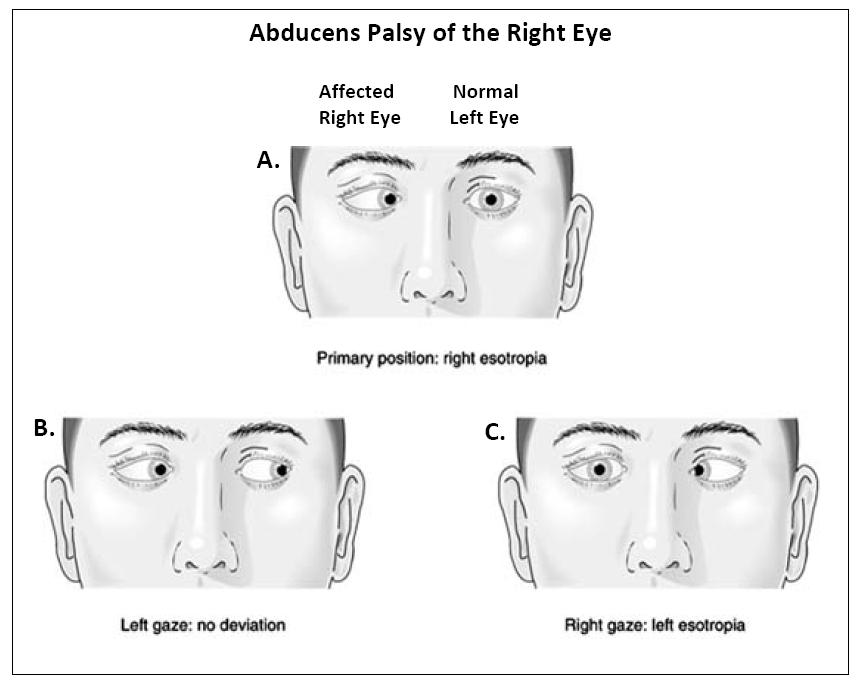
This picture shows what she means.

Pictures of pairs of eyes in various positions

Symptoms of abducens palsy

The symptoms to look for are

  1. When looking straight forward one eye tends to turn in toward the nose. This causes mild double vision.
  2. Normal appearance when the affected eye has to look toward the nose and the healthy eye is looking outwards (away from the nose);
  3. When looking in the other direction and the affected eye has to look outwards (away from the nose) it gets stuck in the middle while the other healthy eye turns in towards the nose. This causes severe double vision.

Note this is different to nystagmus where the eyes move involuntarily and strabismus where the eyes cannot align to look in the same direction.

Dr Han says “We are trying to study abducens palsy – that’s a defect in the nerve that controls outward gaze of the eyes. This can happen with just one eye or with both eyes.”

“We’ve observed inability of one or both eyes to gaze all the way to the outside side of the eye in some people with WAGR syndrome, but not in people with isolated aniridia thus far. But I think this might because we haven’t seen that many people with isolated aniridia.”

If you or your child has aniridia but not WAGR/11p deletion syndrome as well, and you think there might be a problems gazing sideways, please contact Dr Han by email hanjo@mail.nih.gov 

Posted in National Institute for Health WAGR study, Research | Tagged | Leave a comment

Melatonin and sleep

Katie has recorded some points about melatonin, a supplement which some people with aniridia and other conditions use to aid their sleep.

Note: Katie referred to the pituitary gland when she meant the pineal gland.

Jenny has previously told her story about trying to obtain melatonin in the UK.

As an update Jenny says “It’s hard to find the right dosage balance – I know this from personal experience and from parents of children with WAGR/11p deletion syndrom (they didn’t find it effective at first, until they tweaked the dosage, and some had to lower it).”

“I find 3mg isn’t enough and 5mg is too much. That’s with melatonin obtained from America. So the neurologist I saw suggested taking 2x 2mg. That’s why I take circardine mainly because it does come in 2mg doses in is slow release.”

Posted in Patients' tales | Tagged , | Leave a comment

Dear David Cameron: What life is really like with aniridia and on benefits

Today government plans for the biggest shake-up of the welfare system for decades come in to force. Hundreds of thousands of households across the UK will be affected by the changes to benefits.

An article in the Mirror last autumn featured Terri, one of our members. It was published on the day Prime Minister David Cameron told his party conference and the nation he planned to make more ­cuts. Terri told how for her benefits are essential and  should not be reduced.

Terri is 50 years old and registered blind due to aniridia and glaucoma. She lives with her three daughters ranging from 20 to 16 years old in Lancashire. In the article she says:

“This Government seems to think the longer you’re blind the less help and support you need. It isn’t true. There is no more money to take from us – nothing left to give.”

I was born severely sight-impaired but in my 30s, when I had children, it deteriorated even more.

To me, your Government does not understand disability. I rely on my disability living ­allowance of £105.90 a week to get by, but more than half of that goes on paid ­assistance, where a carer comes round for 12 hours every week.

Once they discovered a jam jar full of fly eggs where my daughters hadn’t resealed it properly – I would never have noticed.

Can you imagine what it would have been like if I’d eaten them?

I have to spend a lot of money on washing powder because I’m more likely to get my clothes dirty. It also means it’s costing more in terms of electricity and wear and tear on the washing machine itself.

The bus stop is five minutes away, which might not sound very far, but when you’re carrying heavy ­shopping and using a cane, using a taxi is the only option. That can be as much as £24 a week.

I don’t go out, I don’t drink, I don’t have money for treats or anything special and I can’t really cook meals from scratch, so I rely on ready meals, which makes shopping more expensive. My weekly food bill can be as much as £120 a week.

I don’t need anything else to make me feel like a second class citizen, I already do. But any changes to DLA will make life untenable.

I fear for my three daughters’ future. There’s already a school of thought that suggests those on benefits don’t deserve them and don’t want to work. This simply isn’t true. Ask any disabled person and most will tell you they’d love to work if only they could.

I’m also a single parent, which brings its own stigma.

There’s a belief that the children of those on benefits will grow up on them too. Again, that’s not true.

Please don’t make any more cuts. The impact they have makes people more vulnerable and I fear for what will happen if more is taken from those who desperately need it.”

Posted in Patients' tales | Tagged | Leave a comment

Protected: Jenny’s career – Part 4: Preparing for work

This content is password-protected. To view it, please enter the password below.

Posted in Patients' tales | Tagged , , , , | Enter your password to view comments.

Answer the Impact of nystagmus questionnaire

83% of people with aniridia also have nystagmus (‘wobbly eyes’). It is a factor in how much vision these people have.

Here is an opportunity to contribute to research in to nystagmus.

Nystagmus affects quality of life in all sorts of ways, but no-one has ever measured its impact before. A researcher at University of Leicester is doing just that with a quality of life questionnaire that is specific to nystagmus.

If you’re over 16, have nystagmus (with or without aniridia too) and you live in the UK you can help by answering the  questionnaire. It has to be done on paper and will take about 30 minutes to complete.

To get the questionnaire, email Rebecca McLean rjm19@le.ac.uk with your postal address and saying you would like to take part in the nystagmus quality of life research. She will then post you the survey, consent form and information explaining the project.

For more about nystagmus visit the Nystagmus Network.

Posted in Research | Tagged , , , | Leave a comment

Claire in the Chronicle

News paper article with large photo of Claire

Article about Claire in the North East Evening Chronicle

To promote the North East England aniridia meet-up in February that I organised, I got myself interviewed by the local newspaper.

Here is a scan of the article. Click on the image to view it full size and then zoom in your browser as necessary.

Sorry there is not a text version of the piece – unless someone volunteers to type one – please?!

Organise a meet-up in your area

If you want to meet more people near you who are affected by aniridia, how about arranging an event to do so? It is easy to do and Aniridia Network UK will help with the publicity. Contact communications@aniridia.org.uk with your ideas.

Posted in Patients' tales | Tagged , | Leave a comment

Personal recordings for Rare Disease Day

To celebrate Rare Disease Day we encouraged people to each answer 5 questions about their rare condition and how they feel about it:

  1. Which rare disease do you/your family member/friend have?
  2. How does it affect you and/or them?
  3. Have you met other people affected by the same rare disease?
  4. Have you had a positive experience with the medical profession regarding your rare disease?
  5. How do you think the lives of people with rare diseases could be improved?

Listen to the answers of those affected by aniridia

You can add your thoughts to these in text in the comments below or by recording your own on Audioboo.

Rare Disease Day

Rare Disease Day. It’s an annual international initiative to raise awareness amongst the general public and decision-makers about conditions like aniridia and their impact on people’s lives. By going along people not only enjoyed themselves but also help generate publicity for the day. Find out more at the Rare Disease Day website and follow it on Facebook.

Posted in Patients' tales | Tagged , , | Leave a comment

A parent’s experience of our befriending scheme

To mark Rare Disease Day 2013 we have a story of just how incredibly helpful it is to bring people affected by a rare disease together.

A parent contacted our befriending scheme last November. She has two children, the youngest being two years old with sporadic aniridia and nystagmus. She was anxious about her daughter’s future and was initially put in contact with a young woman with aniridia who is 23 years old. From the quote below you can see that this proved to be very helpful.

“I wanted a contact who had aniridia as I felt that we had been given lots of information but were missing the personal aspect of living with the condition.  My buddy was very open and honest and it was very helpful to talk to her.  She was able to explain a lot about the condition that had either gone over our heads or we were unable to take on board.

We had been in denial that our daughter’s eyesight could be a problem as she was doing so well.  My buddy explained how my daughter’s eyesight might deteriorate as she got older in a real and understandable way. She was able to answer the question that other professionals had been unable to explain to us.  I think at the time of diagnosis we had been emotionally unable to take on board all the possible secondary complications. 

We rarely saw our daughter’s consultant and when we did there was not enough time to process what he said in order to ask more questions.  These questions were forgotten about by the next appointment six months later. 

After speaking to my buddy, we spent a couple of weeks feeling like we were back at the initial stages of her diagnosis again with all the uncomfortable feelings this brings.  However, we now feel that we have worked through this and we can support our daughter more effectively and realistically. 

I also had a session with my daughter’s vision teacher who went through information on a website about aniridia; helping me to form questions to ask my daughter’s consultant next time we saw him.

Talking to my buddy has moved me out of denial into a place where I am more realistically able to support my daughter and find relevant services.  Generally finding out more about the condition has enabled me to find a route to get my daughter an MRI scan to see if any other areas of the brain are affected which in turn will enable us to access relevant support earlier.

Apart from my buddy’s general positive attitude to life she was able to discuss with me what she had found helpful and supportive from both a parental and educational point of view.  I have tried to adopt a ‘can do’ approach with my daughter so if she comes up against a barrier she won’t just stop but find another way around. My buddy has given me other ideas of how we can do this.  I have never believed that daughter would live anything other than a normal life but it would perhaps be slightly harder for her.  My buddy has shown me the realism behind this belief.

We have also found out about research into aniridia. The lady spearheading it had some helpful insights and knowing more about our daughter’s future, enabled us to face up to how vital and underfunded research is into the condition.  By sharing this with our families they have supported this research by asking people for donations rather than flowers at my granddad’s funeral. ”

We have now also put this parent in touch with another family who have a child slightly older than her daughter.

If you would find having a buddy useful, find out about our befriending scheme.

Posted in Parents' accounts | Tagged , , | 1 Comment

Meet-up in Newcastle 24 February 2013

People in North East England affected by aniridia came together in on Sunday 24 February for lunch and chat and fun. The lunchtime meet-up was in Zizzi in Metrocentre, Newcastle

Partners, family and friends of people affected by aniridia were all welcome . Everyone’s thanks goes to two of our members with aniridia, Claire and Beth  for organising the afternoon.

To promote the event in advance, Claire was interview by RNIB Insight Radio.

Afterwards Claire said “We had 8 people at the meal which everyone enjoyed. It was a good learning curve and we can use it to make any future North East events better.”

Rare Disease Day

We are organised the meet-ups at this time to mark Rare Disease Day. It’s an annual international initiative to raise awareness amongst the general public and decision-makers about conditions like aniridia and their impact on people’s lives. By going along people not only enjoyed themselves but also help generate publicity for the day. Find out more at the Rare Disease Day website and follow it on Facebook.

Organise a meet-up in your area

If you want to meet more people near you who are affected by aniridia, how about arranging an event to do so? It is easy to do and we’ll help with the publicity. Contact communications@aniridia.org.uk with your ideas.

Posted in Aniridia Network news, Parents' accounts, Patients' tales | Tagged , | Leave a comment

Going to a work place party 2

After the success of last years’ staff social, the senior management team at my workplace decided they would hold another event this year.

It was planned to be held in the same place, in a local hotel. Tickets were free and unlike last year quickly ran out. A lot more people decided to come, because they heard how great an evening it was!

So on Friday evening, I fed my guide dog Jaynie extra early – which she seemed very happy about – and got changed ready to be picked up by my friend Charlotte. I wore a denim dress, a black short-sleeved top under the dress, with a gold cardigan over the top of the dress and black tights and gold shoes, and gold jewellery. Perhaps in hindsight I shouldn’t have worn black tights, but thankfully Jaynie didn’t get too close, so it wasn’t too much of an issue!

When we arrived, we put our tickets in a big box, to have a chance in a prize draw. Then we got a glass of champagne. Charlotte guided me over to a wall away from the main group of people in the centre of the room, so we could hear each other  give more room to sip our bubbly!

When I was trying to follow Charlotte through the crowded room, two women reached out and stroked Jaynie, and I told them off (very politely of course). I remarked to Charlotte that at a school and college for the visually impaired, you would think they would know better than not to touch Jaynie when in harness! Later though, I discovered who the two women were, I work with them on a very regular basis and they are always cuddling and fussing Jaynie. They were apparently very embarrassed and ashamed, and were worried they had upset me. I was worried I’d had upset them and had maybe come across a bit rude by accident. I think it was partly my fault, because I am aware I haven’t always been as strict with them in past about Jaynie as I could have, and probably should have been. Hopefully we can chat about it next time I see them, or just put it behind us.

It was extremely noisy in the reception room, and later when having the meal, with lots and lots of people talking excitedly. The disco after the meal, meant it got even noisier. Jaynie thankfully didn’t seem at all phased by all the noise, but then again, she is used to rowdy students as when I first got her I was studying at university! I found it very hard to hear what others were saying to me, and again, like last year, felt very aware of the fact that I have an auditory processing disorder. At one point one lady said to me “Jaynie is a good girl” and I said “Yes, she’s around 31kg”, as I thought she said “Jaynie’s a big girl”! Charlotte was laughing in amusement and told me what was actually said.

I was a little anxious about the meal, as I was on the same table as the Chief Executive. So I was a bit apprehensive and thought I definitely needed to be on my best behaviour and try to eat as nicely as possible. When we sat down at our allocated seats, I discovered that the dance-floor was directly opposite me and there were bright flashing lights right directly in my line of vision. I remembered from last time that the lights were on all the time, even during the meal. At first I tried to tolerate them, but then they seemed to get brighter, so I thought I could put my sunglasses on as I had them in my pocket. However, Charlotte helped me to move round the table so we were sat with our backs to the dance-floor and the lights, so that was much, much better.

The disco was good. I did a little bit of dancing, but the dance-floor was tiny and it was very crowded, so most of the time I remained sitting down at a table.

I wasn’t really bothered about trying to socialise too much because it was just so difficult with the noise levels, especially when the music started. However, it was really lovely because some people came to my table and sat down next to me for a good chat. One of these people asked me if there was anyone I wanted to go and talk to. At that point I couldn’t think of anyone, so she took me over to her table and introduced me to someone that worked in the same department as her. It was very interesting to talk to this person, as I hadn’t met them before, and I discovered they had been working at the school and college when I was a pupil. We had a very long chat about various different things.

I was amazed when I won a prize in the raffle – a bottle of bubbly. Apparently they were only allowed to hand out vouchers this year, because last year many people started drinking their prizes before they had even left the hotel and got into trouble. The problem is, in my exhausted state when I got home, I placed the voucher somewhere and now can’t find it anywhere! Better have a hunt around so I can go and collect the prize.

Over-all another fantastic, very enjoyable evening. I would probably say it was a little better than last year even, because I was able to talk to more people.

Posted in Patients' tales | Tagged , , | 1 Comment