Ben gets job with Dolphin

Ben who has aniridia has got a job with Dolphin Computer Access a company providing assistive technology including the popular SuperNova screen reading software. He will be a Technical Support Apprentice.

Ben says “This is a whole new challenge. I’ll be providing admin support, installing and configuring hardware and software, assisting with product testing and providing email and telephone support to customers. I’m actually going to be paid to do something which really interests me, which is what we all want.”

Read the full article where Ben says goodbye to Royal National College for the Blind where he has studied and worked until now.

We hope the job goes well for Ben and hope he’ll tell us what its like.

Got a story to tell about your career that others would benefit from hearing? Contact us

Posted in Patients' tales | Tagged , | Leave a comment

Heather’s story of an American in London

Nystagmus Network logoRead the first part of this article by Heather written for the Nystagmus Network and published in the 100th edition of their newsletter Focus in October 2013.

When my company relocated me to London in 2011 to start their European technical support office I was very excited but nervous. I’ve never been afraid to move somewhere new where I don’t know anyone, but having never been overseas before, moving to another country was a bit intimidating. Initially I focused on the main logistics, such as finding a flat and working out the timing for the move. My company put me in touch with other employees who had or were relocating to answer question and make recommendations. A few weeks into the planning process I realised I had questions that my colleagues couldn’t answer effectively because they were around being visually impaired.

Previously I had joined a mailing list related to aniridia to learn more about my condition. I decided to post on the list to see if anyone had or lived in London and would be willing to help. I immediately got a positive response from James at Aniridia Network UK. He not only volunteered to answer any questions on e-mail but also meet and help me in person once I moved over. I’m extremely thankful for the help that James provided me. Although being visually impaired provided me additional challenges and considerations when relocating, it also provided me access to a local friend and support group that I wouldn’t have had otherwise.

Aniridia Network UK and conferences

I am a shy person and have never before joined a group for people with a visual impairment, so I’ve never had the chance to share experiences and meet people similar to me. James not only helped me with my move but got me involved in Aniridia Network UK (ANUK). I was able to make friends that have aniridia, nystagmus and other conditions that I have. It is very comfortable to interact with them because if I have an issue with something due to my vision, such as not being able to read the menu or a sign, they will likely have the same problem. With already being the new person and the outsider because of being American, it was nice to meet people and not worry as much about issues with my visual impairment. The organisation has also helped me learn a great deal about not just aniridia but my related conditions.

After being a member of ANUK for six months they recruited me as a volunteer and since then I have been their conference coordinator. I was responsible for their 2012 and 2013 annual conferences. It has been extremely rewarding to put effort into a charity that means something to me personally. I had no experience in organising a large event when I started and have learned a tremendous amount. Additionally, I have had the opportunity to work in depth with ANUK members and medical professionals that I would not otherwise have been able to work with. The work in the months leading up to the conference can be very time intensive but the positive feedback from those that attend make it all worth it.

James and the other members of ANUK have made me more comfortable with talking about and exposing my visual impairment. When I am regularly surrounded by fully sighted people it is easy to feel like the outsider even though there are a lot of people going through the same things as me. Through Aniridia Network UK I connected with Nystagmus Network (NN) which provides similar support for people with nystagmus. Prior to joining ANUK I don’t think I would have been able to share my experiences with NN.

Life with a visual impairment

My visual impairment has been both a disadvantage and an advantage. Most days no one notices that I’m visually impaired. Some of my friends don’t know about it, not because I’m embarrassed to mention it, but because it has never come up in conversation or been relevant. Because I’m accustomed to being visually impaired, most the time it is only a minimal consideration. For example, while on a trip to Switzerland the biggest problem it caused was I had to buy a new pair of sunglasses because I lost mine and the sun is too bright when hiking in the Alps for me to not have them. During the trip my travel companion actually relied on me to get us around more than I did her. There are times in everyday life that it can cause unexpected trouble though. For example, when I’m in a dimly lit restaurant when a menu is in tiny print it can be very difficult for me to read the menu. Normally I look-up menus in advance for this reason, but when I don’t know in advance I’m going to a restaurant I can’t do this.

What I’ve learned is rather than hiding my visual impairment and trying to be “normal” I have to embrace it and use it to my advantage. I have skills that I probably wouldn’t have without it. There are opportunities available to me exclusively because of it. Overall I am a stronger person because I am visually impaired and accustomed to challenges, which has helped me generally throughout life. It is only as much of a hindrance as I let it be.

Posted in Patients' tales | Tagged | 1 Comment

Heather’s story of growing up with aniridia in the USA

Photo of Heather

Heather

My name is Heather and I am a 29 year old American. I work as a solutions analyst at a software company completing special projects for our Chief Technology Officer. In 2011 my company transferred me from the USA to London to start their European technical support office. I have congenital aniridia, nystagmus and cataracts. In addition, both my eyes have had glaucoma since I was 13 years old. The visual impairment that has resulted from these conditions affects my life every day but not always in a negative way

Despite the number of eye conditions that I’ve had since birth and the glaucoma I developed as a child, I’m very fortunate to have fairly good sight, that has not degraded significantly over the years, and that has not yet required surgery. It wasn’t until I was an adult that I started to realise how the different conditions affected my sight and started to learn more about each one.

I am farsighted and have worn glasses since a child. I can’t read small print or print far away. My aniridia (having no iris) makes me sensitive to light. The conditions impact my depth perception and ability to focus. I have a null point directly in front of me due to my nystagmus that makes it much easier to read things that are in front of me rather than off to the side.

My mother and brother both have the same conditions, which have progressed differently for all of us. Semi-annual or more frequent visits to have my eyes checked have been a part of my life for as long as I can remember.

Who needs to drive

It was a unique experience growing up with a mum that did not drive, especially in America. My father passed away when I was young and we always lived in a very car oriented part of the country that did not have good public transportation, so getting to places was always a challenge. In many ways it was beneficial for me to be exposed to this challenge early on. Because transportation via car was not readily available I learned how to walk to the supermarket and other places or to take the bus when needing to go somewhere. We did rely on family and friends sometimes but in our daily lives we managed without help.

I grew up knowing that not being able to drive, although a challenge, did not have to control my life.  It is possible to live most places and still manage on your own as long as you’re willing to use alternatives. When I’ve lived in or visited larger cities, such as London or Washington D.C., where walking or using public transportation is the norm rather than the alternative, I have been initially very comfortable whereas people who are used to using a car have struggled to adjust.

Education

I went to a mainstream school throughout my education. The biggest challenge was always seeing the black board. Although my teachers were always told that I couldn’t see the black board they would often forget to ensure I had a paper copy of the notes or to say what they were writing. This made it difficult to learn from a lecture because I would have incomplete information that didn’t completely make sense until I could copy the notes from a friend.

Over the years I adjusted to learning without being able to see the black board. Instead of using lectures to understand the subject, I’d read the materials carefully and ensure I understood what I was reading. Generally this practice has worked very well for me as long as there is printed material to use. I sometimes struggle when learning concepts that I can’t read about and have to learn from someone teaching me though.

Printed material provided its own challenge. Usually school materials were provided in a size I could read. As I got older the amount of material I had to read got larger which was challenging at times. It wasn’t until recently that I realised my nystagmus was probably a large contributor to this because of the effort to focus for long periods of time. During university I used a CCTV to enlarge the text of textbooks so I could read for long periods of time more easily. My Kindle provides me the same benefit now when reading for pleasure.

Employment

It is undeniable that being visually impaired has challenged me in obtaining employment and being employed. It has been advantageous as well. I work with technology which has helped with some of the challenges but presents its own.

When I was young I was able to take advantage of several programs designed to help the visually impaired gain job skills and experience. Before graduating from university I had several internships that I would have struggled to get or not have gotten if I wasn’t visually impaired. Additionally, I was able to take advantage of educational programs for the visually impaired to learn skills, such as typing and the use of computers, several years before my peers did.

I was educated about my rights for accommodations when I started looking for my first full time job and continue to be reminded of them, but knowing my rights and using them have not been the same thing. I’ve only worked for two companies for an extended period and outside of having the computer screen closer to me the only accommodation I’ve asked for is screen magnification software. I chose to wait until after I was hired to ask for the accommodation.

There was never an ideal time to bring the topic up during the hiring process and I wasn’t even sure who to bring the issue to. I ended up just bringing it to the person I was initially in contact with at the companies in the end. In both instances neither company had hired a visually impaired person before and had no knowledge of screen magnification software. They both relied on my knowledge to tell them what I needed and how to accomplish it. Both companies accommodated what I needed, but neither became proactive about ensuring it continued to meet my needs or that it was the best way to meet them. It is still awkward when I have to ask for a new version of the software or for it to be installed on a different machine because I never work with the same person.

I still face challenges on a daily basis at work due to my visual impairment though. Regularly I work with other employees at their computer and they expect me to be able to see and read what is on their screen. Often these are short or one off interactions so I don’t explain my impairment to each person. Instead, I have learned to be able to work and help them without being able to read what is on the screen. Asking them questions about what they see (rather than directly asking what is on the screen) has proved useful in addition to facilitating what we are doing. Having a laptop that I can bring with me to their computer has helped as well. I have to employ the same methods when on site with customers.

The technique I learned in school of understanding by reading rather than someone teaching me has proved a huge advantage at work. I am able to understand documentation and work out concepts on my own more easily. Additionally, being visually impaired has taught me to listen very closely to catch things I can’t see. Unintentionally I will memorise the order and placement of things on the computer because when helping other people I may not be able to fully see what they are doing and I have to rely on that knowledge to effectively help them.  These techniques have allowed me to excel at the work that I do.

Read part 2 of this story

This is the first part of an article by Heather written for the charity Nystagmus Network and published in the 100th edition of their newsletter Focus in October 2013.

Posted in Patients' tales | Tagged | 5 Comments

Walk through London at night raises £742 for aniridia research

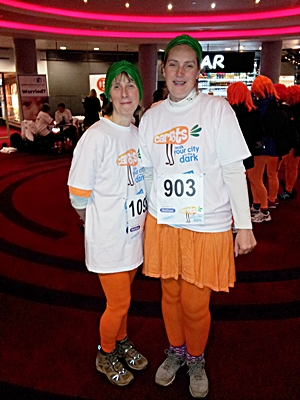
Sisters wearing their carrot themed costumes

Sarah and Lorna are ready to start walking

I’m a reasonably happy walker. Five miles or so can be very pleasant on a nice day. Also, I know people who’ve done the Moonwalk for breast cancer, who I didn’t think were necessarily much fitter than I was, at least with the right training.

On this basis I signed up for the Carrots NightWalk 2013 in London – oh and pulled my sister (willingly) into it too, we both have aniridia.

We scheduled training walks, in and around various parts of London and the home counties. We started at 5 miles and over four months worked our way up to 13 miles. We walked at a respectable pace, but we weren’t going to break any records.

We planned our costumes, which we would be able to walk in. It was harder than we thought to find bright orange clothes.

On 20 September we were ready. We were very lucky with the weather. The forecast was dry and clear with a light breeze. Not wanting to fall foul of night time temperatures we took on board the advice of layering our outfit. At the start it felt cool but not cold and we knew we’d warm up soon enough. After a rousing send off from Noel Thatcher at 11.00pm, we were off. The walk was over four legs:

  1. A civilised walk heading west along the north and south banks of the Thames and then up into Chelsea/Bayswater and Kensington.
  2. A wide tour of Kensington and Hyde Park.
  3. Back down towards the west end and the City.
  4. The City and then back along the south bank of the Thames.

The night was clear and the view along the river rewarded our hard work.

There were three check points on the route. At each point your number was taken and you were invited to have a drink, a snack and a sit down if needed. The snacks were various energy boosting bars and entries for the carrot cake competition – with votes being taken on the walkers’ favourite. At the first check point I decided that four layers including my Carrots NightWalk T-shirt were too much and shed two of them.

On the road we joined up with different groups and made a good pace.

We finished at 4.30am and received a cheery welcome back at the IMAX. We received our medals and goody bags, before being directed towards the refreshments and our breakfast.

Although we were tired at the end, I think it was a good night. We met some great people and it does remind you what a great city London is.

Best of all I raised nearly £500 for research into aniridia and my sister £242. This will go into a pot to be added by the fundraising efforts of other people (you??) until there is sufficient there to make a grant.

Will we be doing it again? As the stiff joints eased I think another Carrot NightWalk could be on the cards next year!

Posted in Aniridia Network news, Fundraising, Research | Tagged , | 1 Comment

£500 donation from 200 mile bike ride

Two adults with their bikesA huge thank you to parents Caryl and Tristan for a £500 donation resulting from taking part in a 200 mile charity bike ride from Caernarfon to Cork. It will make it possible for us to print leaflets for hospitals for people such as parents of toddlers like them affected by aniridia and WAGR as well as go towards next year’s ANUK conference. Thanks to everyone who took part and donated. Proceeds also went to Alder Hey Hospital where  daughter Mari is treated.

ANUK Conference 2013

Caryl and daughter Mari at the Aniridia Network UK Conference 2013

Keep rolling

What could you get sponsored for ANUK to do? If a collection, cake sale or car wash is more you thing then we would appreciate that too. Our fundraising target for this financial year 2013/14 is £3500 which we need to just keep going. Find out how to get involved.

Posted in Aniridia Network news, Fundraising | Tagged | Leave a comment

Review of 2013 Make a Miracle Conference and Social

By Veronica van Heyningen

The 2013 meeting of Aniridia Foundation International (AFI) was held in Charlottesville Virginia, USA, at the beginning of August.  Many of you may be beginning to take for granted the format of these meetings with patients and their families participating along with clinicians and research scientists, but I still find these gatherings very exciting and refreshing.  There is so much scope to learn from each other. 

For Ruth Ashery-Padan, a scientist from Tel-Aviv, Israel, this was her first experience of such a meeting and she thought it was wonderful for her own insights into how aniridia affects people and how they deal with the problems that arise. 

A meeting like this sets out to look at the problems from many different viewpoints and explore all the ways that patients and parents as well as different clinicians and scientists can devise to overcome the problems.

Most of the scientists like me were asked to arrive only for Day 3 of the meeting but I’ll cover the previous days here too..

Day 1

Day 1 focussed on talks from educational experts. They explored everything from early childhood, primary and secondary schooling and the transition to college education.  There were sessions ranging from how to deal with bullying to how to plan employment and careers.

Day 2

On Day 2 it was interesting to see that AFI has been expanding the contexts in which aniridia is studied.  In fact they have set out to study the condition in much broader detail. They have realised from their collective experience that the PAX6 mutation does not merely cause eye problems but may in some individuals also have effects on circadian rhythm (eg sleep disturbance) and on metabolism, possibly leading to weight problems and diabetes.  There may also be effects on brain development affecting other sensory systems (eg hearing).  Their aim is to study many of these possible features for what they have begun to call aniridia syndrome.

So from 6.45-9 am there was a blood sample collection from patient volunteers and their families for research purposes.  This was for genetic studies as well as the assessment of metabolic hormone levels.  I have published on several of these broader aspects of PAX6 from our work with aniridia patients and mice)

Next on Day 2 there were introductions to the scientific and clinical backgrounds related to these possible aniridia-associated problems.  I wish I had been there to hear these talks, but many aspects were reiterated on the following days when I was there, so I can tell you about those sessions.  With a complex topic like this, it is a good idea to tell the stories more than once, with different slants emphasized each time.

From mid-afternoon till dinner, there was a big clinic session to collect patient information on visual and other measurements.  The aim is to learn more about the broad and variable spectrum of the aniridia effects by relating the genetic and hormone information to the clinical features of participating patients.

Day 3

On the morning of Day 3, there were six talks for patients, mostly from clinicians, explaining some of the available therapies for cataract, keratopathies and retinal problems.

The first talk was from Peter Netland who is the ophthalmology chief associated with AFI and based at the University of Virginia Medical School and hospital system.  He outlined the ambition of AFI to expand its remit from just aniridia to congenital eye disorders more generally because they feel this would increase their influence and broaden their patient base.

  • Juan Alveraz de Toledo from Barcelona discussed current approaches to treating cataracts and dealing with keratopathy.
  •  John Freeman from Memphis Tennessee discussed the use of the artificial cornea, the Boston Kpro (=keratoprosthesis) in very severe cases of aniridia-associated corneal disease.
  •  Kristiana Neff from South Carolina described how artificial iris implants can be useful in some cases.
  •  Christopher Riemann from the world-renowned Cincinnati Eye Institute illustrated with amazing film records some of the heroic endoscope-based operations he undertakes to save as much vision as possible in very severe aniridia cases with retinal fibrosis.
  •  Scientist Melinda Duncan, from Delaware, also discussed her work to understand this aniridia fibrosis syndrome better using mouse models.

The afternoon of Day3 was devoted to scientific talks which were meant to be informative for all participants: patients, clinicians and other scientists.   This is always a tall order. 
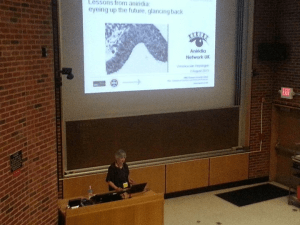
The slide on the big screen reads: Lessons from aniridia eyeing up the future: glancing back

Veronica presenting

The afternoon began with a lunch-time talk in which I was invited to review the many years of my lab’s work on aniridia – partly because of my recent retirement. Then we had more talks.

Robert Grainger, the local organiser and an eminent scientist who made major contributions to our understanding of lens and eye development, using the frog as his model system. With the advent of new genetic methods, he can now create mutations in the frog to mimic human eye abnormalities and then study them in more detail.  This adds to our repertoire of different model systems – my lab used mice and more recently zebrafish.  Different model systems are useful in different studies so it is exciting to have several different organisms to study.

Robert Chow from Victoria, Canada then presented his work in progress on novel levels of PAX6 regulation by micro-RNA molecules.  This could have long-term importance since most cases of aniridia are caused by having the wrong dosage of PAX6, so there could be therapies developed by modulating mechanisms regulating gene expression.

Ruth Ashery-Padan from Tel-Aviv talked next.  Ruth has worked on the developmental roles of PAX6, using mice, for many years.  She is a pioneer of a technique in which the mouse PAX6 gene, which is very very similar to human, is manipulated so that it can be turned off subsequently in different cell types.  So she has managed to turn off Pax6 in the developing retina, separately from the switch off in lens, or pancreas, or in very specific parts of the brain.  This is one very clever approach to dissecting the complex functions of this gene.  Ruth talked about the many different roles of PAX6 in the developing eye, which help to explain why so many different aspects of the eye have problems when one copy of PAX6 is not functioning correctly.

William Klein from the University of Texas, Houston then talked about other eye regulatory genes with key roles in retinal development.  As PAX6 is part of gene network with complex cross-regulations with other genes, it is important to understand how other eye regulators work in conjunction with each other.

James Lauderdale, Athens University of Georgia, gave an update on the PAX6 mutation studies that his group have carried out, interacting very closely with AFI members and Peter Netland.  Jim is supported extensively by the Sharon Stewart Trust originating in Canada.  Interestingly they have found loss of function mutations in almost all cases where a PAX6 mutation could be identified.  They have completed their studies in 68 families and found 51 PAX6 mutations.  Only 3 were found to lead to predicted longer PAX6 protein with the rest predicted to result in no protein being produced from the mutant copy of the gene.  This is exactly what we find for classical aniridia cases.  Jim’s group are also carrying out extensive wider “phenotype” studies in the AFI volunteer cohort – more about this later.

Next Elizabeth Simpson, from Vancouver, Canada, discussed her group’s efforts, again supported by the Sharon Stewart Trust, to develop gene therapy for aniridia patients.  They have been designing “DNA vectors” that can deliver the gene to the eye, initially to all cell types, but planning to refine expression only to various PAX6 expressing cell types.  All this work is done in mice at this stage.  Results are very preliminary.  Therapy needs to be delivered to very early post-natal eyes to have a therapeutic effect on eye size, for example.  There is a very long way to go before this type of therapy becomes available for human trial.  They hope to reduce the lead time by producing a monkey model of aniridia by creating specific PAX6 loss-of-function mutations in Rhesus macaque monkeys in collaboration with a major primate centre in the US.

Cheryl Gregory-Evans, also from Vancouver, discussed the development of the fovea which is the sensitive central part of the retina.  Foveal hypoplasia (under-development) is a key feature of the aniridia which means that the final achievable visual performance in aniridia patients is always less than normal.  We know surprisingly little about the development of this region of the retina and the usual model organisms are not useful as they do not have foveas.  It would obviously also be useful to have a monkey model to study for this work.

This conference was pretty intensive and hard working as emphasized by having a plenary lecture after dinner on Day 3.

Tom Glaser, who was one of the early workers on PAX6 and aniridia, talked about other hereditary eye malformations caused by defects in the retinoid, including Vitamin A pathways.  It has been recognised for a long time that adequate levels of Vitamin A are critically required for proper eye development.  It is not surprising therefore that mutations in proteins required for managing retinoid synthesis and turnover cause eye malformations.

Day 4

On the morning of Day 4, Many of the clinicians who spoke predominantly to the patients on the previous morning, now re-presented their work, sometimes with a different slant, to the scientists.  This would have been a useful revision session for the patients – a second chance to assimilate the complex details of surgical procedures and when they were most appropriate to use.

The lunchtime presentation on this day was from Jim Lauderdale and his team who described the complex laboratory and clinical studies that they had been conducting on AFI recruits to define their non-ophthalmic phenotype more clearly.  We heard that as predicted from mouse models, aniridia patients have somewhat elevated levels of glucose in their blood after meals than matched control cases.  This means that aniridia patients may have a greater predisposition to developing diabetes than normal controls.  Thus more detailed studies of the pancreatic and pituitary hormone systems will be explored in more detail.

The next presentation told us about the brain imaging and functional studies that they carried out on the volunteer patients and controls.  This followed on from the earlier papers that my colleague Sanjay Sisodiya had published with us about abnormal brain structure in aniridia cases. Now the Lauderdale team described their preliminary results from electroencephalography studies in 15 aniridics and 15 controls.  Small differences were observed in these brain functional studies, so that for example there seemed to be a slight delay in event-related potentials – the brain responses to stimulatory signals.  They are also planning functional MRI analysis and auditory signalling studies, which are potentially interesting and informative about understanding in minute detail the potential neurological differences between those with aniridia and control subjects.

After lunch on this final day, we heard from Cheryl and Kevin Gregory-Evans, Vancouver, about the development of a novel type of therapy using a particular type of antibiotic which can prevent premature stop codon mutations from terminating the protein too soon.  The drug causes the insertion of another aminoacid, more or less randomly (ie any aminoacid) at the stop site.  This can help increase the amount of protein made from the mutant gene copy.  Only a few patients carry the right sort of mutation for this to work, but it is an interesting approach.  The preliminary studies were carried out in mice and this scientist/ophthalmologist couple are ready to try the therapy in human patients with appropriate PAX6 mutations.  It is an approach that has being tried with some other premature stop codon mutations with other diseases, including cystic fibrosis.

Phillip Anthony Moore, a veterinary trained scientist from Athens Georgia talked about work in rodents to expand corneal limbal stem cells in culture for subsequent transplantation in therapeutic use.  There are of course other people doing this sort of important work as well.  Ultimately such trials need to be done with human cells and there are labs working towards this aim

For the rest of the afternoon we had talks about the possible role of PAX6 in obesity and diabetes.

For example Ruth Ashery-Padan discussed how PAX6 is required for correct pancreas development.  The numbers of normal pancreatic alpha, beta and delta cells producing insulin, glucagon and somatostatin seem to be decreased in Smalleye mice but there is an increase in ghrelin levels leading to increased desire for food intake.

The following two speakers were world famous local University of Virginia experts: Michael Thorner in the study of ghrelin and other endocrine regulators of obesity and Michael Menaker who over the past 50 years of research discovered the circadian pacemakers in mammals and other organisms.  Mammals have the major control machinery for resetting their daily clock in special retinal photoreceptors distinct from those used for visual function.  Circadian rhythms are critical in maintaining appetite control.  Clearly it is possible that some of these mechanisms may be perturbed in aniridia and other eye anomaly patients.

The role of light control and meal timing in regulation of total food intake and weight control were then discussed by Satchidananda Panda from the Salk Institute in a fascinating talk.  These talks were great, but did not study circadian functions or food intake in aniridia patients.

However, Joan Han, a paediatric endocrinology expert from the National Institutes of Health, Bethesda who gave the last talk, described some of her ongoing studies on hormones and metabolism in WAGR patients who have also been suggested to have a predisposition to obesity.

All of this evidence is fascinating, but very circumstantial at the moment about whether having aniridia does lead to a propensity for obesity through disturbed endocrine and circadian control.  Some of the direct studies with AFI volunteers that are just beginning with the blood samples and clinical details collected at the University of Virginia meeting may shed more light on this.

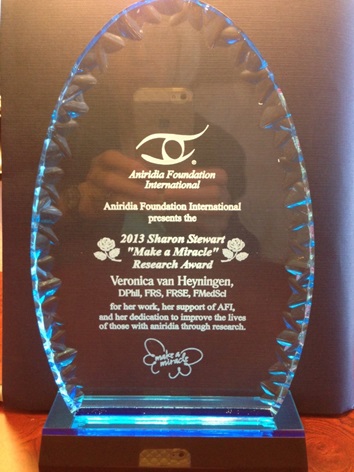
A vertical oval shaped piece of engraved glass on a wooden plinth

Veronica’s award

The meeting ended with a gala dinner where a number of prizes were presented by the very generous AFI President Jill Nerby.  Peter Netland, Christopher Riemann, Jim Lauderdale and Rob Grainger were among the recipients of these prizes for their fantastic contributions to clinical and research efforts.  They also most kindly presented me with an award for my long standing contributions to aniridia research.

Conclusions

It was a most interesting meeting.  AFI are set to explore aniridia in more detail than ever before and to place it into a wider context of congenital eye disease research. 

We may want to discuss at ANUK, although I am not advocating this sort of expansion for the UK organisation since our situation, with a much more organised National Health Service in a smaller country, is very different from that in the US. However, it is very clear, even just from the work in my lab, that there are biological and gene-based links between aniridia and some other eye disorders.

It will also be interesting to hear what ANUK members think about AFI’s very detailed and highly medicalised approach

We can discuss the implications of and what ANUK members wish to see happening here and in Europe.

Posted in Medical staff talking, Research | Tagged , , , , | Leave a comment

Collection at Catterick nets £419 for ANUK

Today Aniridia Network UK Fundraising Officer Liz and her relatives put on ANUK t-shirts and took collecting buckets to the Sunday market at Catterick Racecourse in Yorkshire. Shoppers give their change as they leave the market. The day was sunny and people were generous and £419 was raised. A great outcome and it was fun to do.

Do your bit

What don’t you raise money for ANUK? You could collect or if a sponsorship, cake sale or car wash is more you thing then we would appreciate that too. Our fundraising target for this financial year 2013/14 is £3500 which we need to just keep going. Find out how to get involved.

Posted in Aniridia Network news, Fundraising | Tagged , | Leave a comment

Raising kids is hard enough, so how do mothers with aniridia cope?

Teri

I was born severely sight impaired, so I’ve never really known any different. When I was a young woman in my twenties my condition was stable. I was pretty independent: I had a job, as a bank clerk, and a husband. I just got on with it – that’s what you do. And I’d grown up around people with vision impairments, so it all seemed fairly normal to me.

I always wanted children and knew that the chances were some of them would inherit the condition. But I’d never felt like I’d missed out on anything. I also had every confidence that I could bring up a child with my level of vision.

What I hadn’t bargained for was conceiving twins and a sudden deterioration of my sight during pregnancy.

This rest of this article can be read at it’s source: The Telegraph

Beth

In Newcastle Beth who has aniridia is guided around by her dog Annie and pulls baby Edwards behind her in a buggy. ITV Tyne Tees filmed her talking about getting about and being refused taxis.

Befriending

If you are a mum with aniridia, or have a child who does, and would like support, check out our befriending scheme.

Posted in Parents' accounts | Leave a comment

Cornea tattoos

Recent press and meeting reports  have described corneal tattooing as a potential solution for poor vision caused by injuries to or disease of the iris, up to and including total aniridia.

It is probably important to realise at the start that corneal tattooing is used for people with traumatic aniridia caused by injury to a previously healthy eye. It is not currently suitable for people with genetic aniridia.

Corneal tattooing for cosmetic purposes has been practised for nearly 2000 years, using the traditional method of needles and ink. Not surprisingly, it can be a painful procedure with some risk of longer term eye damage. More recently, the technology used in laser eye surgery (e.g. LASIK) has been used to improve corneal tattooing in clinical situations.

Laser eye surgery comes in various forms but typically requires the use of a laser to cut a flap under the epithelial surface and remodel the shape of the cornea to cure short-sightedness or astigmatism by changing the corneal shape.

In laser-enabled tattoo procedures, small pockets are created by laser below the cornea surface, and these can be filled with ink to cover over gaps in the iris and prevent glare and other problems associated with iris injury or defects. It can also be used for covering corneal scars. Patients report almost immediate improvement in glare, and if ink is used to match the colour of the remaining or original iris, the tattooed segment of cornea may be virtually invisible from a metre or two away.

The problem for people with genetic aniridia is that the cornea is already fragile and susceptible to damage. Most people with PAX6-related aniridia (including patients with WAGR syndrome) will experience some form of corneal problems in adult life. Aniridic or aniridia-related keratopathy (ARK) is the cornea surface wearing out, leading to scarring and some level of loss of vision. The PAX6 -aniridic cornea easy to damage and not good at repairing that damage.

Just as laser surgery and full corneal transplants are therefore not recommended for people with genetic aniridia, corneal tattooing is currently a no-no as well. The risks of permanent scarring are probably just too great.

Nevertheless, we continue to research the causes of corneal degeneration in aniridia, and work towards better ways of managing or curing that degeneration. It’s not impossible that in the future some form of cosmetic corneal surgery or inking will be possible for people with aniridia.

By Martin, ANUK Medical Research Montior

Posted in Medical staff talking | Tagged , , | Leave a comment

Diagnosis difficulties – a father’s success

Three years after complaining that his child was not diagnosed with aniridia until she was a year old, a dad has spurred change that could prevent it happening to others.

Fuad’s campaign has led to the NHS recognising that in the standard “red reflex” test at 8 weeks old, black and Asian children with eye problems may have a different result to white children. They may have an orange rather than red tint to their eye.

The Evening Standard reports that “a spokesman for the Newborn and Infant Physical Examination programme said Mr Mohammed had raised the issue that the test might be harder to interpret in babies from certain ethnic groups with more pigmented retinas. He added: ‘We are finalising an online training package for clinicians and thanks to Mr Mohammed we have included information about this.’”

The red reflex test is usually performed using an ophthalmoscope which is a handheld device which shines a light into the patient’s eye and allows the doctor to see a magnified view of the back of the eye. Initially the doctor is about a foot away from the patient which allows them to view both eyes and compare the red reflex in both then they can move closer to get a more detailed view of each eye.

The light used is a white light from a typical bulb. The issue of colour relates to the colour that the back of the eye appears to be during the test. The retina will appear to shine red which gives the test it’s name. This is the same effect which causes ‘red eye’ in photographs. Black and asian patients are likely to have more pigmentation in their eyes including in the back of the retina which can cause the reflection from the retina to look a paler more orange colour.

When a doctor is performing a red reflex test they are looking for a strong, clear red glow from each eye. Warning signs of a problem can be if the two eyes do not look the same (can indicate amblyopia), if there is no reflex,a white reflex (can indicate cataracts), or a white spot (can indicate retinoblastoma). If any of these symptoms are seen the doctor is likely to refer the patient to an ophthalmologist. If doctors are not aware that the red reflex may look paler in black and asian children then they may not be able to properly interpret the results of the test and make an appropriate referral.

Aniridia Network UK Chair Katie said “In our opinion the red reflex test is probably not that useful in directly diagnosing aniridia. The pupils are normally dilated before performing the test to allow more of the retina to be seen. This could mean the doctor will be less likely to notice that an aniridia patient’s pupil is already fully dilated due to the lack of iris. However, the test does pick up on other eye problems such as cataracts and amblyopia which are quite common in children with aniridia. Hopefully this new guidance will lead to a quicker diagnosis for black and Asian infants with many different eye conditions.

She added “We were delighted to have Fuad’s daughter Shakila and her mother at the Aniridia Network UK Conference 2013 in London and hope to help them more in future.”

Posted in Medical staff talking, Parents' accounts | Tagged , | Leave a comment