Study into frequency of glaucoma and other diseases in patients with aniridia

Purpose

To evaluate the following in patients with aniridia

  • age at first examination at the University Eye Hospital and age at diagnosis of glaucoma
  • visual acuity
  • frequency of family history of aniridia
  • and frequency of ocular and general diseases associated with aniridia.

Methods

This was a consecutive examination of 30 unrelated patients with aniridia and retrospective evaluation of ophthalmologic, pediatric, and internal findings. The relative frequency of age at glaucoma diagnosis within decades was evaluated for the 20 patients with aniridia and glaucoma. Statistical analysis was performed using the Mann-Whitney test.

Results

Relative frequency of the age of patients with aniridia at time of glaucoma diagnosis within the following decades was as follows:

  • from birth to 9 years: 15%,
  • 10-19: 15%,
  • 20-29: 15%,
  • 30-39: 15%,
  • 40-49: 35%,
  • 50-59: 5%.
  • Visual acuity in the better eye of 20/100 or less was found in 60%.
  • Family history of aniridia was found in 33.3% of patients, with 1-4 relatives with aniridia.
  • A total of 76.7% of patients had congenital cataract
  • 66.7% had glaucoma.
  • Mean maximum intraocular pressure of the 20 patients with glaucoma was 35.9 mmHg in the right and 32.6 mmHg in the left eye.
  • A total of 53.3% had nystagmus,
  • 26.6% corneal opacifications,
  • 16.7% bilateral lens dislocation upwards,
  • 6.7% optic nerve hypoplasia,
  • 3.3% poor foveal development
  • 3.3% Wilms tumor.

Conclusions

  1. Up to the age of 40 years, 15% of patients were diagnosed with glaucoma per age decade.
  2. Frequent bilateral glaucoma and similar bilateral height of intraocular pressure suggest a genetic glaucoma disposition with malformation at Schlemm canal, besides possible sequential anatomic changes in the chamber angle.
  3. Associated ocular abnormalities limit visual prognosis.

Full article “Glaucoma and frequency of ocular and general diseases in 30 patients with aniridia: a clinical study”  available in European Journal Of Opthamology

Posted in Research | Tagged | Leave a comment

Run-on mutation in the PAX6 gene and chorioretinal degeneration in autosomal dominant aniridia

Purpose: To identify the causative paired box 6 (PAX6) mutation in a family with autosomal dominant aniridia.

Methods: A family with autosomal dominant aniridia with three affected individuals in two generations was investigated for the causative PAX6 mutation by single strand conformation polymorphism (SSCP) followed by sequencing of genomic DNA from peripheral blood.

Results: A novel PAX6 mutation in the donor splice site of intron 12 was identified in all three affected individuals from the family. The automated splice site analysis web interface indicated a disturbance of splicing and it was predicted that this mutation could lead to an elimination of the normal stop codon and an abnormal 3′ elongation of the mRNA.

Conclusions: We report a novel PAX6 mutation in autosomal dominant aniridia that presumably affects splicing. The presence of chorioretinal degeneration in one of the affected individual raises the possibility that run-on mutations are associated with chorioretinal involvement in aniridia.

From Molvis

Posted in Research | Tagged | Leave a comment

Asymmetric phenotype of Axenfeld-Rieger anomaly and aniridia associated with a novel PITX2 mutation

Purpose: To evaluate the asymmetry of the anterior segment phenotype between the two eyes of a patient with Axenfeld-Rieger syndrome (ARS).

Methods: The entire database of a tertiary glaucoma practice was screened for patients with ARS. The medical records of patients with ARS were reviewed. The clinical characteristics of ocular examination of the two eyes of each patient were recorded and compared. Dental and medical information were also reviewed where available. The anterior segment phenotype was tabulated to assess asymmetry. Asymmetric anterior segment characteristics of patients with ARS were compared with reported cases in the literature.

Results: Eight patients with ARS were identified from screening of more than 5,000 patients of a tertiary glaucoma practice. All patients had Axenfeld-Rieger anomaly in both eyes except one patient presented with an asymmetric phenotype of the anterior segment with features of Axenfeld-Rieger anomaly in one eye, but aniridia in the other eye. This patient had non-ocular findings including flat midface, hypodontia with lack of an upper incisor, and redundant periumbilical skin, typical for ARS. A heterozygous C>T nucleotide substitution was identified in exon 4 of the pituitary homeobox 2 (PITX2) gene, resulting in the replacement of a glutamine codon (CAG) with a stop codon (TAG) at amino acid position 67. This mutation is denoted c.199C>T at the cDNA level or p.Gln67Stop (or Q67X) at the protein level. Only three cases with asymmetric anterior segment phenotype between the two eyes of a patient with AGS have been reported in the literature.

Conclusions: Variability in phenotype may occur between the two eyes of an individual affected by ARS. The current case undermines the advantage of genetic testing to correctly diagnose a rare disease.

From: Molvis

Posted in Research | Tagged | Leave a comment

Protected: Newcomer’s review of Conference 2011

This content is password-protected. To view it, please enter the password below.

Posted in Aniridia Network news, Parents' accounts | Tagged | Enter your password to view comments.

Conference 2011 review

The Aniridia Network UK conference 2011 was on 14 May. It  was a big success. Newcomer Jane said “The highlight of the day for me was definitely being able to meet other parents of children with aniridia, sharing experiences with those at the same stage and receiving wisdom from those who have already ‘been there’. Also, being able to ask honest and open questions of people who have aniridia themselves and to know that there are so many people out there who would be willing to chat to my daughter and support in her journey.”

The agenda included:

Mobility

Explanation of the work done by the habilitation specialists at Priestly School – an an all age specialist centre for pupils with severe sight loss.

Auditory processing disorder

This condition which affects learning has been linked to the same gene which causes aniridia. Expert Dr Doris Bamiou talked and answered questions about it.

WAGR/11p deletion syndrome

A session for discussions and talks from professionals. People coming for this are welcome to join in the morning aniridia meeting or physical activities and lunch if they wished.

Physical activities

The venue was Ackers an outdoor adventure centre. To make this 10th anniversary meeting better than ever we organised archery and climbing sessions to give time to socialise while having fun. They were supervised by staff experienced at both the activities and dealing with disabled people.

Posted in Aniridia Network news | Tagged | Leave a comment

Protected: Mobility session report from Conference 2011

This content is password-protected. To view it, please enter the password below.

Posted in Education professionals sharing, Other agencies | Tagged , | Enter your password to view comments.

Central Auditory Processing Disorder presentation

Central Auditory Processing Disorder ([C]APD) affects learning has been linked to the same gene which causes aniridia. Expert Dr Doris Bamiou talked and answered questions about it at our 2011 conference. Below are the slides and a recording of her presentation


Posted in Medical staff talking | Tagged , | Leave a comment

Recruiting guide dog Connie

After retiring my guide dog Sandie I received an e-mail asking if I would be prepared to consider a German Shepherd as they have very different temperaments and need different handling to the two labradors I have had before.  I said I would as I had always wanted a shepherd as a guide dog ever since I had heard about their work.

Sandie and Connie in the boot of a car

Going to beach together

At my matching visit this huge dog came sniffing round my house.  It was very strange as I am used to a tiny 26kg labrador.  We had a chat about her issues and what needs work and then we went out for our matching walk.  She is a very fast paced little worker with lots of initiative and very good stamina.  We walked about 2 miles which was great for me to be able to see how she does in different conditions.  I decided that as her only real issue is doing big busies on walks and that I have had Sandie who has IBS I would take her.

Connie is a beautiful long haired black and tan German Shepherd.  She weighs 32kg but is very long and tall.  She is very chilled out and likes her cuddles and licks your hand to say hello.  She has a wild side and likes to throw toys at you, play fetch and puppy play.

We started training from home 2 weeks ago doing routes around my local area.  I like training from home in some respects because you get to learn routes that you do on a day to day basis.  I dislike the fact you don’t have support from others who are going through the process.  Connie enjoys our local routes as she can really stride out on long stretches of pavement with no kerbs to slow her down.  She needs lots of praise in her work and because she is nosey she someties needs to be told to ‘leave it!’ as she is too busy watching what is going on rather than where she is going.

We did the route to work and everyone thought that she was beautiful although my colleague Vici is very scared of Connie’s big teeth.  She seemed to enjoy looking around the building and sniffing her bed.  I think she thinks ‘that bloomin’ labrador gets everywhere’.

How is working with a labrador different to working a shepherd?  Shepherds do emergency stops at kerbs whereas labs slow down and then stop to give you warning.  Shepherds also leave the kerb very fast when you give them the command.  Shepherds are very smooth and you don’t feel much bouncing in the harness.  Their obstacle avoidance is very smooth and they only nip in and out if they are doing crowd work.  Usually you don’t notice they have guided you round something.  They are also incredibly focused on where they are going if they know the route.  Labs are always very pleased with themselves whereas shepherds seem to be quietly pleased.

I thought I might get less attention having a German Shepherd but actually people often say that they have never seen the breed used as guide dogs.  In actual fact they were the first breed to be used as guide dogs.

Beth and Connie on the garden patio

At home in the garden

Connie and I qualified on Wednesday, the manager followed us in the car.  They say it was because two people walking behind might be a distraction but I reckon it’s because they couldn’t keep up. roflol  I think our walk was a true reflection on what a good partnership we have made already but also how far we have to go.

I have my shepherdess as my left hand lady now and we are both getting to know each other and settling in which will take up to a year.  Their will be laughter and tears but most importantly love and trust between us.  I am sure she will make a fabulous guide dog and I am loking forward to spending many years with her.

Posted in Patients' tales | Tagged | 1 Comment

Retiring guide dog Sandie

Some of you may remember the daily diary I did on the Aniridia Network International Yahoo group about my guide dog training with Sandie.

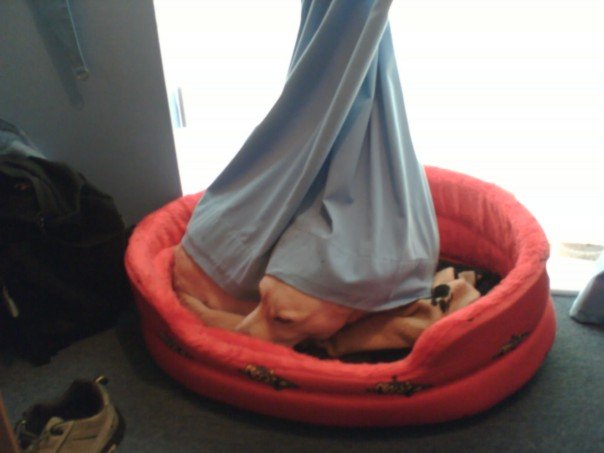
Sandie in bed with a curtain also twirled around on top of her

"I made this mess myself"

That little pint sized yellow labrador is now 8 and has been working for just over 6 years.  She was diagnosed with arthritis of the elbow at 4 years old and has been on Rimadyl, doggy Ibruprofen, ever since.

After the snow which fell on my wedding day and lasted 4 weeks Sandie became very slow.  I decided that I needed to think about retirement so I called my local guide dog team to come out and have a look at her work and a chat.

I was anxious all day about my visit at lunchtime. It turned out that Stig (My instructor) was 3 hours late due to a 3 hour trip to HMV with someone he is on class with! I joked that he must have a good music collection now.

I decided to do the walk to the metro station as it has two hills one down
and one up. We walked through the gap in the hedge and then about 20 paces down the hill. Sandie was working slowly and I could feel her elbow going (you can’t see a limp you can just feel it in harness). She was looking around for Stig at one point so he had to walk closer as she likes to keep the pack together. As we were walking I told him I could feel her elbow going. He said he didn’t need to see any more and we went back inside for a chat.

He said she was showing that physically she cannot do the job anymore but
mentally she still wants to and therefore I needed to go on the list as a priority. Her workload had to be reduced as much as possible.  We then discussed all the practical paperwork stuff and what kind of dog I would like next.After he went I got a hug off my support worker and Sandie (who also did her
head stand and gave me a big lick on the mouth!) and then my PA turned up to get her pay slip so she gave me a hug too. I shed a few tears but I also felt
relieved that at some point this year I would be able to let Sandie put her paws up. She is always so willing to work even though it is getting hard for her.

She has been with me through so much:

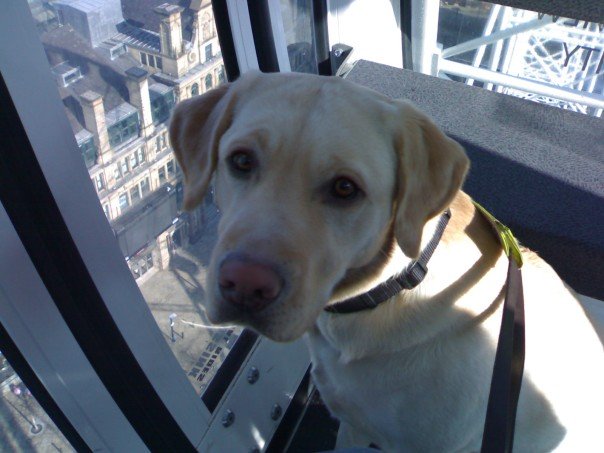
Sandie looking into the camera while the pod of the big wheel is up in the air

Sandie on the big wheel in Manchester

  • We’ve lived in:
    • Barnsley (2 weeks)
    • Manchester (3 years)
    • Hartlepool (2 years)
    • Newcastle (1 year).
  • We spent 2 years of living in Manchester travelling to Hartlepool and back every other weekend.
  • She has been on:
    • a plane to Devon
    • the London Underground
    • the big wheel in Manchester.
  • She’s met the Mayor of Manchester She’s appeared on the front page of the Hartlepool Mail.
  • She literally sat next to me through some of the darkest months of my life when I struggled for a reason to live and with what was reality and what wasn’t.
  • It was also an honour for her to lead me up the aisle on my wedding day which is a dream I always had for her.

She’s got into some scrapes

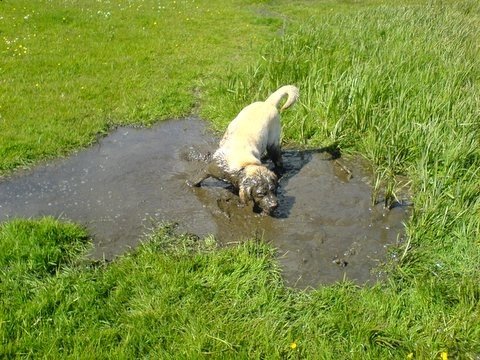
Sandie diving in to a muddy pddle

"More mud - woof woof!"

  • Dulcie and Sandie stole a sock off my washing line and played tug with it.
  • She once dragged me unknowingly into a pet shop in Kendal and stood wagging her tail at the toys!
  • She also dragged me off the bus into Wilknsons to the pet section in Salford (we had never been there before)
  • and this is still her best trick being able to go to any Wilkos and find the pet section.

A few weeks later with all the paperwork complete I decided that my  best chance of finding the right dog for me in the quickest time possible was to give up the harness and become a Priority 1.  Priority 1’s are people who are waiting for a replacement dog but do not have a working dog.   I waited 2 more weeks and received an e-mail asking me if I would consider a possible match.   I will tell you more about that in my next blog post.

Posted in Patients' tales | Tagged | 1 Comment

Pig & Pimms Garden Party in aid of Shine The Light On Aniridia

By Elly Chappele

Shine The Light On Aniridia has been been raising funds to enable research for a cure for Aniridia to begin this year. we hope, at Moorfields Eye Hospital in London under Dr Julie Daniels and her team.

We have reached approximately £30,000 now with the campaign Shine the Light on Aniridia which is a feat we never thought possible! The target we need to achieve is £50,000 by the end of the year.

This event will help us get closer to the target:

‘Pig & Pimms’ Garden Party
from 3pm Saturday 21 May 2011 at
Acton House in Felton, Northumberland
by kind permission of the Ferguson family. 

It promises to be a wonderful day with a hog roast, Pimms, bouncy castle, face painting, planting in the walled garden, treasure hunt, jazz and much more…..

Please help spread the word about this event and if you can attend yourself we would love to see you there!

Tickets can be booked via email at: info@actonhouseuk.com

Prices

  • Adult £15
  • Child of school age £7.50
  • Under 5s FREE
  • Family ticket (2 adults and 2 school age children) £40.

All monies from this campaign go directly to the research, there are no overheads, no third parties and no admin fees.

Best wishes

Elly, James, Ella the Fairy Queen and Reuben

Posted in Aniridia Network news, Fundraising | Tagged , | Leave a comment