Katja Lumezi’s daughter Tina was born with aniridia, and from the moment she was diagnosed they have received “immensely valuable” support from the Aniridia Network and Moorfields Eye Hospital.
To show their gratitude, Katja ran the Hackney Half Marathon on 20th May 2018, raising over £630 for the Aniridia Network! We will also receive over £100 as a result of people claiming Gift Aid at no extra cost to them.
“I made it! I finished running my first half marathon yesterday. Thank you so much for supporting us with your generous donations which continue to come. We have raised some good money for Aniridia Network, a charity which continues to support people with visual impairment. Thanks a lot, it all adds up!”
We at the Aniridia Network would also like to thank everyone who donated. And we especially thank Katja for taking part in the event for us, we are very grateful!
Many people with aniridia also have nystagmus, and this year’s Nystagmus Awareness Day will take place on 20th June – the day before Aniridia Day!
The Nystagmus Network have celebrated Wobbly Wednesday in November since 2013, but this year they have permanently moved it to the summer. So the main event will be on Wednesday 20th June, and the few days either side will be known as Wobbly Week.
Sue Ricketts, the Nystagmus Network’s Information and Development Manager, told us about the charity and the awareness day at our London conference in April. You can see the video of her presentation below, along with further information about the awareness day.
The theme of this year’s Nystagmus Awareness Day is “nystagmus in the open”. Everyone is being encouraged to make the most of the time of year by getting outside and having fun together, raising awareness and funding in the process.
Activities will include barbecues, garden open days, sponsored cycle rides, sports days and lots more, so there will be something for everyone to enjoy.
Sue Ricketts will be opening her Lincolnshire garden to the public on Sunday 24 June. She said:
“I look forward to welcoming as many friends and neighbours as possible into my garden for Nystagmus Awareness Day. It will mean there are a few more people who know about nystagmus and where to find support and information.”
Schools and hospitals are also getting involved, with reception displays, cards and leaflets for visiting patients, and lots of bunting and balloons.
In the lead up to the big day, the charity is running its “how amazing are you?” campaign, sharing stories of adults and children who have achieved great things despite having nystagmus, or maybe even because they do.
Nystagmus Network Chairman, Richard Wilson OBE, said:
“We are very excited about the new date. I have a feeling this is going to be one of the biggest Nystagmus Awareness Days ever.”
I was born with aniridia and did the usual sports at comprehensive school. I was the only disabled person there never mind the only visually impaired pupil there. I never really liked playing rugby, football or cricket for the obvious reasons and lack of confidence, despite loving to watch the football on the telly and listening to the cricket on the radio.
After attending the Royal National College for the Blind in Hereford, I gained a bit of confidence from doing judo and karate. I also discovered parasport such as 5-a-side blind football.
I knew very little of the VI cricket scene until a few years ago when I went to a session that was set up by couple of people, from the Wolvhampton and Staffordshire. I loved it and still do, but now playing in Worcestershire).
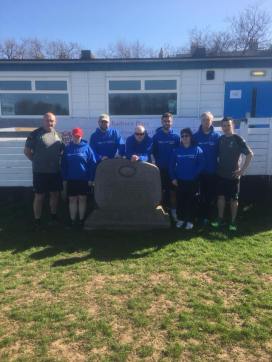
People at Worcester Warriors Rugby Club are trying to develop an adapted version of rugby for the visually impaired/blind community called hugby. You tackle someone with a big friendly hug. I love this idea and it’s keeps being developing with ideas from both coaches and players.
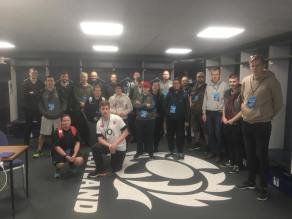
Recently a group of us with various disabilities including several of the hugby players went to Scotland to have a go at mixed ability rugby. I can tell you that as a person who was born with sight problems and from people who have lost their sight for whatever reasons over their lives, we loved it. Three of us had problems with too much light but I was the only one with aniridia.
So if you want to try sports because you love sport or want to keep fit or just to meet new people and have fun, search in your local area for sports that have been adapted for people who are visually impaired/blind. You never know, you may win gold in the next Paralympics or Commonwealth Games!
Like everyone, we’ve got stuff in the house we don’t really need. So as part of a neighbourhood event we held a jumble sale in front of our house. The proceeds were split between our two favourite charities.
Once we had sold a step ladder, locks, books, picture frames and more we had made £23 for Aniridia Network.
This is in addition £7 I’ve made for the charity in 2018 merely by using Give As You Live whenever I’m shopping online, including Amazon or for groceries.
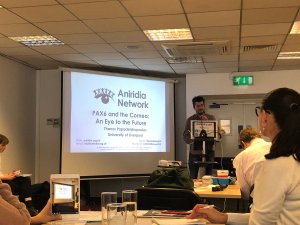
One of the speakers at this year’s conference was Thanos Papadimitropoulos from University of Liverpool. He told us about his team’s research, funded by Fight for Sight, into a potential new therapy that may one day be able to slow down or stop the progression of aniridia.
His talk got a positive reaction from the delegates, and afterwards he took the time to discuss his research further with those who wanted more information. One said: “When I spoke to him at lunch, he clarified things and was extremely helpful.”
Below you can see the video of Thanos’ presentation, followed by his written review of the day. For more information about his team’s research, please visit their blog, where they will post updates as the study progresses.
Review by Thanos Papadimitropoulos
Recently I was invited to take part in the annual conference of Aniridia Network UK. There, I was given the opportunity to present the work we undertake in Liverpool University, alongside Dr. Kevin Hamill and Prof. Colin Willoughby, developing a therapeutic tool for Aniridia Associated Keratopathy. It was revitalising (and somewhat intimidating) to be able to communicate my research to the people who my work focuses upon, those affected by Aniridia rather than my usual audience of research scientists and clinicians. I certainly got a lot out of it, and I hope the audience appreciated it too!
From my day at the meeting, it is evident that a tight community is being formed around people that are or will face similar difficulties and challenges due to their eye condition. A lot of work is being done from the organisers to keep people informed and up to date with all the different aspects of Aniridia. And, maybe more importantly, form a network that provides emotional support and the chance to make new friends. If you are reading this as a patient I encourage you to check out the network.
Coming back from a conference that is organised not by big pharmaceuticals or academics but by the patients, and for the patients, helps put some things that I am doing into real-world perspective. Although the final aim of our work is to develop a therapeutic tool for AAK, speaking with patients also provides us with knowledge and ideas of how we can ease the burden of the people affected by Aniridia. It’s easy to see our work as cells in a dish or even pieces of RNA but the implications on quality of life and what matters to the patient is key to our research going in the right direction. We can’t underestimate the ideas that we gain from these meetings, ideas that we will soon start to put in motion.
A big thanks go to the organisers for a flawless conference throughout the day and to the people that showed an interest in our research and were really friendly throughout. This was my first time speaking at one of these meetings and I couldn’t have been made more welcome. It really was inspirational and informative to get a chance to interact with everyone.
I think my closing remark on my presentation probably sums up the most important thing I took with me from the conference.
“We, scientists, tend to lose ourselves in the labs, or with our faces stuck against our computer screens. It is nice to be reminded WHY we do WHAT we do, and for WHOM.”
Reports & Accounts
To receive and consider the accounts for the years ended 2017 and 2018 and the reports of the charity trustees
Any resolutions received.
Appointment of charity trustees
To reappoint the following as trustees until the 3rd AGM after this one, subject to the compulsory retirement of 1/3 of trustees by rotation at each AGM as described in the charity’s governing document: Katie Atkinson, James Buller, Martin Fleming, Emily Nash, Eleanor Burke.
Consultation on the foundation model for governance of the charity.
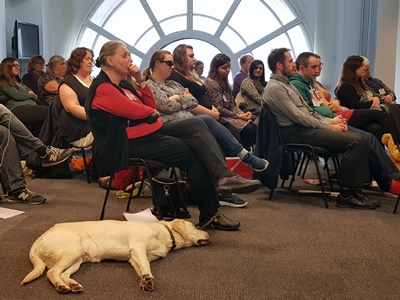
The AGM 2018 was a session at Conference 2018. Members could to the AGM for free but to attend other sessions the conference ticket fee had to be paid.
Join the Trustee Board
Trustees are the volunteers who form our governing body. They work as a team and are collectively responsible for controlling the management and administration of the charity. Being a trustee can be hard work, but also be very rewarding and provide great opportunities for personal development and improving your employability.
Applications must be made by 5pm on Tuesday 27 March 2018.
Chair of Aniridia Network UK Trustee Board and Head of Knowledge and Services Katie said
“This is the first time we have offered a grant of any kind. It is a very exciting milestone for us and chance to make a big impact. I do hope that we will be able to offer more awards focused on aniridia in future.”
Please share this opportunity with any eye doctors you know so we can get the best ideas submitted.
Let us know in the comments below what you think should be researched.
This is excellent and exciting! It means we have more potential to get funds and support, leading towards being able to do much more.
Previously we were only registered with HMRC as a charity to let us claim Gift Aid on donations.
For many years we’ve wanted to register with the Charity Commission, to get the talisman of a proper charity number and all that brings. However, until recently we were not big enough to qualify and didn’t have the time to work on it. That’s now changed.
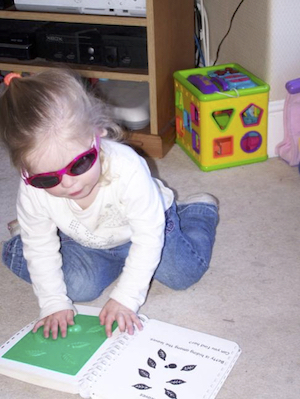
It is not always easy to know what toys to buy a child with a visual impairment, so here are some thoughts and ideas to help you.
You don’t need to buy toys from specialist suppliers. Choose toys that will make the best use of any vision they have, and that develop other sensory skills such as the sense of touch and hearing. Older children will no doubt want the latest toys but the same criterion applies. Hopefully the following checklist will help.
Provide toys that:
encourage using eyes to follow an object and physical movement: bubbles, balloons, hand puppets, balls (scented, lit, sparkly), pull -long and wind-up toys, cars, train sets.
encourage hand-eye co-ordination and/or fine motor control: posting toys, inset puzzles, bricks, beads, peg boards.
have interesting textures: feely bags, soft toys, balls, building blocks, Duplo
make sounds: bells, chains, beads, wind chimes, rain stick, music makers and instruments, feely bags (fill with cellophane, beans, rice etc), books with audio features.
are reflective, fluorescent or bright: foil survival blanket, cheerleader pom-poms, torch, metalic or push button light up toys
have scents: make playdough with scented oils, scent bags filled with herbs
feature switches/controls that are easy to find by touch
have bold lettering and strong colour/tone contrast
Check out these links for sensory toy and play ideas
Look out for this symbol! Toys with this symbol contain small parts that could be swallowed and cause a choking hazard. They should only be given to children over 3 years and of sufficiently advanced development. More information about toy safety symbols.


 Many people with aniridia also have nystagmus, and this year’s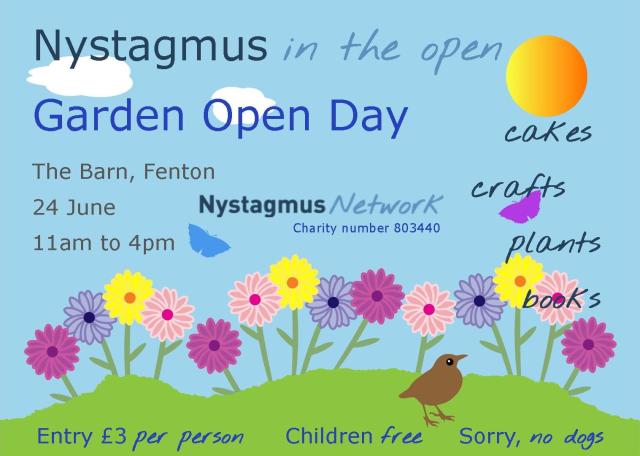
 I was born with aniridia and did the usual sports at comprehensive school. I was the only disabled person there never mind the only visually impaired pupil there. I never really liked playing rugby, football or cricket for the obvious reasons and lack of confidence, despite loving to watch the football on the telly and listening to the cricket on the radio.
 People at Worcester Warriors Rugby Club are trying to develop an adapted version of rugby for the visually impaired/blind community called hugby. You tackle someone with a big friendly hug. I love this idea and it’s keeps being developing with ideas from both coaches and players.
 Like everyone, we’ve got stuff in the house we don’t really need. So as part of a neighbourhood event we held a jumble sale in front of our house. The proceeds were split between our two favourite charities.
 One of the speakers at this year’s conference was Thanos Papadimitropoulos from University of Liverpool. He told us about his team’s research, funded by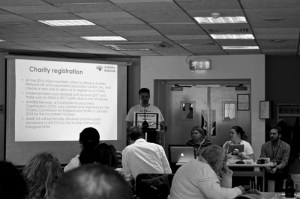
 Details of what our officials did between April 2017 and March 2018 are in the
 Provide toys that:
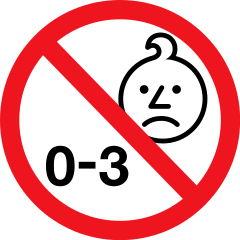 Toys with this symbol contain small parts that could be swallowed and cause a choking hazard. They should only be given to children over 3 years and of sufficiently advanced development.



 Aniridia Network