
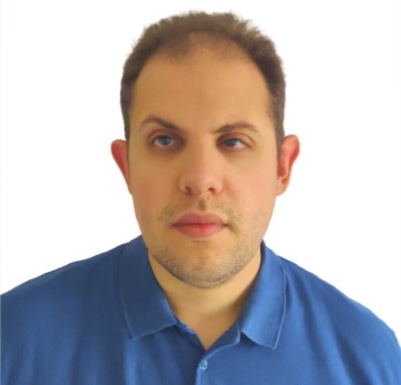
At our recent online meetup to mark Aniridia Day and Father’s Day, we heard from Simon, 43, who has aniridia and is bringing up a child with the same condition.
In his talk he shared what it’s like to navigate aniridia from both sides. His son is going through many of the same things that he did growing up, yet the world has also changed and many of the challenges are new or different.
Check out the video and transcript of his talk below.
Transcript
So I was born in ’83 and I was the first person in my family to have Aniridia as well. My son was born in 2010 and I always knew there was a chance that I would pass on the phenotype of PAX6.
And my parents and I had blood tests carried out. I think it was Professor van Heyningen actually who analysed the samples, which would have been in the early 2000s. And at the time they didn’t find any abnormalities in PAX6, but I remember being told at Moorfields that there’s still around a 50% chance. But that was as much genetic counselling as we had at the time.
So I suppose when Wasim was born, having the diagnosis wasn’t necessarily unexpected but it was still quite worrying. He was born in Barnet Hospital in London and it was identified I think the day he was born or the day after.
And he was seen by an ophthalmologist at Barnet Hospital, but she quickly referred him to Professor Tony Moore at Great Ormond Street. So he was under Tony Moore’s care for the first few years. So I think we were fortunate in that we were in London and we were near to Moorfields and Great Ormond Street.
But when he was around one and a half or two years old we moved to Nottingham, as my parents wanted us to be nearer to them. And then we transferred to Queen’s Medical Centre, where I think both he and I found that there wasn’t the same level of care or expertise in terms of dealing with Aniridia and related eye conditions.
Fortunately now we’ve moved to Rugby, so he is being seen at Moorfields once more, and I think he’s due to be transferred to the adult services clinic. Well he’ll probably be seen in clinic for the external eye disease clinic like me, probably under Daniel Sibley or Saj Ahmed.
So he’s nearly 16, he’s in year 10. He’s not quite sure about what he wants to do, but he’s doing reasonably well at school. And fortunately I think things have developed a lot. They’re probably still not perfect, but in terms of special educational needs provision, the schools he has attended in Rugby have seemed to be much more forthcoming in terms of support.
There have been a few difficulties with things like his photoreactive glass lenses, and some teachers haven’t read through his file and then they’ve queered why is he wearing sunglasses when he’s indoors. But generally I think things have been a lot smoother for him than they were for me when I was going through school.
And I think probably, from a father’s perspective, as somebody who has Aniridia and many other related eye conditions, I think that’s helped me in a way to empathise with him and to be able to understand what he might be experiencing.
For example, a lot of his friends are now talking about learning to be able to drive and we’ve obviously had to have the conversation about how his vision won’t be sufficiently correctable. And I went through that when I was 11 or 12 years old, and as a child I was somebody who was obsessed with cars, so I remember how difficult an experience that was for me when I was being given that information.
And I think also it has helped in that when I’ve gone to medical appointments with him I’ve been able to ask questions. For example at Moorfields he was being seen in the paediatric strabismus clinic. And because recently in the last five to ten years I’ve started to have issues with cataracts and corneal scarring or Aniridia-related keratopathy, obviously a concern I’ve had is that he might suffer some deterioration in his vision or chronic eye pain later on in life. And maybe it wasn’t widely known about when I was a child.
So I’ve now asked for him to be referred to the paediatric cornea clinic at Moorfields Eye Hospital and he will be seen under external eye disease. So hopefully he’s in the best possible place.
But they’ve said so far he does have cataracts, but there’s no sign at this stage that he has any issues with his corneas. But we do keep nagging him to put his lubricating drops in. Quite how often he’s doing it we don’t know.
But I suppose overall my observation as a parent who has Aniridia is having had that first-hand knowledge and the experience, I suppose it helps in terms of supporting and empathising with what a child might be experiencing, in summary.







Pingback: Parenting and aniridia: Online meet up | Aniridia Network