
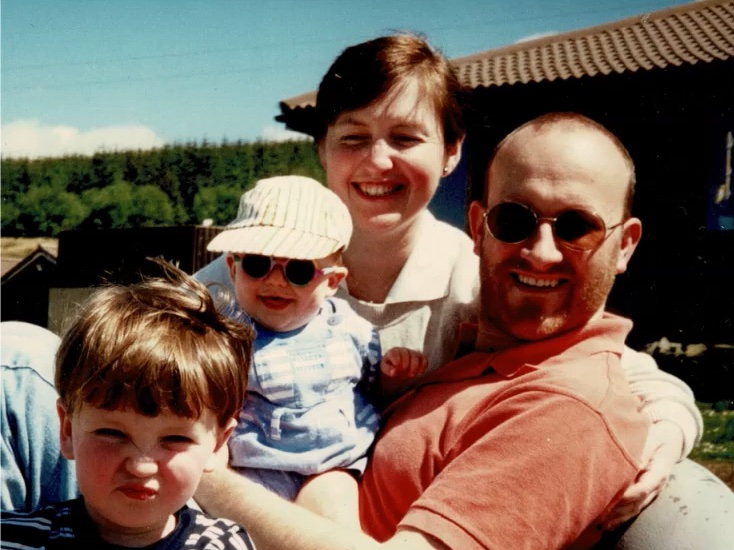
This year’s Aniridia Day on 21 June coincided with Father’s Day. So we held a special online meet up to explore parenting topics, with 3 short talks and an open discussion.
One of the talks was by Mark, 62, who has spent almost three decades supporting his son Harry, 29, who has aniridia.
Mark reflected on what he has learned over that time, from Harry’s diagnosis through his childhood, school, and into adulthood — and the highs and lows along the way.
His main observations were:
- It’s a unique journey for each family
- Seek friendly professionals
- Aniridia provides challenges but it is what you make of it
You can watch the video of his talk and read the transcript below.
Transcript
I don’t have Aniridia but Harry, my second son, does. And I thought I’d look back from a dad’s perspective of what I recall from the best part of 30 years with Aniridia.
If some of this seems familiar, it’s because it builds on the Journey With Aniridia talk that Harry and I gave to the Aniridia Aniridia Network UK conference in 2014, which is why the slides I’ve got have been trimmed from that and they’re not quite on brand. So apologies for that. And of course the YouTube for that is on the Aniridia Network homepage, so if you’ve watched that recently, some of this will be familiar.
What I found interesting when I read my notes from 2014 is how much of this journey I’d forgotten. The fights and the struggles and the coming to terms with being different, and making adjustments, and being involved in advocating, had all become a distant memory. Which is probably a good thing in that the hassle and the heartache doesn’t continue. Things do get better.
So it’s a unique journey for you. Every family has their own personal journey and each person in the family has their own separate journey, all shaped by circumstances, and you become your own experts in the condition.
Looking back, my journey as a dad has been one of providing practical help and taking a scientific approach to understanding the condition. Whereas in contrast Andrea, Harry’s mum who’s sitting out of shot beside me, has been the more reassuring and supporting emotional. And I think between us as parents we’ve covered most bases for it.
And for context, there’s no previous occurrence of Aniridia in our family. And I think it was quite interesting listening to Harriet, because she’s laid the groundwork for an awful lot of things that we’re going to be looking at.
So, Harry was born 30 years ago, half of my lifetime, in the early hours of a cold November morning in 1996 in Furness General Hospital in Barrow, which is a remote town in Cumbria, famous for building submarines.
And as soon as he was breathing, the midwife counted his fingers and toes, Something that hadn’t been done when Harry’s elder brother had been born in Royal United Hospital in Bath two years earlier. And when I asked, they said “your elder son wasn’t born in Barrow”. Ten fingers and toes, no genetic problems, I mistakenly believed.
We moved up to Scotland when Harry was only a few weeks old. And he was referred to Glasgow Children’s Hospital for checks at his eight weeks check up, and Aniridia was diagnosed.
The explanation of the condition then was clinical, blunt, with no attempt at reassurance and, what’s more, no practical advice that answered what does this mean for Harry and for us, his family? And we really wanted real world answers.
In 1996, there was no social media and a search of the early internet threw up only medical information, much of which was inaccurate or not relevant for the UK. And it wasn’t what we wanted. We were looking for practical information drawn from lived experiences.
It’s easier now with social media and niche community groups, but 30 years ago it was by word of mouth. And the most helpful conversation that gave us some reassurance was with Yvonne Boone, who then was part of Aniridia UK.
Harry was subject to the six-monthly routine of a range of tests, which weren’t well coordinated. And it took us a few years of chaos to finally realise that there wasn’t a standard way of doing things. We had to start working it out for ourselves.
We kept lots of notes – what’s happening, what experts say, what the plan is, and making lists appealed to my nature. It was something that I could do by being pretty systematic with it. And the lists included any significant differences in Harry’s behaviour compared to his elder brother.
And we slowly came to realise, to our great relief, that in most respects, Harry was a normal, happy toddler. But after three or four years we still didn’t really understand how best to treat Harry’s sight with glasses. By this stage he had prescription lenses, but he’d been wearing kids sunglasses at the time, and they didn’t work with prescription lenses.
Eventually we found a specialist ophthalmologist, and although he was 90 minutes away across Glasgow, the journey was worth it, because in our first 45 minutes with him he did more tests on Harry’s eyesight than had been completed in the previous three years.
And that leads to my second observation, to seek out friendly professionals, find the experts and get them to answer your questions. They do exist, but you might have to get recommendations.
We were offered loads of really useful information, much of which hadn’t been mentioned at all in the previous three years of growing up and diagnosis and hospital visits. And I’ve got to admit, I really enjoyed the visits, and understanding the technical and scientific or practical side of Harry’s Aniridia. And being able to break it down into cause and effect really helped me to understand it.
About this time we started to think about nursery and preschool, and we realised that even if teachers wanted to, they wouldn’t find information that was important or relevant to Harry in textbooks.
We drafted a simple A4 information sheet to summarise our knowledge and related observations of Harry’s eye condition and how they affected him. This was done with Harry’s input as best he could and then written from Harry’s perspective, and this personalised sheet of “My name is Harry” was our first pupil’s passport.
And by writing down what we knew, Andrea and I discovered that each of us had spotted different aspects of how Harry reacted to things. And even now, after 30 years, there are still aspects of Harry’s condition that only one or other of us still understand.
In 2003, when Harry was seven and settled in primary school, we moved from Scotland to the Forest of Dean on the Severn Estuary in Gloucestershire. Our local village was small, only 60 pupils, and what a contrast.
This was a very different care regime, and we thought Scotland had been chaotic. But in England, there was no joined up support, and Gloucestershire seemed very fragmented. We were starting again from scratch, but by now we were becoming battle-hardened.
We revised the pupil’s passport with Harry’s suggestions and turned it into a booklet. He understood his condition and wrote it up as a diagram. “Where the arrow is pointing, that piece is called ‘Iris’. Some people have an iris and some people don’t, like me, Harry Westwood.”
But within six months, it was clear that his self-esteem had taken a knock and that he was struggling at school. We called a meeting with a head teacher. Harry was eight and was very aware of what was wrong and how he thought things should be changed for him.
We reviewed everything that we could think about at school, and it turned out to be a really good learning session for both us as parents, for Harry, and for the teachers. We pushed for a statement of educational needs to be put in place before his SATs started.
But not only did we want support and adjustments for the things that were holding him back, we also needed to manage people’s expectations about what Harry could still do normally, and what he would want to do, to prompt people to set prior expectations for him.
Andrea and I became parent helpers at school and we both got involved in helping the local Scout group to support Harry. I’ve ended up running our local Scout group for the last 23 years and find myself advocating for all young people who need support when their parents claim they can’t or won’t do such and such a thing.
And I find it interesting that quite often parents of capable young people unknowingly put constraints onto what they think their children can do. So it’s not just medical conditions that hold young people back. Parents’ expectations can also hold back.
Now eventually it came time to move to secondary school. He was going from a village school to one that was ten times the size, where Harry would be anonymous initially. We updated the pupils passport again, including a more thorough understanding of successes and shortfalls.
And in secondary school we had much less contact with Harry’s teachers, so Andrea arranged to meet Harry’s teaching assistant at school every Friday, as school finished. And this was a mum thing. And I became gradually less aware of details of issues and progress. For me, to some extent, Harry’s secondary school just happened.
Fundamentally though, Harry got stuck in at school, and with Scouts he completed the Duke of Edinburgh Bronze, he became a prefect in his final year, and he was determined to demonstrate that Aniridia did not define who he is.
Now his school didn’t have a sixth form, so after GCSEs we had to work on the transition between schools again. Harry’s results were good enough to get him into the sixth form at Tommy’s Grammar School in Gloucester.
They didn’t have much experience with pupils joining the sixth form with special needs, so we sat down with the SEND coordinator and explored some of the issues and again we rewrote his passport.
But by now Harry was more than capable of managing a transition. He visited the school before the start of term, took videos of the routes through the corridors, and studied them to really learn the layout of the school and how to get from A to B.
And learning routes from videos was a skill that he became renowned for. Studying routes using Google Street View, identifying landmarks so that he could find his way around. He became an expert at it and showing his friends around, and he had little difficulty navigating his friends around Rome.
Harry’s A level results got him to Birmingham University. We were excited, albeit with some trepidation at the prospect of Harry leaving our care and managing his Aniridia by himself. But he was fine. Five years at Birmingham Uni disappeared in a flash. He graduated with a Masters in Physics.
And I rattled through this, not because it is trivial, but because Harry did this mostly on his own, advocating for himself, insisting the adjustments were appropriate. And while there was a bit of support from home – publishing applications, strengthening arguments, making more coherent cases – on the whole, it was Harry’s efforts that supported him and his advocating for himself, admittedly supported by the bank of Mum and Dad.
Harry got a job in business intelligence, analysing big data, a job that’s easily done from a home office. And as with many other post-lockdown families, we find ourselves all living under the same roof, frequently working from home.
We refurbished the house to enable five adults to work at home, including setting up Harry’s study to be dark with desk space and enough sockets to support the power requirements for modern technology. He continues to help as a team member with our Beaver Scouts.
But recently though, Harry’s been having more discomfort with his eyes. His eye drops aren’t providing quite the same relief. And this hose illustrates the industrial quantity of eye drops that he gets through. Now, Harry approves of that comment as an “appropriate level dad joke”, as he told me yesterday.
Localised specialists aren’t sufficiently familiar with Aniridia to be able to provide tailored advice. So he arranged for a private consultation at Moorfields this month. And for the first time in 15 years, I accompanied him on a medical consultation.
We spent the best part of an afternoon doing a variety of tests, speaking to specialists. And suddenly I was transported back 25 years to Glasgow, filling in key details, taking notes, asking questions and checking our understanding, and again taking an active part in the consultation process. The more things change, the more they stay the same.
But there were several noticeable differences at Moorfields compared to Glasgow. Harry now had 30 years of experience to draw on and knowledge of his own condition, and was able to describe his symptoms and answer detailed questions and ask probing questions.
I had half a lifetime of experience in developing my understanding of Harry’s condition and was able to fill in gaps in his narrative, and provide broader, richer context for the doctor’s questions.
And we both had 30 years of experience of dealing with medical professionals, and were happy to keep pressing and pressing until we felt that everything had been discussed and everything was properly understood.
I think notably though, compared to Glasgow, Moorfields had the time to be thorough and ask the questions and not let up until they were content. But even now there’s more consultation to be done because we haven’t yet found out everything we need from genetic experts.
So what does this mean from a father’s perspective? Well, Harry’s done much more and achieved much more than Andrea and I dared imagine 30 years ago. But Andrea and I have become involved in and contributed to groups, organisations and our community in ways that we might otherwise not have committed to under different circumstances.
And in looking back and thinking about half a lifetime with Aniridia, I amended my final observation from the 2014 talk.
So, yeah, Aniridia does provide challenges and it is what you make of it, but also what it makes of you. There’s no doubt that it has provided challenges and opportunities. For us, it’s not been the end of the world that we vaguely imagined 30 years ago. Far from it.
I concluded in 2014 that we were probably much richer for it. But with the benefit of another 12 years, I go further and say that we are very definitely much richer for it growing up with Aniridia.








Pingback: Parenting and aniridia: Online meet up | Aniridia Network