By Sema in Istambul, Türkiye.
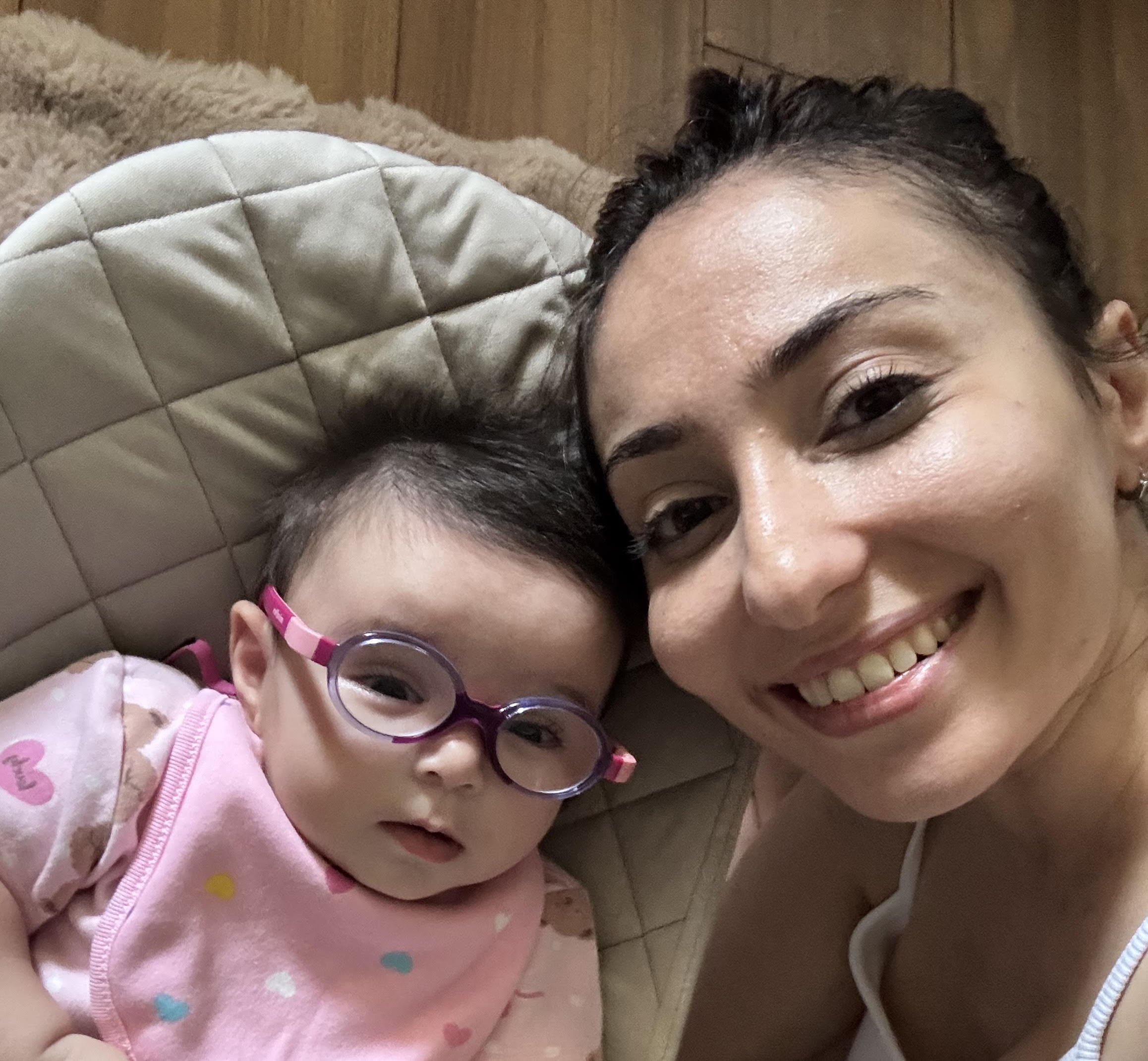
When I first held my daughter Karsu in my arms, like every mother, all I wanted was to know that she was healthy. My pregnancy had already been an incredibly precious and emotional journey. Karsu came into our lives following IVF treatment and was a very long-awaited baby.
She weighed 2,510 grams at birth. During those first weeks, I was occupied with the things that fill the mind of any new mother: feeding, sleeping and whether she was gaining enough weight. We had no idea that another journey was about to begin.
When Karsu was around two months old, she was diagnosed with sporadic aniridia.
Until that day, I had never even heard of ‘aniridia’. Suddenly, I found myself researching a rare condition I knew nothing about. I quickly learned that aniridia was much more than the absence or incomplete development of the iris. It could affect several structures of the eye and required lifelong ophthalmological follow-up.
Many questions
As a mother, my first question was very simple:
“Will my daughter be able to see?”
Then came many more questions.
How would her vision develop?
Would she be able to attend school independently?
Would she develop glaucoma or cataracts?
How could we protect her eyes from light?
What could we do now, while she was still a baby, to give her the best possible opportunity to use and develop her vision?
Genetic testing
Tests later identified a deletion on chromosome 11 involving the PAX6 gene, providing a genetic explanation for her aniridia. Importantly for us, the WT1 gene relating to WAGR was not included in the deletion.
My husband and I were also tested, and our results were normal, indicating that Karsu’s deletion was de novo.
Genetic testing also revealed a deletion involving part of chromosome 2. At present, the significance of this finding remains uncertain. There is not enough information in the medical literature to tell us clearly what, if anything, this deletion may mean for Karsu’s future development.
We have been advised that there is no definitive diagnosis or predictable outcome associated with this finding at this stage. For us, this means that some of the answers will only become clearer as Karsu grows and develops. We will continue to follow her development closely with her doctors, but for now, we are learning to live with a degree of uncertainty rather than assuming that a particular problem will occur.
After diagnosis
After the diagnosis, our lives became filled with ophthalmology appointments, genetic testing and research. We began regular paediatric ophthalmology follow-up in Istanbul. At present, Karsu has no glaucoma or cataracts, which we are very grateful for. She has started wearing glasses, and we are exploring early visual rehabilitation and ways of supporting her visual development.
But one of the most important things I have learned is that receiving a rare-disease diagnosis is not only a medical experience.
As a parent, you constantly think about the future. Sometimes you spend hours searching the internet, wondering whether a study taking place somewhere else in the world could one day change your child’s future.
I began following research involving PAX6, potential gene therapies and clinical studies, and reaching out to researchers and aniridia organisations in different countries.
Finding Aniridia Network and the wider aniridia community became very important to me.
New understanding and goals
When your child has a rare condition, knowing that you are not alone makes a real difference. Seeing that another mother or father once asked the same questions you are asking today reminds you that your child’s future is about much more than medical reports and test results.
Karsu is still only a baby, and we do not yet know exactly what the road ahead will look like.
But my goal is no longer simply to find the answer to “What will happen in the future?”
My goal is to do everything I can today to support her visual, physical and emotional development, while continuing to follow the science and learn from other families.
Perhaps sharing Karsu’s story will reach another mother somewhere in the world whose baby has just been diagnosed with aniridia and who is feeling the same uncertainty I felt.
If it does, this is what I would want to tell her:
You are not alone.
Not every question will have an answer today.
But as you find reliable information, the right specialists and other families walking the same path, the road ahead gradually becomes a little clearer.
Sema wrote this after reading our Tell your story page. Get in touch if you would like to do the same