
Dr Joan Han, a physician at the National Institutes of Health in Bethesda, Maryland, USA, who is researching aniridia and WAGR/11p deletion syndrome has a question for you:
Do the eyes of anyone with aniridia not move fully to the side when looking side ways?
This picture shows what she means.
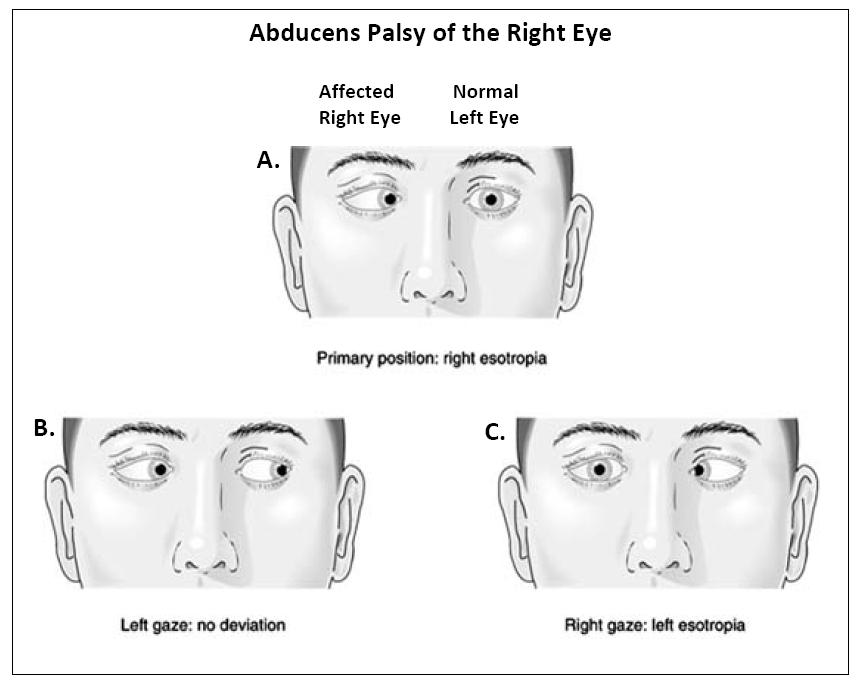
Symptoms of abducens palsy
The symptoms to look for are
- When looking straight forward one eye tends to turn in toward the nose. This causes mild double vision.
- Normal appearance when the affected eye has to look toward the nose and the healthy eye is looking outwards (away from the nose);
- When looking in the other direction and the affected eye has to look outwards (away from the nose) it gets stuck in the middle while the other healthy eye turns in towards the nose. This causes severe double vision.
Note this is different to nystagmus where the eyes move involuntarily and strabismus where the eyes cannot align to look in the same direction.
Dr Han says “We are trying to study abducens palsy – that’s a defect in the nerve that controls outward gaze of the eyes. This can happen with just one eye or with both eyes.”
“We’ve observed inability of one or both eyes to gaze all the way to the outside side of the eye in some people with WAGR syndrome, but not in people with isolated aniridia thus far. But I think this might because we haven’t seen that many people with isolated aniridia.”
If you or your child has aniridia but not WAGR/11p deletion syndrome as well, and you think there might be a problems gazing sideways, please contact Dr Han by email hanjo@mail.nih.gov







 Aniridia Network