
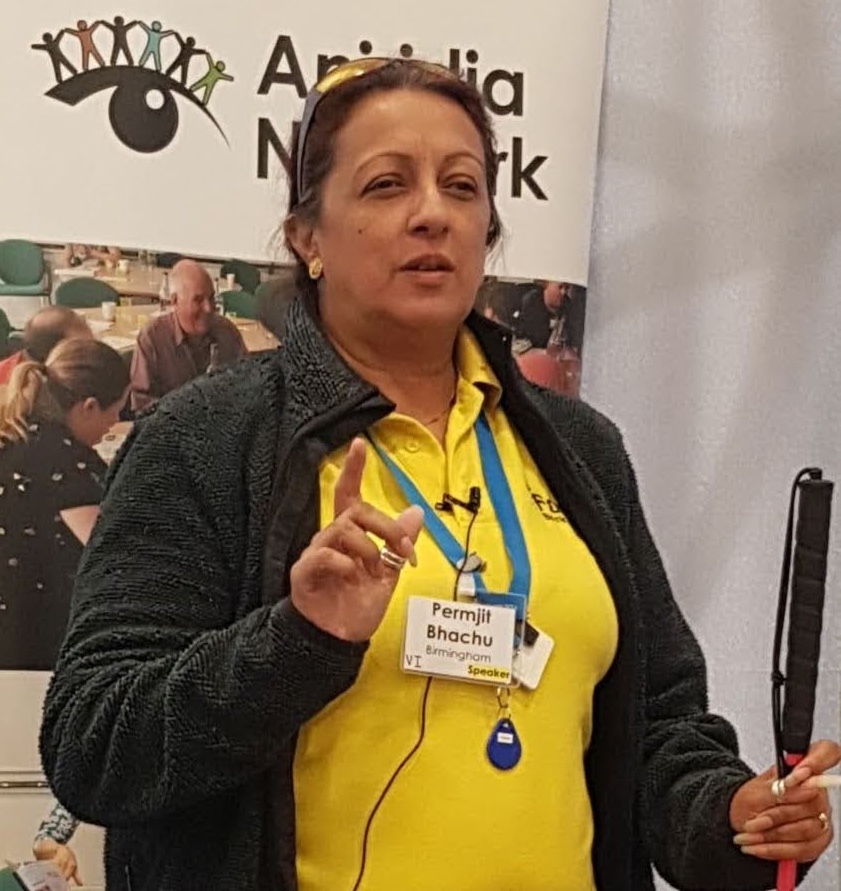
Permjit Bhachu is Information, Advice & Guidance Coordinator at the charity Focus Birmingham.
At our 2023 conference in Birmingham last September, she gave a talk about one particular person she had been working with, who had endured a great deal of hardship on their sight loss journey and had to contend with the stereotypes of the benefits system. It’s a story of Hope and the importance of reaching out if you need help.
You can watch the video of her talk and read the transcript below.
Transcript
[James] Right, our last talk for today is Permjit here. She’s come from an organisation locally called Focus Birmingham, a local vision impairment charity, and she’s going to talk to us about benefits and life during the pandemic.
[Permjit] Good afternoon everyone. As we’re entering the end of the day, I don’t know how I’m going to live up to the other speakers, so I’m very humbled to be standing here today.
As it was explained, I do work for a brilliant organisation, Focus Birmingham. We are an independent sight loss charity.
My role is information, advice and guidance, and it’s exactly what it says on the tin. I call this my holistic career and I’m actually based in the low vision centre.
And I have been speaking to some of you today and some of our clinicians are still there. And I have to be honest with you, this is the best thing I’ve done.
But prior to this, I actually come from an arts background. So I totally diversified and work for Focus.
Now I’m going to be talking about a case study which I have been helping an individual. They identify as somebody called Hope.
Now Hope was actually an individual who had an academic career. And they were struggling with their failing eyesight. And they identify as they/them, so I will be addressing them as them and Hope.
Hope was also a very get setter person that wanted to be there at the centre of helping everyone.
But with failing eyesight, which led on to other medical health conditions, they’d lost their academic career more or less overnight. Which set them down into very deep depression, very sadness of having no financial means to support themselves.
And also, you know, being this independent, the family that they were the go to person started to go to other people. So they’d lost their identity as to where they fitted in the family arena. Hope always wanted to be that person, never to be the person to be dependent on anyone else.
The eyesight led on to other health conditions which inhibited their mobility. Sadly, it affected their inner relationships. So a lot of people started to not help.
Hope felt very isolated and then they started to stay at home. They didn’t know where to turn to, what to do, and they decided to stay at home.
Savings were depleting, once having such a brilliant academic career and mind, they couldn’t recognise their face in the mirror anymore.
Five cycles of “why me”, the anger, the grief, disappointment in themselves started to step in. And even the arguments got bigger and bigger and more inflated. So they didn’t know what to do.
Money was depleting and then they thought “Well, where do I go? What do I do?”
After earning such a substantial amount of salary every month, they were left with the bare bones to live on. Poverty was striking and they had to resort to going on to benefits, but didn’t know where to go.
So they came to us. Hope then sought sanctuary from us and they needed help.
I mean, you can all agree with me here folks. Navigating the benefits system is very, very difficult. You need to have an encyclopedia to even understand the basic jargon.
So there were various means that they had to go through, like Work Capability with DWP.
Again, the stereotype that everyone on benefits fits, you know, the negative stereotype, Hope wanted to break. They felt that they were not that stereotype as it’s portrayed in the media, and everywhere else that we hear and see and read. So they came to us for support and were broken, actually.
They needed counselling. They were depressed. They needed help. And they didn’t know who to turn to, so they came to us.
And fortunate for them, they came to a service which has very, very high esteem for looking at a person-centred approach and making lives better, which is two of our core values.
The actual individual themselves, Hope, thought “Well, what do I do?” And the shame they felt in applying for benefits was overbearing.
So they didn’t understand what ESA meant. They didn’t understand the different tiers of the benefit system. They didn’t even understand why you had means-tested and non-means-tested benefits, because they didn’t know which way to turn.
So they went through the Work Capability, proving that the fact that they needed support, and felt humiliated when they had the assessment. And bearing in mind this person has a creative academic mind.
And after that, they wanted to apply for what they called PIP. Again, understanding the benefit system, thinking “Well, hang on a minute. Why do I have to go through it again? I’ve just done the Work Capability.”
But that was for assessment for work, not for your disability. And the question that they asked is, when they were granted ESA, why cannot the PIP and the ESA be joined? Why do you have to go through it time and time again, and to be humiliated and felt small?
Hope pursued, carried on, and even the questions were quite repetitive, and the evidence that they had to provide, with medical and other assessments they went through.
Now, when they were starting to get more or less back into a financial stability, Covid hit. And we’ve all been through it, folks.
Hope, being on their own, felt more isolated. They were just starting to regain a bit of their confidence and a bit of self-esteem.
And those two/three years that they were isolated, they were able to engage with the activities that we have at Focus. Some of them were online. How many of us kept saying “How do I use Teams and Zoom?”, “You’re on mute.” How many times we’ve all heard that.
But Hope didn’t lose hope, and they carried on and pursued.
But having said that, at the end of the day, they still weren’t awarded their PIP and they were living on… and this is a question for the audience, for all of you. What essentials would you cut out, and could you survive on £450 a month?
Because that’s what Hope was granted under the ESA, which is contribution-based. And they couldn’t understand how they got to this, because they had thousands and their savings are depleted pretty quickly.
They started to rely, in Covid, on their neighbours, because they were facing financial poverty. Not only with their utilities, but also internet poverty.
And how many of us, you know, we couldn’t social distance, we got forgotten as a community. The vision impairment community got forgotten. So we had to fight. I mean, what was the thing about toilet rolls? I don’t get that.
But the question is, folks, and I will revisit that question, could you survive on £450 a month? What would you cut out, would you class as essential? That is the question that Hope is throwing to you.
Hope carried on, and Hope thought “Hang on a minute, I can’t keep carrying on like this.””
We were coming out of Covid and Hope was actually struggling with Long Covid symptoms, as well as everything else that was going on.
So trying to rehabilitate, trying to get back onto the straight and narrow was very difficult. Depression was still there. And until they could actually admit to themselves they needed help, they reached out.
And Hope now, fast forwarding a few months into the last few years, Hope wanted to give something back. And they kept saying “I used to do this, I used to do that.”
And we were saying, well, how many times when you’re given a diagnosis, folks, you have the clinical pathway? They forget the emotional and the holistic pathway. So the two do marry, and Hope was wondering “Well, I don’t know what to do anymore. Where do I go?”
And when they were given a cane, that was the next step for rehabilitation. Because when Covid did hit, every service that was available to us had stopped. Nobody was actually engaging face to face anymore.
So suffering with Long Covid symptoms, financial poverty, and also turning to their friends and family for support, it’s like going cap in hand. But Hope never gave up.
Hope wanted to give something back, and wanted to actually help the organisation that helped them. So they seeked to actually do volunteering, looked at various volunteering roles, who they are now affiliated with various charities.
They did actually get their PIP at both enhanced rates. And they are no longer on the ESA benefit. They are now in a career and they’re giving something back.
So my question to you before I conclude folks, because I’m mindful of time, what would you cut out? So could I just have maybe one or two answers just thrown to me?
What would you cut out with £450? What would you cut out?
Would it be food? Would it be the internet? Would it be clothes? It’s hard, isn’t it?
That’s what Hope lived on. And cereal was the best friend, which isn’t very nice actually. It depends what you eat.
But Hope now is actually in full-time employment.
And it just shows that with organisations like Focus and other organisations that are around, counselling was the first step that was taken. But you have to walk with them. Tools can be given to people, but it depends on how you embrace it.
And my personal story folks, the role I do is crucial to the story of Hope. Because we don’t want to lose hope in times of Covid, post-Covid, in times of a cost of living crisis. The benefits are very difficult to navigate, especially when you’ve worked in such a great career.
And there’s many Hopes around in this room, as I’m sure you’ll agree with me. So, like I was saying, please don’t give up hope.
Hope is real. Hope is in a successful career, with a little smile on their face, and they are embracing their disability, which has given them empowerment, enjoyment. Everyone has their bad days, who doesn’t, but they’ve not looked back, and they’ve gone from success to success.
And with charities like Focus, and other charities like the RNIB and yourselves, and the amount of importance on research, let’s hope we can have a cure for all visual impairment and all diseases.
Because people concentrate on, when you have a disability, what you can’t do anymore.
Let’s concentrate on what we can do, folks. Let’s enable everyone to have that hope and not lose it. Thank you.
[Applause]
I have missed a lot out, I’m going to be honest. You know what they say about remembering!
But does anyone have any questions about the £450 budget? It’s hard, isn’t it?
[Lady 1] Do you think it’s better, a local charity? You’re a small local charity, really, aren’t you?
[Permjit] Yes, we are.
[Lady 1] Do you find you’re more nimble and able to help?
[Permjit] Since I’ve been doing this role, I have seen the progress, just similar to Hope’s case, has made.
Some people haven’t had PIP, they’ve had it denied three times, and with gentle filling in the forms. People say to me “Well, how do you do it?”
But even though we are small, we are quite big. We’ve been established since the late 1800s.
The name has changed over the years, but it’s not just about people with dual sensory loss, because we’re very unique, we have a low vision clinic. So we have optometrists on site and also a low vision dispensing optician as well.
We have a shop affiliated to where we are, and also we have information, advice and guidance.
I also have a colleague who actually delivers kitchen skills and being safe in the kitchen for daily living, for people who are transitioning over from BMVI.
And also they do tech, because technology is so important folks. I mean, if we didn’t have our technology.
Some people are actually facing hardship, so some of the actual benefits do not… they are disadvantaged for people who are on a contribution-based style ESA, because not all the means-tested benefits.
So, you know, I could be here all night, which I don’t want to be, because I know we’re all engaging for the right reasons.
But even though we are a small charity, we provide a lot of support, not just for the individual, but for families as well. Because it affects the families and people forget that.
And I’m actually one of a similar case to Hope, because I wanted to give something back.
And when Hope was always saying “Well, I can’t do this, I was an academic”, they still are an academic. They haven’t lost that brainpower, they haven’t. And that’s the belief that they’ve lost.
So for any organisation, big or small, we all fit in the cog.
And we do do signposting as well to other charities, and RNIB and also Birmingham City Council, and also working closely with the ECLOs. Our referrals come far and wide, but within the Birmingham quadrant, which is one of the criterias.
I actually am a trustee for another charity. And I’ve seen how much work a small charity does actually do, and the impact it makes on people who are either on their own or their family or they’re struggling.
All they do is reach out and we can support them as best we can. And we do have realistic outcomes as well.
Ok, any other questions, folks? No?
Thank you for listening, hope I haven’t bored you!
[Applause]
Thank you to Glen for the video editing and write-up.





 Aniridia Network