
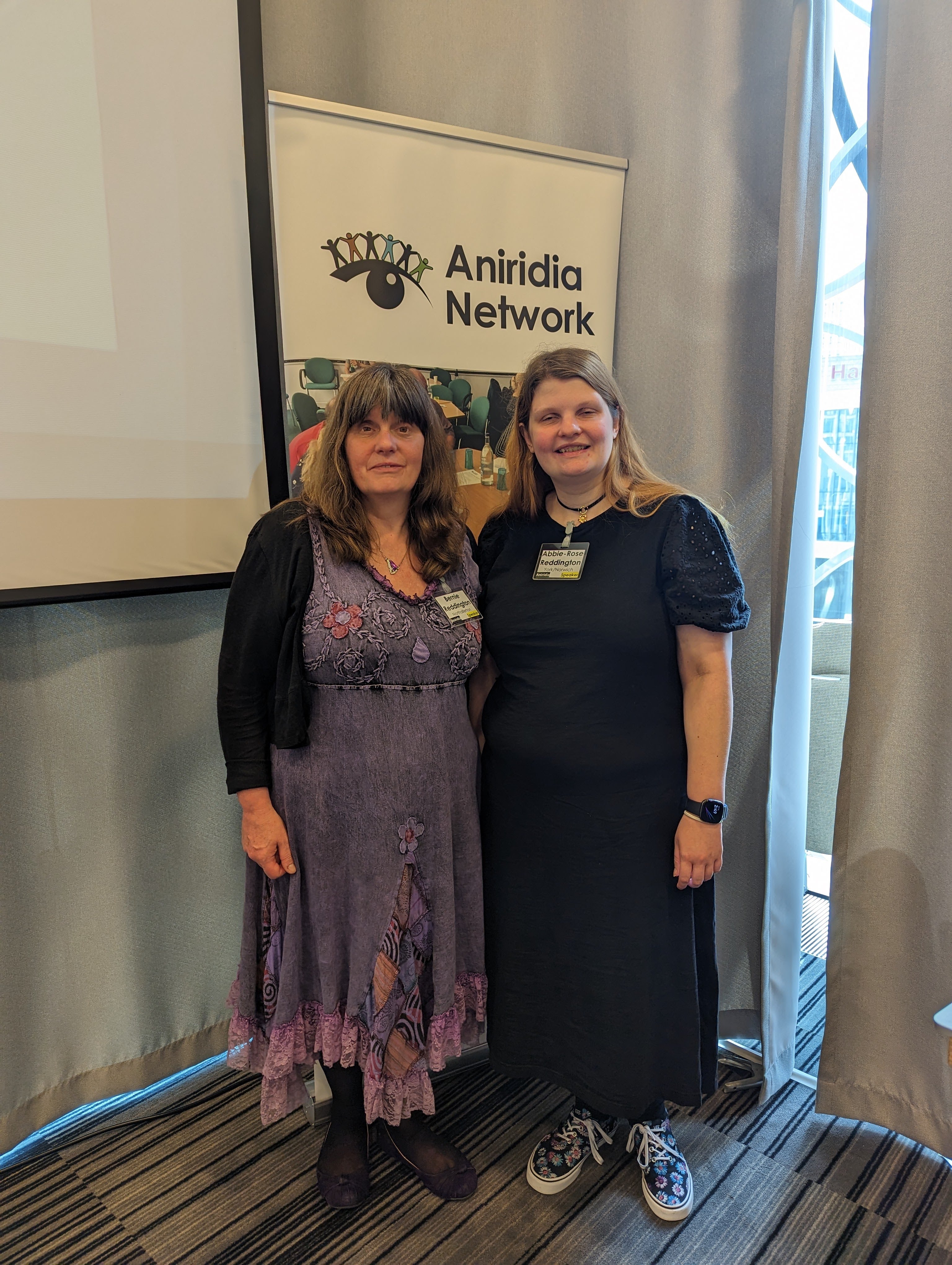
Mother and daughter Bernie and Abbie Reddington both have Aniridia and Auditory Processing Disorder (APD), which have impacted their lives in a variety of ways.
They spoke openly at our 2023 Conference in Birmingham last September about the challenges they’ve faced and the coping strategies they’ve developed using assistive technology and communication techniques. They also shared their advice for others affected by the conditions and took questions from the audience.
You can watch their discussion in the following video, below which we’ve also included the transcript.
Transcript
[Bernie] So just a little bit of information before we start. So if we talk about APD, that’s going to be Auditory Processing Disorder. So we will just shorten that to APD, especially with only 20 minutes to do it. And I’ll let Abbie begin.
[Abbie] Yes. So hello, I’m Abbie. We’re both also reading from notes as well. So if we pause briefly, it might take us a while to process.
So I’m Abbie, I’m 25. Just qualified as an occupational therapist in palliative care. And like we say, I’ve got aniridia and APD.
And as important the question is, I hate the question of how much vision do you have, because it’s so hard to explain. But I have about 8 to 10% in my right eye and 2 to 3% in my left eye. Do you want to do you, Mum?
[Bernie] Okay, yeah, brilliant, okay. So my name is Bernie. And I have aniridia as well. I have had the bingo card of all the different eye conditions associated with aniridia. And therefore, I don’t have any vision at all now.
I lost my sight completely in 1994. So it’s been quite a long time without any vision. I’ve got prosthetic shells. So I’ve actually got my sighted daughter’s eyes now. So I’ve stolen some irises from my daughter, but they’re in prosthetic form.
And I work for the RNIB, as I’d already said earlier on. I’m in work in the regional campaigns, I’m a regional campaigns officer. So we talk to decision makers and community members about things that affect them and try to make improved services and make things easier and help people really. So that’s my work.
And yeah, I have APD too. But I’d like to ask Abbie actually, so what was your experience of being diagnosed and education and that kind of thing?
[Abbie] So I was diagnosed at quite a young age, at 7 years old, so beginning of school. Too young to really remember getting the diagnosis, too young to understand the diagnosis. So it was quite hard to explain, particularly to my teachers and my peers, what APD was and what they could do to support me.
So at school from other kids, because I had to wear a microphone and headset and the teacher had to wear… well, the teacher had to wear a microphone, I had to wear headphones to be able to process the information that the teacher was saying… kids just assumed that I was just deaf.
So I was always known as the deaf-blind kid, despite the fact it’s not a hearing loss. But as a kid, you just can’t understand why you have this equipment and it makes you not really want to wear it.
[Bernie] And you actually had a bit of an issue, didn’t you, with the teacher, when they went off out of the classroom with the microphone?
[Abbie] Yes, so my teacher went out of the classroom with the microphone on still. I thankfully had taken the headset off, and I went to find them and I found them coming out the toilet with it. So I’m glad that I took that headset off!
And I found a diary from when I was younger and it had like headings for different environments and you had to say your feelings. And under school I just put “angry”.
[Bernie] So your experience at school was quite different to mine really.
[Abbie] Yes. Would you like to say yours?
[Bernie] Okay. So really from my experience, I just knew I was weird, and that was it. And I knew there was a problem and it was the listening.
It was like if it was a lot of information all at once and as I got older, once you get through middle school, it seems that all the writing starts to get smaller, and everything gets longer and bigger and faster.
And I did struggle to keep up with what was going on. And it wasn’t because I didn’t understand. It was just that, I don’t know, there was just something unknown, but no one really knew about it.
So I only actually found out in 2005 when we did the research with Dr. Doris-Eva Bamiou around APD. And that’s when I found out.
And I read about it, and I read about the symptoms, and I just cried. Because it suddenly felt like, although its label isn’t actually helpful, I just understood that there was a reason why I felt very misunderstood at school and how I struggle with social situations and listening in busy classrooms or in the playground. I suddenly realised why that was actually so difficult. So that was a bit of a pain really. But yeah, I didn’t really get a diagnosis until I was a grownup.
So what kind of things these days, how does it affect you Abbie? What sort of things does it cause a problem with?
[Abbie] So my memory’s the big one. I have terrible memory, particularly around if there’s like a lot of instructions at once, or even if I’m having a conversation with someone later on, they’ll reference that conversation, and I’m like: “You’ve never told me this before.” And they’re like: “We’ve had a whole conversation over it. Do you not remember?” And I’m like: “No, I literally remember nothing from it.” And it’s just weird, thinking I’ve had this whole conversation and I can’t even remember it.
[Bernie] And I think people think you don’t care or you’re not really being that very diligent or attentive. So like: “Haven’t you listened to me?” And you think, no, actually, I can’t listen.
[Abbie] Yeah, my organisation skills are terrible. No matter how much I try to organise my stuff, organise life. I struggle a lot with it, don’t I?
[Bernie] You do, yes. She needs lots of prompts and I think having little routines, and I think that feeds in a bit to the OCD side of you really, doesn’t it?
[Abbie] Yes, so I have OCD as well. And I also have what my friends call time blindness. So they’ll always tell me half an hour before the time that we’re actually meeting up.
[Bernie] Yeah, absolutely. So are there any other things? Do you struggle with the phone and doing things online and that kind of stuff?
[Abbie] Yeah, so with being on the phone, I really struggle to have conversations and actually be able to follow the conversation and remember the conversation. I really struggle if there’s a really strong accent or even regional accents. And then what was the other thing you said?
[Bernie] Well, languages at school, I think for both. We had a bit of a laugh about this, because we were just saying how rubbish we were at learning languages. Especially if a word is pronounced differently to how it’s written, that is actually really, really hard.
And the way people say things, we hear a thing in our heads. So it’s almost like you’re trying to predict what someone’s going to say. So you almost have your own agenda. So you hear the word coming out and you hear a certain word. And it’s definitely not that word.
[Abbie] And it’s almost like you can’t make those sounds that they’re making and you just can’t connect the two.
[Bernie] It literally does go in one ear and out the other. And you say: “Can you repeat that?” And you hear it, and you hear it again and again. And it still doesn’t make any sense.
[Abbie] And it is almost like they are speaking another language. But sometimes I can say the sentence back to them, but it doesn’t mean I know what it is.
So my prime example is going into a shop and them asking if I wanted a bag. And I just stood there and stared at them and I was like: “Do I want a bag?” So I was able to change the sentence to first person, but I still couldn’t understand what the question was and what the answer was.
[Bernie] Yeah, that’s quite a handful really, isn’t it? So I think people get very frustrated with us, because you hear what you think you’ve heard, and you believe in what you’ve heard, and you have to go with that.
And sometimes it can shake your confidence and your self-esteem, because now we know what the reason is behind it, it makes you doubt. You think: “Well, is what I heard the right thing?”
And when Abbie was a bit younger, a teenager, you know, very bolshie, something would kick off at home, she would shout through from one room to another, I would mishear her. I would answer back to what I thought I’d misheard. She’d get annoyed with me because it wasn’t anything like what she’d told me. Then she would mishear what I said. And we’d just end up down this APD rabbit hole. And it’s like: “Ah!”.
But we’re a bit better now in standing back and realising that actually it’s not, you know, why are we just not understanding each other?
And I do wonder, because a lot of people who don’t have aniridia have APD as well, and I think it’s very under-diagnosed really. Do you think enough people actually understand APD Abbie?
[Abbie] I feel like no one understands it. I’m constantly having to explain it to people. And I think it is just not known about enough at all.
[Bernie] And I think we’ve often just put it down to the sight loss. So I think it’s more obvious, because it’s actually a hidden disability really, there’s something underneath. And I find, at work in particular, it’s as much of a pain as the visual impairment.
Because I can use a screen reader to get over the visual impairment, but actually I’m reliant on a form of information gathering for me that actually is inherently hard for me, because everything I do is coming through my ears and it’s really exhausting, it’s really tiring.
So though people think: “All you’ve been doing is listening to something all day”, it’s mentally really, really tiring. But people just see the visual side of it and put down all the issues to that. But actually I find that people forget that these things sort of like intersect with each other and they kind of affect each other.
So normally, if you were to look up APD online, they’d say to get around this problem, do a video call or make pictures, so that person can reinforce that learning. Because we’re both visual learners, even though we’ve got deficient vision we think in pictures rather than words. Which is great, but actually when you can’t rely on that, it makes it incredibly difficult.
And at work, over COVID we changed our way of delivering courses from face to face courses to on the telephone courses. And I found that really, really hard going, getting used to that. Because I was trying to read a script and trying to talk to people, trying to listen to people on the phone, and it was like a mental car crash for me personally. But yeah, it was hard work. But you do get used to things in a way.
So what sort of ways have you found to get around your APD Abbs?
[Abbie] So one of the ways is at work, through Access to Work, I got a pen, which is called a Livescribe pen. So when I’m writing notes in my notebook, the pen also records it at the same time.
And I have an app on my phone, so then that information goes onto the phone. I can click on headings that I’ve written in my notebook and it will play the recording from that section of the meeting. And then I can also get it to transfer my handwriting into written text. It’s a bit like dictation where it doesn’t always get it right, but you get most of it.
[Bernie] Yeah. And I find that going into a quiet place. So if you’re talking to your kids or another person, and you know that they have APD, it’s always good not to shout across a room to them.
Sometimes when we’re in different rooms, I’ll actually come out of the room and ask her to stop shouting at me. I’ll say: “Look, I’m going to have to come”, because I’ll go: “Pardon? Pardon? Pardon?” three times because I don’t get it.
So making sure that you’re facing the person, that you’re talking really clearly and slowly, not giving them too much information all at once. And, you know, just being considerate about the background noise. Because you know when your internet signal goes down on a meeting and all you get is like broken-up speech, that’s basically what it reduces it to when lots of stuff is going on in the background.
And naturally, sighted people lip-read across the room, and when you’re visually impaired, and you’ve got APD as well, you just cannot follow a conversation.
So including your friends or your family members with APD by just being a little bit more attentive, or just making sure that they’re in, say, a central position or in a quiet space, that that can make a massive difference, can’t it Abbs?
[Abbie] Yeah. And I’ll also repeat what I’ve heard to almost confirm what I’ve heard is correct. Because another thing I find I do as well is I worry about mishearing something, or I worry too much about missing information, that I then start trying to predict what’s going to be said. Which then means I hear what I want to hear, rather than what is actually being said.
[Bernie] So yeah, actually saying it back. And actually if you’re a teacher or a parent, it’s no good saying to your child: “Did you understand that?” Because if it’s us, we’ll go “Yeah”, just to get you off our backs. And it’s better to say: “Can you tell me about what I asked you to do?”, and actually ask them to speak it back, because that really reinforces what has been said to that person.
So sometimes I will mutter back and it sounds like I’ve gone slightly delirious, but all I’m doing is actually just talking it back to myself and I can remember.
And actually, if someone’s in the middle of doing something, if they’re really busy, I find that actually it doesn’t sink in as well when I’m in the middle of a task. But on the other hand, when I’m trying to remember things, I will associate with the task that I was doing when I heard something or we had a conversation. And I can actually drag back those details out of my memory from that activity that I’m actually doing.
So do you think that’s enough Abbie? We covered all the main things.
[James] You’ve got about 10 minutes.
[Bernie] Oh, wonderful, okay. So I was just wondering if you’ve had any humorous encounters with APD, Abbie, anything that’s happened which has made your friends or yourself laugh over it?
[Abbie] So one of them is… so we’re from Norfolk originally.
[Bernie] I’m not from Northallerton by the way, even though it says I am, I’m not. [Laughter] Might have been an APD moment there actually.
[Abbie] So in Norfolk we say chimley rather than chimney. And until I was about 15/16, I thought that it was chimley. And I’ve never heard or been able to process the fact that people were saying an N instead of an L. And it wasn’t until I was looking up Norfolk terms and I saw that it said that people in Norfolk say chimley and I’m like: “That’s what it is.”
[Bernie] Yeah, and I think my favourite moment as well, we were coming back to Norwich… I think we were coming back to Norwich, but through Cambridge on the King’s Cross to Cambridge line. We went through Hitchin and Baldock. And the kids were delighted when there was a station called Pigeon and Bulldog. [Laughter] So it does have its humorous moments.
And songs, and I know lots of people mishear songs. And I think in the Titanic song, “the heart goes on” is translated in APD language to “the hot dog goes on.” And “rhythm is going to get you” is now “vitamin’s got to get you.” And you’ve got a couple as well, haven’t you?
[Abbie] So “I’m every woman” has turned into “climb every woman.” [Laughter]
[Bernie] And there’s a few rude ones we can’t really say which we discussed on the way, but we felt it was inappropriate.
[Abbie] And another funny story was recently I’ve gone to a local town with a friend and we were going to the Abbey and she turned to me and she was like: “Oh no, this is a police station.” But I heard “poo station” rather than police station. I was like: “What? Where are we?”
[Bernie] It’s not the public toilets?
But, you know, I think when we talk about it with each other, we realise that actually it’s a really varied experience. And some people with aniridia won’t have APD symptoms at all, but actually some people do and it does affect us. There’s a lot of overlap in what we experience, but it is a very individual thing.
But we’ve learned to step back sometimes. And I think when we do misunderstand each other, we’re able to step back and say: “Actually, I think we might have had an APD moment. Let’s step back from this. And did you actually mean whatever you said?” And it’s often better mended like that if we can. But now we’re actually acknowledging it, and actually sharing with people. Because I think, until recently, I wasn’t owning up to it.
Even at work, I’ve got a support worker to write notes for me now, for example, in meetings, so that I can concentrate on listening to the meeting. And things like that can make such a massive difference, just small little adaptions and things.
And I think we should all be letting people know what these things are It’s just a part of us. It’s how we are, it’s how we tick. There we go.
So have we got time for any questions or comments, if anyone has any? Have you got a question? Hello.
[Woman] I’ve got retinal dystrophy and I find it very hard because I share an office. And a lot of the time I’m the only one in the office who’s got the VI. But I hear what you’re saying, like you find it very difficult to concentrate.
Because I’m losing my train of thought, because I’m using audio to process instead of using the visual cues that we would have had. I’m using my audio cue, because I have got Ushers, but at the moment my hearing isn’t affected, but I find it very difficult to try and concentrate to dictate to my support worker, who is here today, and it’s very difficult to process what I was trying to say. And I do get very, very tired. I thought it was just me though.
[Bernie] It’s exhausting, no, it’s not…
[Woman] But I do get very exhausted, especially later on in the afternoon, because you’re constantly talking, you’re constantly dictating.
[Bernie] Yeah, absolutely. I shouldn’t be interrupting, but actually that’s a symptom of APD in itself, is interrupting people. Because we had this incident at breakfast where Chris interrupted Abbie, and I told him to shut up, and then he forgot what he was going to say. And that’s why we do it, it’s this interruption thing. So I’m so sorry.
But yes, I totally get the exhaustion. And what I’d think about really carefully, and building into your support plan at work, is making sure you take a regular break during the day. So not doing, say, back-to-back meetings, or just making sure you’ve got five minutes just to go outside and get a bit of fresh air, or just take an auditory break.
And I think that’s for VI people without, I think that’s really important for everybody. And you should be entitled to that as a reasonable adjustment in your work or in school.
And I think it’s important for kids at school to make sure of that actually. I think when my mum was a teacher, one of her kids wrote an essay and he said “School is like a warm zoo.” And I think that is actually very true. It can feel very overwhelming, and APD and general sensory overload. You need to take yourself out of that sometimes, so it can help you to deal with those intense times.
[Woman] It’s actually very hard. I mean, because I think people forget – “But you managed it so well”.
[Bernie] It’s the swan syndrome. You’re paddling like mad underwater, but you look serene on the top.
[Woman] Absolutely. The interesting thing I wanted to ask Abbie was the pen. What is that device called?
[Abbie] It’s called the Livescribe.
[Woman] The Livescribe?
[Abbie] Yeah.
[Woman] Thank you. Thank you very much.
[Bernie] We’re happy to talk to people at lunchtime as well or whenever. We’re always available.
[Woman] Thank you.
[Bernie] Okay.
[James] Any other questions?
[Man] I just want to say Abbie, you’ve taught me a lot today, especially with my grandkids. You know, the two youngest, he tends to, when you ask him to do something, he looks through you, and he’s not taken in. But then you look at the other grandchildren who can do things.
But he wants you to hug him, he wants you to cuddle him, but if he was left alone, he would just sit and put ear mufflers on so he can’t hear things like that. But when you take him on holiday, and give him a little bit of a prompt, he’s coming down water slides. “Oh, he’ll never do that, he’ll never do that.” But if you guide him correctly.
But sometimes it’s so frustrating and you think” “That is so simple, how does it not? How does it possible help do that?”
[Bernie] Yeah.
[Man] But it’s made me realise I need to spend more time, and when he’s got that fear in his face, he genuinely doesn’t know what he’s saying.
[Bernie] Mmm. And it’s just taking that little bit of extra time and maybe just taking it more slowly, giving them a little bit less information all at once. You know, cracking it down to one or two tasks or things at a time, and just building it up, and getting them to reiterate what you’ve asked them. And that just helps them.
And not in an antagonistic, in a kind of “Why haven’t you listened to me?” way, because I think then it can make you very anxious. And I think both of us have suffered over time with depression and anxiety.
And I think that goes to sight loss and to APD, and the two things combined. It can be pretty isolating sometimes. So I think people just pacing it out. So if people want tips and hints, again, we’re very happy. We’ve tried all sorts of different things over the years.
And I think because it’s quite a fairly unknown thing, it’s trial and error. I think someone said earlier about learning things as you go, and you learn what works and what doesn’t work. And sometimes the things that don’t work are as important as the things that do, because you know what to avoid in the future. So they’re not failings, they’re just a learning curve.
[Abbie] I would also say, you said about him wearing earmuffs and stuff, allowing him to have that time. Because sometimes you feel like you need that audio break and it’s just like closing your eyes when it’s too bright. Obviously you can’t easily close your ears, so it’s really important to be able to have that time to almost reset.
[Man] How do you find eating? He eats the same thing all the time.
[Bernie] Ooh, ah.
[Man] He will not change, no matter what we do.
[Bernie] Right, this is anecdotal. We were talking about this last night as a family. We think that actually it’s wider than APD, it’s more than just auditory processing. It’s more of a sensory issue.
So Chris in particular, my son, who’s sitting somewhere in the room, he’s over there. You’re very anxious about different textures of food and stuff like that. And for a long time, when he was a baby, all he would eat was cucumber and ham. And the health visitor was just: “Well, actually it could be worse.” And she said: “Just carry on.” And he was okay. But you do avoid a lot of different texture foods, don’t you?
[Chris] Yeah, and even textures of clothing. I was very nervous about having numbers on your football shirts and stuff. I remember, it sort of ages me, but having Beckham on the back of a football shirt, and I was really nervous to wear it because I really didn’t like the way that the waxy stuff felt on my back.
And even to this day anything touching, I’m a bit like “Ugh”, if anything touches my upper back it’s very sensitive. And I think, yeah, foods, touches, sensitive clothing. Even the way I have my hair. I will feel my hair and if it doesn’t feel the way I want it to feel, I will wash it. I’m like that, because I’m very high maintenance.
[Bernie] Exactly, yeah. I think it is, it’s a wider thing.
[Abbie] I think it also kind of goes the other way as well, because quite often I crave particular feelings and textures.
[Bernie] You touch things a lot, don’t you?
[Abbie] I touch things a lot with my OCD, I have to touch things a certain amount of times because I’m craving those feelings. And yeah, I have to be able to get those textures, otherwise I just can’t sit still, I get really fidgety and uncomfortable.
[Bernie] You use fidget toys a lot, don’t you actually?
[Abbie] Yes, I have a lot of fidget toys.
[James] I’m going to call a halt there, because I’m sure everyone’s keen for some lunch. But you can obviously continue this conversation over lunch. So thank you very much.
[Bernie] That’s okay, thank you.
[Applause]
Thank you to Glen for the video editing and write-up.





 Aniridia Network
Pingback: Living with Auditory Processing Disorder | Aniridia Network
Pingback: Conference 2023 review | Aniridia Network