
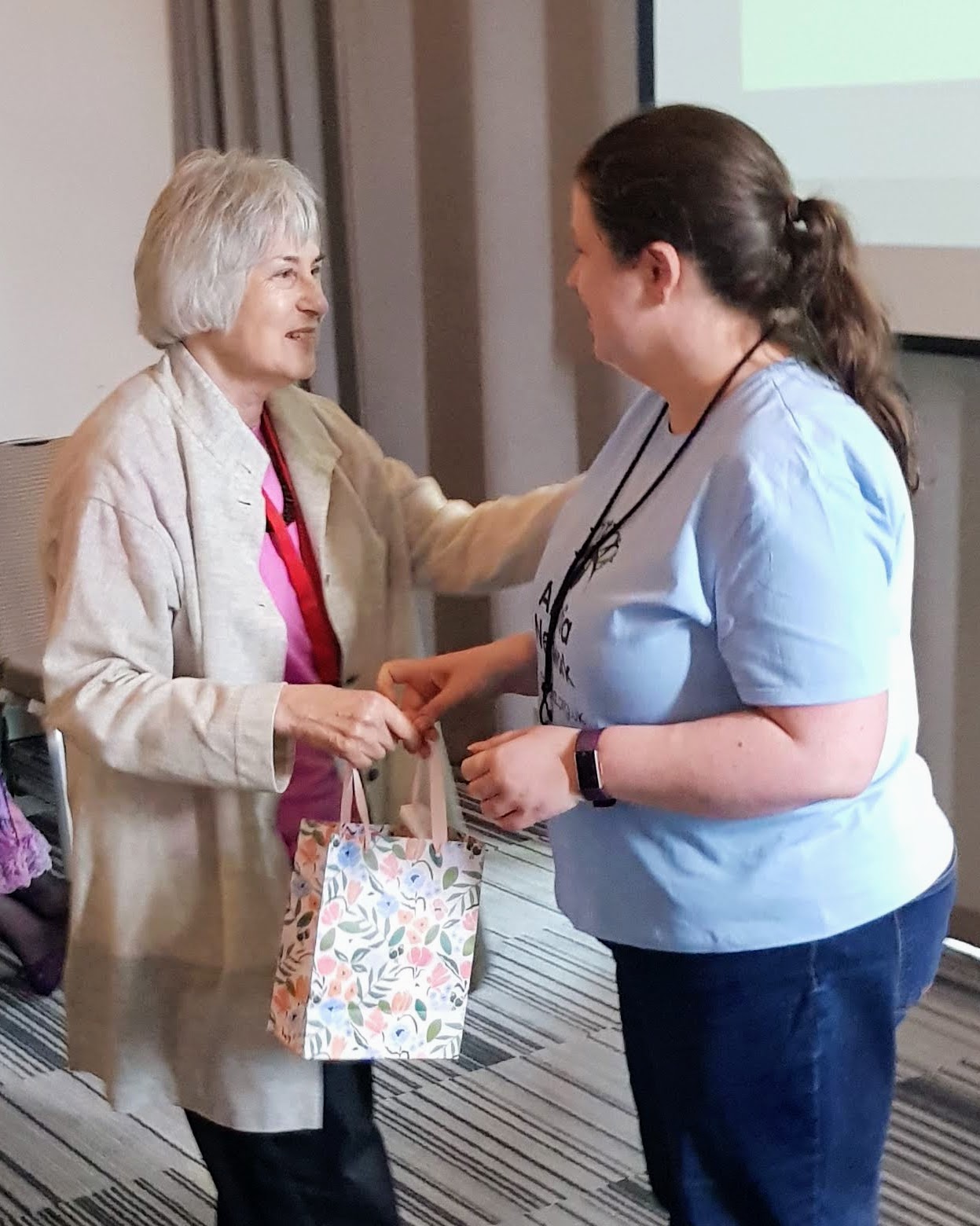
We honoured the huge impact Veronica van Heyningen has had on our understanding of aniridia at our recent annual meeting. After a distingushed career growing understanding of the diverse functions of the PAX6 gene that often causes aniridia, Veronica has spent a decade as Patron of Aniridia Network.
At our 2023 Conference in Birmingham, Veronica joined fellow patron Tony Moore to reflect on developments in aniridia during their extensive careers and to look ahead to the future.
Chair of Trustees Katie Atkinson then followed up their retrospective talk with a short speech, and presented Veronica with chocolates, flowers and a certificate of her Lifetime Achievement Award with the citation:
For helping make people hopeful, confident, supported & well informed regarding aniridia.
Through an illustrious career growing understanding of PAX6. Enabling Aniridia Network to better meet the needs of its members as a volunteer, donor and Patron.
Aniridia Network has enormous pleasure to present this award with the unending admiration and gratitude of the Trustee Board.
Veronica intends to remain as patron while stepping back to focus on caring responsibilities. To fill the gap she first secured the eminent Tony Moore to be a new patron.
You can see the video of Veronica and Tony’s discussion below, along with the video of Veronica receiving her award. The transcripts are provided below as well.
Transcript – Veronica & Tony’s Reflections
[Andrew] I’d now like to warmly invite our two distinguished patrons, Veronica and Tony, to come up please. Patrons are a great asset to any charity, and Tony and Veronica are passionate about promoting the charity’s work and objectives, and we thank you for all that you do for us. And they’re just going to spend a little bit of time now looking forwards and looking backwards.
[Veronica] Okay, well it is wonderful to be back here again and back with you all. I’ve really been enjoying being patron. So I’m a research scientist and I have worked on aniridia for a very long time. I was there at the time when the gene was identified, I was involved in it but I’m not the only one obviously. The PAX6 gene was identified in 1991. And of course all of that work was a huge collaboration, international, between scientists and clinicians.
And actually we couldn’t have done it without the patients. Although I didn’t know many of you until much later, quite a lot of you were on the panel, and I’ve been collaborating with Tony and I will keep coming back to this for a long time. Quite a high proportion of the cases that we started analysing when the gene was identified came via Tony Moore at Moorfields. Because I think it’s one of the biggest centres and Tony is a fantastic observational clinician as well as a very good geneticist.
So the identification of the gene started with patients who had deletions, WAGR patients mainly, because that was the easiest way at that time to try and find a gene. But once the gene was identified, then we were interested in everybody who had anything like aniridia.
And indeed because we also worked with the model organism, the mouse, we identified features and published about them. So the mice have reduced eye size, the heterozygous mice, the mice who have aniridia also have reduced eye size. And the homozygotes, because we can breed them, are lethal, so we’ve learnt a lot about PAX6 just from the mice.
And because people, clinicians like Tony and others, read about that work, they also sent us people with microphthalmia, not just aniridia, so the spectrum of phenotypes that we were sent was very large. And we made cell lines from everybody and their DNA, I hope, and that the cell line actually is still I hope in Edinburgh. But I think it’s getting a bit outdated now, because as you know you don’t have to give blood anymore, you can just spit in a tube to get your DNA. So things have really advanced a lot and that’s just one little thing.
But the science has advanced absolutely hugely and in a way I think we haven’t mentioned that perhaps enough. You know, there couldn’t be the amount of information, with or without the internet, 10 or 20 years ago as we have now, because we didn’t know all the facts.
The facts are still coming, people are still working on PAX6 which turns out to be a very important gene in early development of the brain, the neural tube, the spinal cord, as well as the eye of course, but also the pancreas, and different bits of the brain are dependent on PAX6 expression.
And because we studied that expression pattern, mainly in mice ,but it’s very, very similar to the human, and Tony met up with Sanjay Sisodiya and he is the person who started the imaging, the MRI scanning of a number of you who were volunteers. And so it was he and his team who identified for example the absence or reduction of the anterior commissure, which is the link between the two parts of the brain and reduction in the corpus callosum.
So those were considered to be part of the features that might be involved in the hearing problems. So it’s the processing that is at fault. Each ear is working fine, but the connection between the two halves of the brain is probably damaged right from early development probably.
So knowledge is accumulating and we need that. We still need to come back to all of you, because to talk about what you are finding is so important to understanding the biology. And it’s only if we understand the biology that we are going to be able to develop better ways of management and treatment for aniridia but also many other genetic diseases.
So really it’s a sort of circular process, we needed you all to participate and to help us find the gene, then to look at the spectrum of mutations that we also heard about from Vivienne and possible treatments that are being thought about with different mutations, heard about from those.
So it’s a constant toing and froing, and that’s why I’ve really enjoyed being patron here and meeting so many more of you, and seeing how brilliantly you cope with difficulties that, you know, are not the easiest in life. I’m really always full of admiration when I meet any of you, so keep up the good work.
I also think Aniridia Network has developed hugely. I think it was in 2012, just as I was retiring, that you asked me to become a patron. And now I’m getting pretty old, so I’m 76 now, and my husband’s not all that and he needs quite a lot of attention. And so I thought it was really time that we had at least a second patron.
I’m still around, but I think Tony, who’s quite a bit younger than me is going to be absolutely excellent, and many of you have known him for a very long time. He is a wonderful clinician. He was the holder of the top chair in ophthalmology in Britain, the chair of ophthalmology, and he will be a fantastic new patron for you.
[Applause]
[Tony] Thank you Veronica for those very kind words. I didn’t recognize myself. When I was asked to become a joint patron of the Aniridia Network, I immediately agreed. I thought it was a very great honour.
And I’ve looked after children and adults and families with aniridia my whole professional career. It’s been a great privilege. And when you’re as old as I am, I’m only two years younger than Veronica, but you have the privilege of seeing children with aniridia go through life into adulthood. And, as old as I am now, you have the privilege of seeing them having their own children with and without aniridia themselves. And it’s been a great joy. And as Veronica said, I have nothing but admiration for the parents who fight the system to get the best care for their children, and also the fortitude of the children and doing so well as they’ve grown older.
When James asked me to do this today he said “Well, you should introduce yourself.” Well, Veronica has done that to a large extent, but to give you my background, I’m a clinician who has an interest in research. I went to the local grammar school in Slough – you know “come friendly bombs and fall on Slough”, and I got out of Slough as fast as possible.
As an aside actually, my nephew saw an ad in a competition in the Slough newspaper to write a eulogy about Slough to counteract John Betjeman’s poem. And he won first prize. And the prize was given by Attila the Stockbroker, I don’t know if you’ve ever met him, a very great poet. And his opening words were “Come friendly bombs and fall elsewhere, not on Slough so fair.” Anyway, it went on like that.
And then I read physiology at Oxford, then went to medical school there, and did junior medical jobs in Oxford and then Moorfields. And then I did sub-specialty training in paediatric ophthalmology looking after children, I did a year at Great Ormond Street and a year at the hospital for sick children in Toronto, which is a fabulous institution. And I came back and I did inherited retinal research for a while, waiting for a job.
And you’re all too young to remember this, but in those days you only got a job as a consultant when someone died or retired. They didn’t create new jobs. And in fact all of us senior trainees at Moorfields who were waiting for a job had a little map of England, with the red mapped recently died, the black one seriously ill and the yellow one was still thriving.
And it was very sad, because some very good ophthalmologist died in Cambridge and I got a job at the Addenbrookes hospital in Cambridge, which is a wonderful institution. I stayed there for 16 years and then, as Veronica said, I moved to an academic job to the Duke-Elder Chair at Moorfields. And that was a real fantastic institution, it was a real privilege to work there.
And after that, when I got to 65, I didn’t want to retire, and so I went to California and worked in a medical school in San Francisco for the last six years, which again was a wonderful experience, because I got to see how the American system worked. And the one big difference is the medical system is fantastic, but the social support system in the States is abysmal. If you have children with vision impairment and other things it’s not good.
And I’ve had the great privilege of collaborating with Veronica in particular and other scientists, and James says “Maybe look back at aniridia when you started and how it is different now, the management.
Well, I was appointed in 1986 to Cambridge and all that we did then, we really only diagnosed children and adults with complete aniridia, with no iris and barn door eye phenotype with nystagmus, and we knew they had it. And all that we did with children that were born with aniridia was we regularly ultrasound their abdomen to rule out a kidney tumour, and try and help them through the complications.
And then, as you say, in 1992 Veronica’s team found the PAX6 gene causing aniridia. And that had a real major influence on the field, because we could start to see how different spelling mistakes could cause different changes in the eye. And it was very, very interesting because different eye conditions you would never have thought had aniridia had different changes in the PAX6 gene. And then the next thing was, well, this gene is switched on in the brain, the pancreas and the eye, and in specific parts of the brain. What does it do?
And Sanjay Sisodiya, who Veronica just mentioned, was a very bright neurologist in London, and he had a grant to look for developmental brain genes, and it wasn’t going very well, and he had an idea. And he came to talk to Veronica and I. The idea was take a gene that gives you an eye abnormality that’s absolutely recognisable, but who appear in talking to patients, and I can talk to all of you in here and know that you’re normal and intelligent, just normal people, and ask the question “What’s wrong with the brain?” And he said “Do you think that’s a good idea?”
And I thought, well, it’s quite a good idea, but there was one drawback, and that was I had to write the Moorfields ethical committee approval form. Has anyone ever seen one of those? Well, it takes days to write, and so I held the project up for a while because I had to write this. And the other interesting thing was, when I was reading about this to fill the form in, there was one case report of a patient with aniridia that didn’t have a sense of smell. So we put smell tests into the thing. And the smell test is you scratch a pad, sniff, and say what… you know, is it pine or whatever. Anyway, so the project got off the ground and it was amazingly interesting, as Veronica said.
And the other serendipitous thing, which is related to the earlier talk, is a patient rang me up. There was a patient in Sanjay’s study, who’d gone for a hearing test at Queen Square, the big neurology hospital, and the doctor said “Well, she’s got normal hearing in each ear, but she’s got this rare thing where you can’t put the hearing together, you have this hearing processing disorder. And isn’t it strange she’s in your study.” So we then recruited other patients Veronica had found into that, and that started that whole thing.
So there are a couple of lessons from that, is that often little accidents like that, if you don’t just leave them aside, if you think about them they can push the research forward. And the second lesson is it’s always better to have lots of scientists with different interests sitting in the same room drinking coffee, so that you discuss these things.
So the final thing is, what else has improved over this time I’ve been in? Patient care has improved. Sub-specialisation in ophthalmology has been fantastic. You can now see a corneal stem cell expert, you can see someone who can do a very good cataract operation in an aniridic eye, you can get very good treatment for glaucoma, and that’s been fantastically good for patients.
The drawback to that is there’s a danger of you going from A to B to C and back to D again. Like, I’ve done the cornea, but you can’t see any better, why don’t you try a cataract doctor? Why don’t you go to a glaucoma doctor? So you need someone to give you good holistic care, and that’s a challenge. And I think we’ve learned a very interesting last talk about how technology has really, really helped children and adults.
And I think the management of aniridia… now, I am old now. Since 1986 when I started as consultant, the management of patients from the medical point of view is amazingly better, and I think it’s also the management from the point of view of school support is improved, maybe not good enough but it has improved. And we know a lot more about the genetics about why changes in PAX6 give you the problems with the eye, the brain, the hear and the sense of smell.
What’s the challenge that’s left, what’s the future? Well the challenge is to, like all genetic eye disease, develop treatments. Because if you’re like me and see a lot of other genetic eye disease, if you’re born with vision impairment and you’ve got a stationary condition that doesn’t get any worse, that has vision about the level of aniridia, those patients go throughout life much more easily with less challenges than those with aniridia, because of the later complications.
And I think that the combination of the new genetics, gene editing, stem cell therapy, are really going to solve the corneal problem. Won’t be too long either. And that just leaves you with glaucoma to prevent and treat, and that will probably be in the hands of the surgeons. But techniques are improving all the time in that field.
So I hope that gives you a bit of optimism for the future. And again, I want to thank all of the patients with aniridia that have helped my research and Veronica’s research over the years, and also say again it’s been a great privilege working with aniridia. I’m looking forward to working as a joint patron with Veronica for the Aniridia Network. Thank you very much.
[Applause]
Transcript – Veronica’s Award
[Katie] So if you haven’t seen me yet today, I’m Katie, I’m one of the trustees. I am here with what’s hopefully a little bit of a surprise for Veronica. If you’ve been to our conferences before, you know as well as thanking all of our volunteers, we do like to recognise the contribution of volunteers who have gone that little bit the extra mile. And so we’d like to present Veronica with a lifetime achievement award.
As she said, she’s been patron for over 10 years, and in that time I think she’s been to almost all of our conferences that we’ve held, as well as attending, I think, again, all or most of the European aniridia conferences, which bring together the medical, the scientific and the patient communities all together in one place. And I think she’s also been to conferences for aniridia in the US and beyond.
So having someone like her, who’s got a distinguished scientific career behind her, really helps us build the links between the patient groups and the medical and scientific communities, and really helps to push forward the research into aniridia.
So we have a certificate and a small gift to give Veronica now. And we’re also going to send you a bunch of flowers.
[Veronica] Thank you. You are one of my examples of a real successful person, you know, you’ve really done fantastic. You’ve got a PhD in physics.
[Katie] That’s right, thank you very much. And thank you for everything you’ve done.
[Veronica] Thank you. And you were one of the people who asked me.
[Applause]
Thank you to Glen for the video editing and write-up.






 Aniridia Network
Pingback: Conference 2023 review | Aniridia Network