
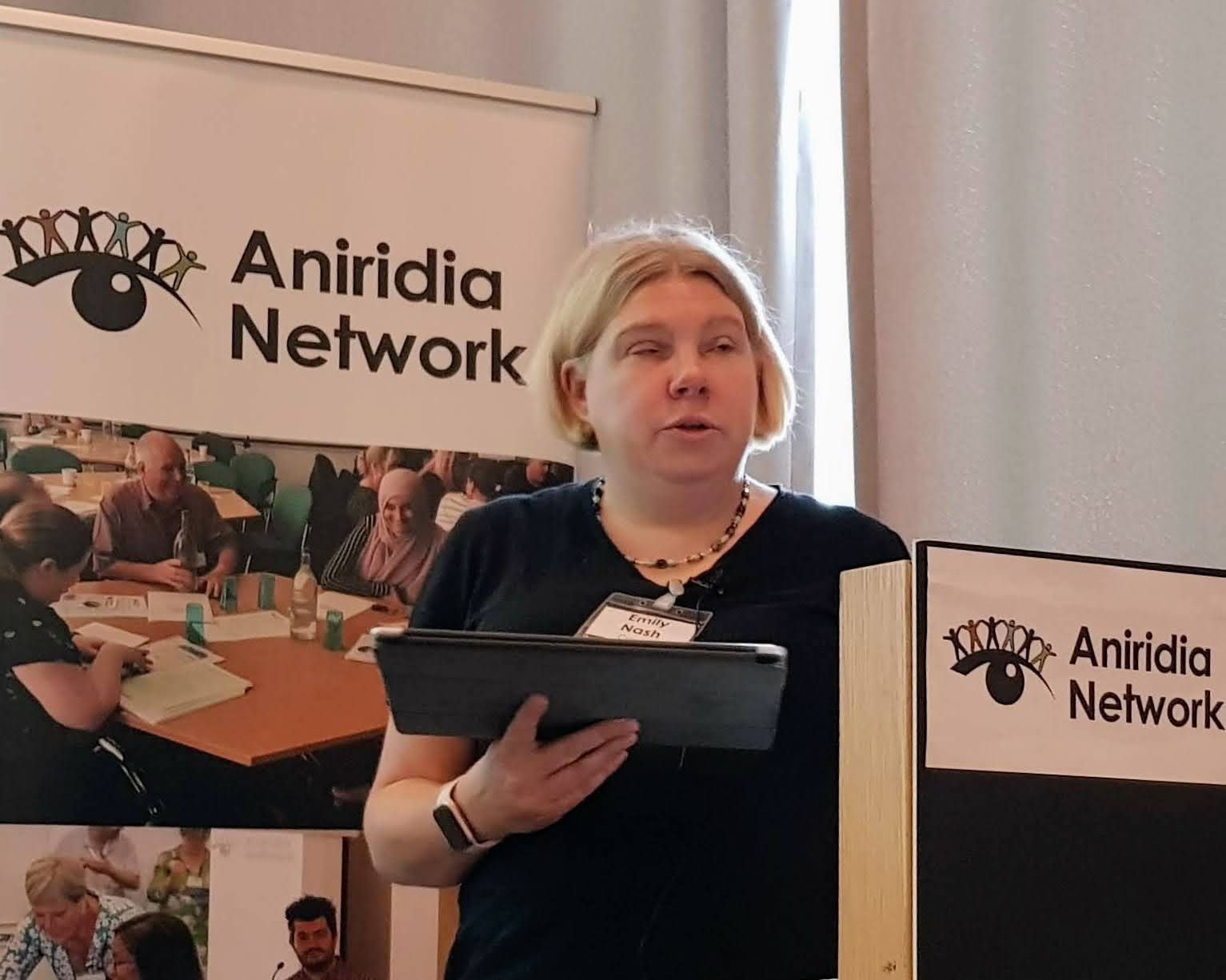
At our conference in Birmingham in September 2023, Emily Nash gave the following presentation discussing her life with aniridia, and her upcoming research study into how the accessibility of transport can be improved for people with sight loss.
The study forms part of Emily’s PhD at Coventry University, and is jointly funded by the university and Motability,
Update December 2023
Emily is doing 30-60 minute interviews about your rail travel experiences – positive and negative.
You would get a £10 voucher for your time and participation.
The interviews will be anonymised and used to inform future studies looking at how better to support travellers with sight loss, be more confident and independent in their travel.

To register your interest contact nashe5@uni.coventry.ac.uk
Here is the video and transcript of her conference presentation.
Transcript
[Emily] Good morning everybody, thanks for inviting me to talk today.
My presentation today is in two halves. So the first bit is I’m going to talk about my personal experience and some of those things Helen was just touching on in that question session.
So I will talk about my personal experience as both a patient with sporadic aniridia, so definitely that journey about learning and exploring aniridia for the first time. But then I’m also a parent of two children with aniridia, so that experience as well.
And then the second half of my presentation is regarding my research that I have started earlier this year at Coventry University, jointly funded between Coventry and Motability, looking at accessible transport for those with visual impairment.
So just to start off talking about my journey really, I’m just going to reflect on my life and my experience since I was born with aniridia.
So looking at how I wanted to really fit in, looking how I went and explored the world, but then probably more recently really learning about the condition, finding others with the condition and then looking for that support.
Because I’ve definitely got that experience of having to navigate it, taking time and actually being quite a bumpy journey along the way.
Helen in the discussion just talked about experiencing sight loss as an adult and I would definitely say that that’s how I felt really, that I was born with a visual impairment that was quite stable until I was about the age of 25, and that’s when I started seeing that deterioration.
So in terms of my school life, I was born with sporadic aniridia as I said, the third of three children and I went to a mainstream primary school and secondary school, but I had no formal help there.
I had some helpful teachers who would do the odd thing off their own back, but there was no real structured approach to any support I had.
And I found that this was quite a lonely experience at times, that I didn’t have anyone to talk to about what it was like to have a visual impairment or perhaps to find strategies. So everything I learned really was by trial and error and therefore took time.
But I see quite a different experience now for my children, who’ve got coordinated care, both within their school with teaching support, but also the visually impaired teachers from the local authority as well.
And it’s certainly a much more coordinated approach, with a psychological component I think as well, so the ability to talk about the condition, but then access to other social events as well. So I do definitely think that is quite different.
When I was in my 20s, I still didn’t really know anybody else with sight loss. I was still quite convinced that I could probably do the same as everyone else and I set off to explore the world really and my vision certainly didn’t have as much impact as it does now.
But I travelled independently to Australia and New Zealand. I’ve also lived around the UK as I went to university, and I studied psychology and then later physiotherapy at Cardiff University, which really started on my career managing personal injuries, and really advocating for the psychological and physical interaction really, in this kind of injury management, but I think any conditions really.
And I think that’s still an area that is lacking really is the psychological support. And I also played ladies football really.
So up until this point I probably knew very little about aniridia and I certainly hadn’t met anybody with aniridia.
But as I said, when I was in my mid-20s, I did begin to see a deterioration in my sight. And it was only my consultant at the time who said: “Go away. Go away and look at what we know about aniridia and what treatment options there are.” Because some of the surgeries, stem cell transplant, those types of things were just beginning to come around and available.
So I was a student at the time, so I spent the day in the library, going and having a look, and suddenly began to learn about what aniridia was and its wider implications as we’re going to hear today, beyond just the lack of the iris.
I was lucky enough to be referred, or I think I was lucky enough to be referred really, to the Queen Victoria Hospital in East Grinstead, where I’ve had my care since 2005. And going to a centre of excellence really has just made a massive impact on being able to preserve my eyesight I think, and being able to learn and understand how to do that really.
So since then I’ve had a number of surgeries. I’ve had stem cell transplants, I’ve had a Morcher lens inserted, I’ve had two cataract surgeries, and more recently two corneal transplants.
But I think really being able to know and understand about the condition has really allowed me helped, but they are a time commitment, they have been a travel commitment to get to East Grinstead, and a medication regime afterwards. And I’m still on a cocktail of eye drops today, which takes its toll in terms of completing every day.
I do think this knowledge has really helped me navigate for my children as well, what they require and what they’re likely to require, particularly when they’re young and they’re unable to tell you. I found this really useful when they were preschool, because I think it’s quite hard and a lot of the health professionals I worked with don’t know much about the condition either really.
So I think to give an indication of perhaps what the sight was like or what might be needed was really useful.
It was only really when my son was born – so our first child was born in 2014 – that I really decided I wanted to go and meet others with sight loss. So that’s only really a decade ago.
So I’d spent most of my life not knowing anyone else really with sight loss, and not appreciating that we all have such common experiences really.
So I became quite a passive user of Facebook and saw many of the group discussions. I also joined Aniridia Network and became a trustee, many years ago now, which was also useful in just understanding the condition.
And now more recently for me and the children, I’ve joined a variety of both national support networks, so things like the British Blinds Sports, but also a local support group for me only last year, which is an adult group of working age who go out and do activities.
And for my children there’s a local… it’s called UCAN, but it’s a children’s activity charity really.
And so really it’s only over the last decade again that I’ve just really kind of explored that support that is required.
And I think the support that all three of us requires is quite different. And that’s probably something I hadn’t appreciated before having children really, that I knew that I would understand the condition, I would know what they would probably need or experience.
But what I probably hadn’t appreciated was the resources to try and navigate three times through a system. I mean it does feel that really, that things aren’t combined, I’m having to repeat the same journeys for each of us.
But we do have a variety of different supports, including educational support for the children, I’ve accessed the disability student allowance and access to work in the bits that I’ve done. We both have social services support, so direct payments.
And I’ve had white cane training, but again they’re two different systems, adult and child services, which is sometimes challenging. And then I’ve used some of the charity supports as well, so I’ve currently got a guide dog application in, I’ve used the RNIB telephone counselling for that psychological support, which I think is just so important. But I’m still finding it hard really to find local social groups and local social activities for us all.
So if I was to just reflect what would be my tips or summaries, in terms of what I’ve learned for somebody with sporadic aniridia, and I think learning about the condition has just been really key for me, just to make informed decisions and really understand what we might require, and why the children are different, why their experience is just quite different to me.
I think talking about what it means to have a disability is really important, and I think as a nation we’re doing that more, but I think people still find it really hard to understand the daily impact and the accumulative effect of having to take more time to do every activity, or the regular medication every day, and I think that’s somewhere that we still need to be educating a wider population on.
As I said, psychological support for all long-term conditions, and I found this quite hard to access. Because yes, as I’ve had more sight loss, the challenges change the support you need, and you’re almost starting again, but there aren’t really any services to support that.
And then lastly, really, I just want to be actually contributing to some of our solutions really that will make a difference, and that’s where my research comes in really. That’s where my journey with aniridia has taken me to the National Centre for Accessible Transport (NCAT).
So I don’t know if many people have heard this, it was on the news at the start of the year, where Motability have put £20 million worth of funding into a consortium based at Coventry University to look at accessible transport for all disabled people.
The focus is very much that there is still a gap between disabled and non-disabled users of public transportation, so that’s everything from your taxis to airlines and everything in between.
And so they found, in 2022, they reported that disabled people make 38% less journeys than those non-disabled users. But this statistic has not actually changed in the last decade, despite things like the Equality Act in 2010, the Inclusive Transport Strategy in 2018, which have been designed to encourage inclusion, yet we’re not seeing difference. And as Helen said, in terms of lack of research, there is certainly a lack of evidence in this area.
So there are a number of projects being supported, but the three of us on the left-hand side of this picture are all PhD students at Coventry University, and in order to be able to apply for the course, we all needed to have a lived disability, so a lived experience of a different disability. So I’m looking at sight loss, the others are looking at manual handling on airplanes for those with mobility issues, and also quality of life of what access to transport means.
So that just takes me on really to talk now a little bit more about my actual research, and so this is just the background to what I’m going to be doing and what I want to be looking at.
So as I said, it is a PhD, so it’ll be a three-year program of which I’ve only just really started. But I think just in terms of vision, we know that it can give us rich information, it can tell us about perhaps risks, it can tell us about the environment around us, perhaps the climate, but it can also give us emotion and also that memory of past experience.
But what does it mean when we’re trying to get around and we don’t actually have that vision?
Accessible transport is just so important in order for us to access healthcare or employment activities, but also social activities. And all these are just really important aspects of just feeling part of a community.
As I said, there is limited research really, in terms of accessibility to transport, and we know it’s also quite varied around the UK. If you talk to people in this room, we’d all have quite different experiences, and that’s quite a challenge really. And there really is a lack of evidence of looking specifically at sight loss as opposed to other disabilities.
And certainly with the trains, currently an accessible station is classed as step free. It’s not necessarily looking at, is there tactile paving, where’s the presentation of signs? So it’s quite limited, currently the guidance in terms of what constitutes accessibility.
So the RNIB have estimated that there’s 410,000 people of working age with sight loss, and this is obviously a variety of conditions. And the Vision Strategy of 2008 really wanted to ensure earlier diagnosis of eye conditions, improving eye health, but then also providing effective support once people have had a diagnosis. And really it’s this area I feel that just still hasn’t really reached its potential in order of supporting us.
So in my research, I am looking at all those with sight loss. So Helen did mention a number of different conditions, and I think similarly, in this space really, a lot of the research has been done with people with macular degeneration of an older population, whereas I really just want to make sure that I’m just capturing the voices of all those with sight loss, whatever the age and whatever the stage as well.
Because I think there is so much variation in sight loss and what people need, and I certainly think even what my children require to what I require is quite different, and I don’t think that’s really currently taken account of.
So I’ve talked already a little bit around my experience with aniridia. But as I said, my sight began to deteriorate when I was 25. But now I really find that detail is a challenge. I can’t read normal print and I can’t recognise people’s faces.
And while this isn’t my vision per se, it just gives that idea really of how our vision differs. But for a traveller, they need to be able to know where they want to get to and know how to be able to get there, avoiding things like street furniture, other people, or signage posts.
So to date, really, guide dogs and white canes have just been associated with mobility. The guide dog’s job is to get you from A to B, it isn’t able to give you that feedback on the environment. And similarly, the white cane may be able to tell us about the presence of kerbs or tactile markings or steps.
But there’s so much more we need to know in order to navigate transport systems and be able to get to our destinations. So we’re just going to consider some of these.
So there’s a book by Goldsmith in 2018 that looked at the mobility of visual impairment, and looked at all the components of orientation and mobility. And certainly my experience is that I’ve had very limited orientation and mobility input.
I’ve had a couple of sessions to use a white cane, but very little other support in terms of how I get around, either like locally or more nationally. And everything has been by learning it myself.
If you just think of a station, things like landmarks are commonly used by those with sight loss. So we might use things like a statue or a bench or a clock. But people may also use the colour of railings or the numbers of pillars to know where they are.
And people in this room could actually probably describe in more detail than your average person, perhaps their route today here, and what you passed, because then that begins to form our cognitive mapping really, of our memory and how we get around. And it’s that cognitive mapping as well, that is really just a learned skill for those with visual impairment, which allows us to build the map.
And when we’re getting around, we’re doing it from memory, rather than using those visual cues. And that’s why, things in our houses are so important, that perhaps that we’re not moving those. And just having things like your tea, coffee and sugar in the same order is just quite important.
So there are some local initiatives from a transport perspective. But they’re all local, as I said really.
So for example, South Wales have a confident traveller programme, where they take out groups on their network for days out in order to try and get them used to the network, and therefore be more confident in travelling independently. Virgin have installed these large print tactile maps on their East Coast line.
But there’s currently a lack of consistency and a lack of sharing. So each train company who manage their stations will have an accessibility group, and will look at doing some initiatives. But there’s not really that sharing. So travelling from Cardiff to here, I’ve potentially travelled through three different travel company stations, and they’ll all be different.
And so certainly my experience of coming from Cardiff to England is they don’t use the passenger assist app. So Cardiff can’t use it because of bilingual laws. And suddenly it breaks down that support. So there’s a real need to understand what’s working and perhaps what’s not.
And so the RNIB’s also just done research which they released in April 2023, looking at inclusive journeys. And they also reported that 37% of those with visual loss found it difficult to use public transport. But then over 80% felt that they needed assistance going on an unfamiliar journey compared to a familiar journey. So we know that that experience has an impact too.
But we need to be able to help people find the red train sign at a station, maybe the entrance to the left hand side or be able to navigate the steps.
So my research is going to use the visually impaired community with a variety of methods. So I’m still yet to determine how I might do this. But certainly it will be surveys and questionnaires with people. And that’s what’s typically been used so far.
And one example, they did a study in 2018 of London Transport and they interviewed 13 people, looking at their experiences, and how they found that the turn up and go assistance was for a whole journey. And that’s maybe not what people required. But things like access to the Freedom Pass did give them some better access to transport.
But it’s very much a recall of people’s experiences. And we know that our recall is… you’re quite often going to recall when things go wrong, rather than when things go right. So they’re good at identifying barriers, but are they good at identifying what we’re doing well?
So we still got a good proportion of people with sight loss who were able to navigate from their front doors to their desired locations, using a variety of skills and knowledge. And that is what I just want to try and understand more.
So I’m just going to look at people actually, while they’re travelling, looking at having a diary, so an ethnographic study.
So it will be at the time just being able to record what type of aids we use. So it might be guide dogs or white canes, but it could also be monoculars, magnifiers, that type of thing, as well as different types of apps. So there’s quite a few out there, perhaps like your GWR or Trainline app, but also those a bit more specific for those with sight loss.
But certainly the RNIB found that there was quite a variation and not everyone was using these technologies. So just trying to understand why are we not taking them on board and using them. But then also understanding what skills or what prior knowledge people know.
So we know that if a route is more familiar, that we are more likely to use it, we can do it independently. So just trying to understand what is it really that we have learned on that way. And then largely what skills. So do things like white cane skills or the ability to use some of these apps and interact with them, allow us to problem solve as we travel?
So this is just currently the level of information that is available when you look at train stations. So it’s just a 2D representation, happens to be of Coventry. But I think this is quite difficult information to support travel.
And we know that you don’t go to many conferences where, like Aniridia, have given the detailed instructions from train stations. But that’s what we need to be seeing really, I think.
And we are beginning to, there’s a couple of stations now in South Wales where you can go on and you can have a bit more of a virtual tour of a station, which is so much more useful than perhaps just this 2D representation.
But really what I want to be able to see really is a day where we can just have that flexibility that non-disabled users are having with travel, the ability to turn up and go, get assistance for those bits that are important to us.
But also I think, you know, I’ve reflected my personal experience of my orientation and mobility training being quite limited, and I think we need to be providing more skills and knowledge as our transportation systems and our communities get wider and more complex.
I think that training needs to keep pace with it really and providing support. And I believe that’s what will give us more access to all those activities that we want to do.
So my last slide is just the details. If anybody wants to know a bit more about what is happening at the NCAT, there are a number of other projects going on and my details are there as well, if anybody would be interested in becoming involved in my research, that will probably start I would have thought kind of January next year. So January, 2024, I’ll be looking for participants to share their experiences while they travel around.
So yeah, has anyone got any questions?
[Person 1] Hello.
[Emily] Hi.
[Person 1] More of just a… yeah, I think it’s really… listening to what you’ve said, it’s really, really important.
I think some of the positive things that you say about South Wales come from some of the customer first work that’s being done on the part of Transport for Wales, particularly around some of the work that Geraint does and Confident Traveller schemes and all that. It’s all tied into this thing called Customer First. It’s under resourced, completely under resourced.
I know of no other train operating company that do anything like that. Would you think that something similar would work outside of Wales in the English setting as well? Or do you think it’s… with obviously Transport for Wales being owned by the Welsh government, there’s a definite responsibility there. The train operators in England, they don’t have that.
Do you think that’s something that they should be doing as a matter of course?
[Emily] Yes, definitely. I think they should be. I think this is part of the challenge really, that there’s no consistency.
But then also I think it means then, for us being able to access that information, you’ve almost got to go and look at what each train operators are doing.
And I’ve learned so much in the last six months about how to travel, because I happen to be doing a PhD. That’s crazy, isn’t it really? I’ve got 40 years of experience of sight loss, and I’ve learned stuff.
And we’re learning stuff from each other, sitting in a room like this and sharing tips. Which is great, but that shouldn’t really be the way that we’re supporting people in the long term really.
So yeah, I think there needs to be a bit more of a change and a bit more of a responsibility across the rail network to be coordinated. And to have some of that, yeah, this is actually kind of making a difference. But I think it’s unfortunately then getting into each train company to find out what they’re doing and what their accessibility groups are doing.
[Person 1] And then my second question, if I’m allowed one, is about the bus pass and rail cards and travel cards in general.
Because the system is so complicated, and there are different concessions in different areas, and different concessions for people from different areas. The system is so complicated, not even the poor bus drivers, guards on the trains, whoever, nobody knows how the system works.
And it becomes even more complicated when that gets tied up into rail and all sorts of things and half off in Scotland, but only if you’re Scottish, you get it free. It’s such a complicated system across the whole of the UK.
Is there any movement towards streamlining that and simplifying it at all?
[Emily] Not that I’m aware of, but I do believe that it’s ideas like that, and issues like that, that the NCAT initiative really has been set up for. Because I think if you get rid of like barriers like that, do you actually instantly almost make it more accessible to travel?
Because otherwise, you’ve just got another thing that you’ve got to go and research and understand before you’ve even left your front door. And I think there’s this huge amount of time spent in planning your journey, whereas, you know, why should we be doing that?
And yeah, I only learned on the South Wales Confident Traveller program that I have a, I happen to have a Disabled Railcard, because I do travel around the UK, but not everyone does. But if you just show your bus pass, which is free in South Wales, then you automatically get a discount. But nobody knows that. So nobody knows some of this information. And yeah, as you say, if you ask on the trains.
So no, as far as I know, there’s no movement on there. But I think NCAT is now the platform that we can start to address some of these things on a national level, because it needs to be national. There’s no point in Wales itself or Scotland or anybody saying: “Well, we’ve now got a streamlined system, but it doesn’t matter how often do I travel into England really. Thanks.
[Person 2] Do NCAT have a plan to inform the mobility people who are teaching the kids? Because I’m aware Hannah had lovely cane training skills as she’d say, but when we start asking about “Oh, are there any apps she could use?, absolutely no knowledge whatsoever.
[Emily] Yeah, I think it’s a real challenge across healthcare, the whole of healthcare. The professionals are all a little bit scared about what technology to suggest to people.
And yeah, I mean, I find that as well, because of this, I’ll go and ask anybody, “What do you know about these apps?” But it shouldn’t require that really.
I’ve got a contact, so it’s my children’s actual mobility trainer, who’s got a particular interest, actually, because they can completely see that, yeah, there is this gap.
And so yes, as part of my study it is something that potentially… do I want to focus on, yeah, that type of area really.
Because I think there are some really good things that the children’s services are doing, but it’s still, yeah, not quite… there’s still a gap where you come into the adult and the wider world of how to use apps.
But yeah, I think they’re completely underutilised. And that’s one thing that I would really like to explore more is how we just all learn to be able to use the apps.
Because I think it’s all very well saying, well, there’s a good app called Seeing AI, but it’s effort. If you’ve got sight loss, it’s effort to get your phone out, download it, have a look where the controls are. And suddenly, you’re a bit like “I don’t think I want to do that anymore.” Because I’ve also got to learn how to cook my dinner or find this route or something.
So we’re just not going to do it just by people signposting saying there’s a useful app there. I think we need people to actually support us to use apps.
And I think things like that, I think virtual reality could give us an experience of getting to train stations and what they’re like. I don’t know how many people came through Birmingham New Street – how do you find the exit to Birmingham New Street?
[Audience laugh]
And you know, all my visual friends say exactly the same. So even those with with full sight go: “Yeah, I don’t know. I don’t know how we get out of Birmingham New Street.”
And so I think being able to just be able to see before you travel somewhere, where your tickets are, where your toilets are, where you can get a coffee.
Because it’s the whole experience. It’s not about getting to Birmingham. I want a coffee when I want a coffee, not just because someone’s walked past with a trolley or something. I want the same availability as other people.
[Person 3] I think we need to be really careful not to… I think often people throw apps at us as a kind of perfect solution. Because they’ll say: “Fred down the road, he’s fantastic. He’s a super user. He can do everything with Seeing AI or Be My Eyes or whatever.”
And I think actually, I really struggle with that for all kinds of reasons. The fact that I’ve got my guide dog in one hand, I’m holding my shopping in the other. And so what do I do, balance my phone on my nose or something? I think we just need to be a little bit careful that, yes, these tools are great, but they don’t replace really good rehab training.
[Emily] Yeah, and I think there’s that real balance really between, yes, smartphones are great, apps are great. They have probably really given us an avenue.
But yeah, so many people lose their batteries, run out of batteries because they’ve used it for these other things. And I’m outside… you know, probably most of us in this room, you’re outside in the sunlight and actually it becomes really difficult to use. So yeah, I think there’s all kinds of things.
Yeah, so I would really encourage people, when I am looking for participants really, to just come and have your say.
[Person 3] Just really quick, this is really quick, but I work for the RNIB campaigns team, and we have a whole load of work around inclusive journeys.
There are nine of us across the country. Eight of us are actually severely sight impaired. Two of us have aniridia. So actually, we’re a really good team to have involved.
And I don’t know whether you’ve done any work with Erik Matthies, our Policy Officer for inclusive journeys?
[Emily] No, I’ve spoken to your research team. Is that part of you or is that someone else?
[Person 3] They’re separate.
So I’ll give you our details, because it would be great for you to be involved.
I think that’s part of the problem with RNIB sometimes, is that the research team, the voice of the customer and all that, sometimes they don’t always communicate well with us. But we’re there on the ground so we can get local knowledge for you or we can put the word out for you. We can get participants, we could help you.
[Emily] Definitely, I’ll come and speak to you, yeah, thanks.
[James] Thank you very much. We need to move on I’m afraid, but Emily’s around the whole day. So please do catch her and have more conversations about this, it sounds like a really good piece of work. Thank you very much Emily.
[Applause]
Thank you to Glen for the video editing and write-up.






 Aniridia Network
Pingback: Conference 2023 review | Aniridia Network
Pingback: Can access to station information improve train travel for people with sight loss? | Aniridia Network