
Our Patron Veronica van Heyningen worked at the Medical Research Council for more than 35 years. In that time she and her colleagues in Edinburgh did pinoneering work to undertand the PAX6 gene. They were identified it as the gene most frequently implicated in the changes associated with aniridia. Here she looks back on that work and how how it has improved our understanding of aniridia.

In 1983, my colleague Nick Hastie and I set out to look for the genes implicated in WAGR syndrome, which includes Wilms tumour and aniridia. When these two distinct diseases occur together there is a chromosomal deletion involved, taking out the two neighbouring genes on one copy of the chromosome. Nick and I contributed substantially to the international effort to map and identify these genes, at a time when this was a much harder and slower task than it is now, with detailed human genome information available.
Since these genes, WT1 and PAX6, were isolated, around 1990, we devoted much of our research effort to understanding how they work. Nick’s group has focussed on WT1 and we worked on PAX6. These early studies on PAX6 heralded a new era for my lab.
We were first to demonstrate PAX6 mutations in aniridia and to show that the gene is turned on and “expressed” in each layer of the developing eye: in the retina, lens and cornea, which explains why all these components of the eye are affected when one copy of the PAX6 gene is not working.
From 1991 we focused on deciphering the many obvious and also some more subtle effects of mutation
affecting the PAX6 gene.
Following the initial pinpointing of the gene, mainly through the study of individuals with WAGR deletions, we explored how different types of genetic changes cause PAX6 malfunction and also the broader spectrum of effects that the mutations may lead to. Thus, we published papers on human PAX6 gene mutation effects on olfaction, brain structure and function, auditory function, potential sleep perturbation and the possible role of PAX6 in pancreas maintenance as well as development. Several of our papers explored exactly how individuals with different PAX6 mutations are affected and how their problems evolved with time.
Critical for these studies was the participation of the aniridia community – you! We maintained a database of human PAX6 mutations.
We also showed that a mouse, first described in Edinburgh as the ‘Small eye’ mouse, carries PAX6 mutations too. This means that we can study many of the effects of PAX6 mutation in a small laboratory mammal since it is not possible to get eye tissue from people.
Using comparative studies in model animals such as fish and mice allowed us to dissect
the many different functions that the normal PAX6 gene fulfils. DNA sequence in the
gene’s flanking regions either side of PAX6 is conserved across multiple species. These
elements function as regulators of PAX6 expression in different stages and in different
organs. The importance of such “enhancer” regions was reinforced by discovery of a
novel mutation in one such element, leading to aniridia. The function of the element had
previously been shown experimentally and the change due to the mutation was also
demonstrated.
Some of our other studies described the identification of mutations in novel genes when
the eye malformation suggested a possible link to PAX6, but no PAX6-related changes
could be found. In several such cases we (and others) were able to identify different
causative changes in other genes. It is always exciting to solve such puzzles and link
similar eye problems to different genes. The newly identified genes often belong to the
same interacting gene networks and help us understand more about the roles of PAX6.
Correct PAX6 function is critical for eye development. Losing the full activity of just one
copy of the gene leads to aniridia-like phenotypes. The precise dosage and timely
expression of PAX6 in multiple eye components (retina, iris, lens, and cornea) is
essential for correct eye development. The gene also plays key roles in stem cell
functions in the mature eye. The role in corneal maintenance is well known to many with
aniridia.
PAX6 is now known to be critical for eye and brain development (multiple components) and pancreas development, and very likely for adult maintenance too. However mutation in one copy of the gene affects mainly the eye, leading to congenital aniridia. We have studied PAX6 in great detail, showing that this gene plays a role in controlling other genes during development and also later on in maintaining adult cells. Other roles of PAX6 are still being explored.
This diagram shows how PAX6 interacts with many other genes – all those shown here
are implicated in genetic eye disease.
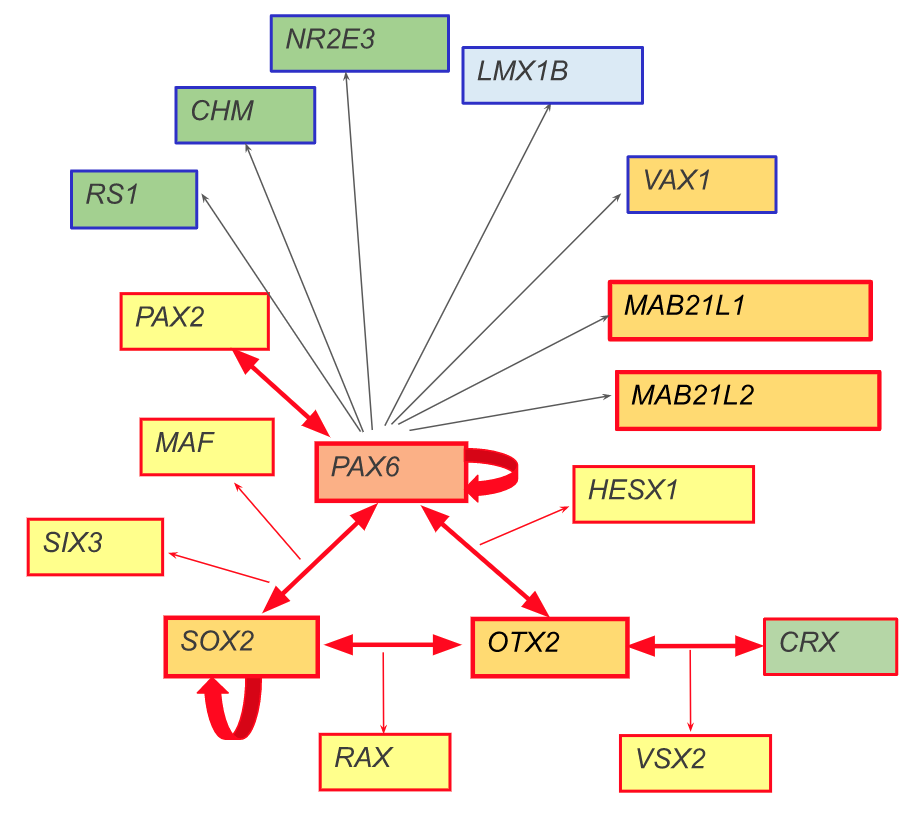
Most of them, like PAX6 itself, produce proteins that regulate the expression of target genes by interacting with the regulatory regions (enhancers) flanking th e target gene. Some associate at the protein level too. These genes with a role in eye development interact in a complex inter-connected network. When mutated they lead to eye disease
- Green: retina
- Yellow: developmental anomalies
- Orange: complex syndrome
- Blue: glaucoma
Even in retirement my interest in eye genetics has continued strongly throughout my time as Patron. When invited to participate in a meeting I tend to accept. In October 2022 I gave the Heritage Lecture at the EVER meeting in Spain.
I also published a detailsed biographical review of my work, showing the strong focus on PAX6 and genetic eye anomalies.






 Aniridia Network
Dear Veronica,
I am and always have been very and deeply impressed by your work. The sharing of your professional biography (the link in the original posting) is a true present for everyone interested in aniridia and related diseases – thank you very much for sharing this extraordinary research biography with us.
We met two or three times and I do hope you will continue even in your retirement in London to inspire the younger colleagues.
With deep respect and heartfelt greetings,
Prof. Dr. Barbara Käsmann MD PhD
Dept. of Ophthalmology, University of Saarland
Germany
Medical Advisor to Aniridie-WAGR e.V (German Aniridia support group)
http://www.aniridie-wagr.de
Pingback: Lifetime achievement award for Veronica | Aniridia Network